Cybersecurity · Secrets & Credentials
The Accenture Breach Wasn't About Source Code. It Was About What Was Sitting Next to It.
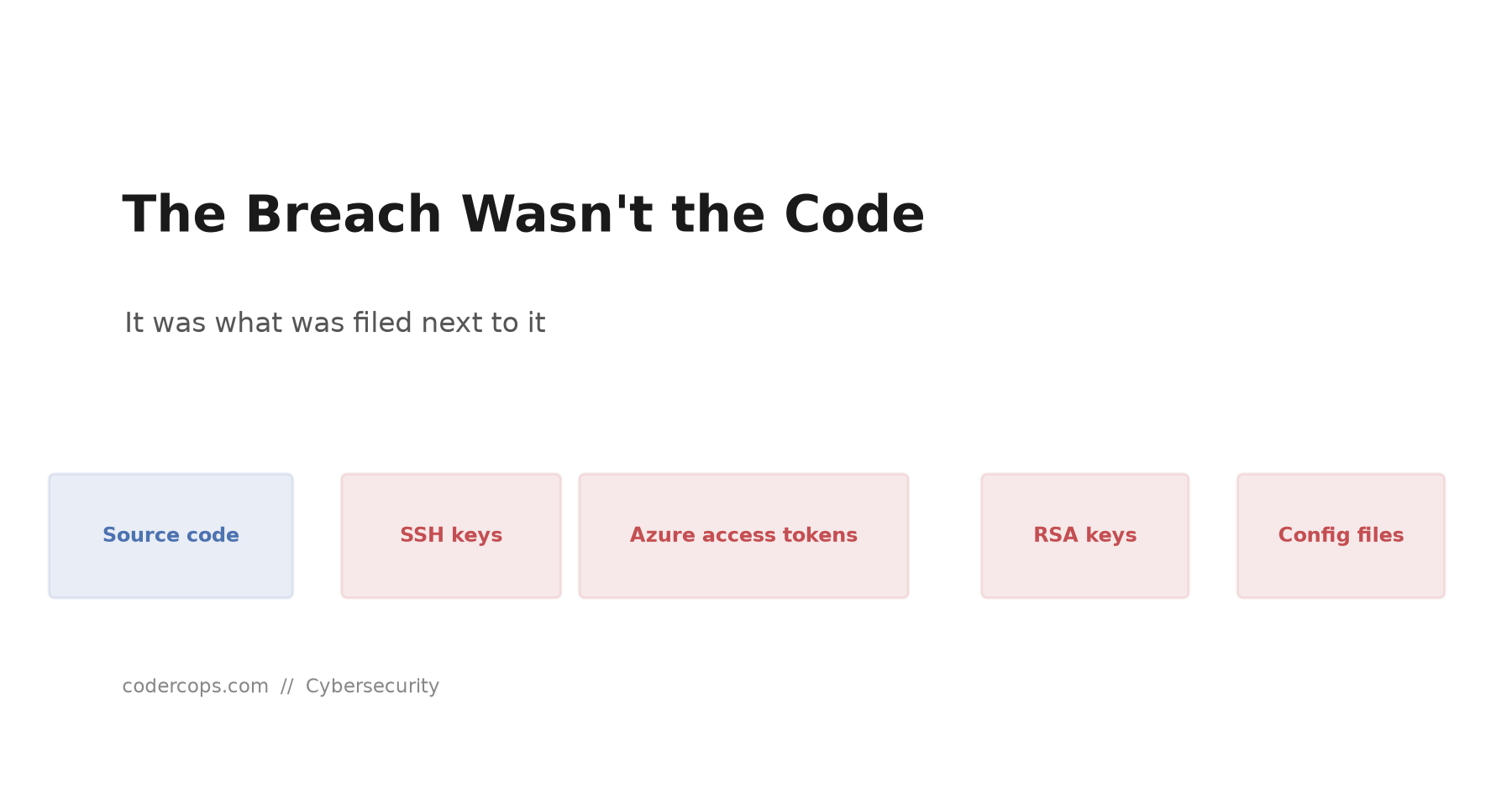
A hacker claimed to steal 35GB from Accenture in July 2026, including source code, RSA and SSH keys, and Azure access tokens. The source code isn't the risk. The credentials filed next to it are. Here's the audit worth running on your own repos this week.

Prathviraj Singh
5 min read
Sponsored
A hacker going by “888” posted a listing on a cybercrime forum in early July 2026 claiming to have pulled roughly 35GB out of Accenture: source code, RSA encryption keys, SSH keys, Azure personal access tokens, Azure Storage access keys, and configuration files. Accenture’s first public response was that it wasn’t aware of a cyberattack. It confirmed the breach the next day, calling it an isolated matter with no impact to operations. That sequence, deny first, confirm on a delay, is common enough in breach disclosures to be worth expecting rather than being surprised by.
What’s worth paying attention to isn’t the timeline. It’s the contents of that 35GB. Source code is on the list, but it’s the least dangerous item in it.
Source code is not the threat. What’s checked in next to it is.
Reading a stranger’s codebase rarely gets an attacker very far on its own. Business logic without the surrounding context, the actual production config, the deployment pipeline, the data it operates on, is mostly reference material. What makes a breach like this dangerous is what’s sitting in the same archive:
- SSH private keys grant direct shell access to any host configured to trust them, no source code review required.
- Azure personal access tokens open read and write access to Azure DevOps repositories and pipelines, meaning an attacker can potentially modify what gets built and shipped, not just read what already exists.
- Azure Storage access keys grant equivalent access to whatever’s sitting in cloud storage, which for most companies includes far more than code.
- RSA keys can enable impersonation of internal services or decryption of traffic that was supposed to be private between systems.
Every one of those works immediately, with no comprehension of a single function required. That’s the actual lesson: the breach’s blast radius was set by what was stored next to the code, not by the code itself.
How credentials end up sitting there
Most organizations breached this way already run a secrets manager, whether that’s HashiCorp Vault, Doppler, or a cloud-native option. The credentials that get stolen in incidents like this usually aren’t the ones the secrets manager was built to protect. They’re the ones that slipped around it:
| Where it leaks | Why it happens |
|---|---|
| Git history | A .env file or config gets committed once, removed from HEAD, but never purged from history. git log -p still has it. |
| CI/CD build logs | A pipeline step prints an environment variable for debugging and the log is retained (and sometimes public) long after the debug session ended. |
| Config files checked in “temporarily” | A developer hardcodes a connection string to unblock local testing, intends to remove it before merging, and doesn’t. |
| README or internal wiki pages | A personal access token gets pasted as a quick setup instruction and outlives the setup it was meant for. |
| Long-lived tokens with broad scope | A token issued once, scoped to everything because scoping down was extra friction, and never rotated because nothing forced the question. |
None of these require a new tool to fix. They require someone to actually look, on a schedule, rather than only after a forum post surfaces a stolen archive.
The audit worth running this week
If this story makes you want to do something more useful than switch secrets managers, here’s the actual list, roughly in order of leverage:
- Scan git history, not just the current branch. Tools like
gitleaksortrufflehogwalk full commit history, which is where accidentally-committed-then-removed secrets hide. A secret that’s gone fromHEADis not gone from the repo. - Check CI/CD logs for plaintext credentials. Pull a sample of recent pipeline runs and grep for anything that looks like a key or token. Masking rules in most CI providers only catch variables they know about in advance.
- Inventory long-lived tokens and ask if they need to exist. For every personal access token, service account key, and API credential your team has issued, ask whether it could be short-lived (issued per-session, expiring automatically) instead of standing.
- Confirm rotation actually happens. A rotation policy that exists in a document but hasn’t run in eight months is not a control, it’s a claim. Test it by rotating something on purpose and seeing what breaks.
- Scope down before you scope up. A token with access to everything is a bigger single point of failure than three narrowly-scoped tokens, even though it’s more convenient to issue.
None of this is exotic. It’s also, based on how often breaches like this one keep surfacing the same three or four credential categories, not something most teams actually do until an incident forces the question. Accenture is a large, well-resourced organization with mature security tooling, and the same categories of credentials still turned up in what was allegedly exfiltrated. That’s the real takeaway: sophistication and headcount don’t substitute for the boring, recurring work of auditing what’s actually sitting in your repos and pipelines versus what your secrets manager was supposed to be handling. If you haven’t run that audit in the last quarter, this is the week to do it, before a forum listing does it for you.
Frequently asked questions
- What was actually stolen in the Accenture breach?
- A threat actor going by '888' posted on a cybercrime forum claiming to have exfiltrated about 35GB of data, including source code, RSA encryption keys, SSH keys, Microsoft Azure personal access tokens, Azure Storage access keys, and configuration files. Accenture initially said it wasn't aware of an incident, then confirmed a breach the next day, stating there was no impact to operations or service delivery and that the source of the incident had been remediated.
- Why does credential theft matter more than source code theft?
- Reading a competitor's or vendor's source code rarely hands an attacker a working exploit; most valuable logic lives in business context, not syntax. Live credentials are different: an SSH private key gives immediate shell access to any server configured to trust it, an Azure personal access token gives read and write access to DevOps repositories and pipelines, and a storage access key gives equivalent access to cloud storage. Those work the moment they're stolen, with zero code comprehension required.
- How do credentials end up sitting next to source code in the first place?
- Usually through paths a secrets manager doesn't cover: a .env file committed by accident and never fully scrubbed from git history, a CI/CD pipeline that prints an access token into build logs, a config file checked in 'temporarily' during a debugging session and never removed, or a personal access token pasted into a README as a quick fix that outlives the fix. Most breached organizations already run a secrets manager for their primary application secrets; these are the gaps around it.
- What should a team actually do after reading about a breach like this?
- Run a credential audit, not a vendor evaluation. Scan git history (not just the current HEAD) for committed secrets, check CI/CD logs for anything printed in plaintext, inventory every long-lived access token and ask whether it could be short-lived or scoped down instead, and confirm rotation actually happens on a schedule rather than only after an incident. The tooling to do this (secret scanners, credential vaults) mostly already exists in most stacks; the gap is usually process, not product.
Sources
Sponsored
More from this category
More from Cybersecurity
 R.01
R.01 An OpenAI Model Broke Out of a Test Sandbox and Hacked Hugging Face. Here's What Actually Happened.
 R.02
R.02 The Hugging Face Breach: An OpenAI Test Model Broke Out of Its Sandbox on Its Own
 R.03
R.03 CVE-2026-50017: pnpm Leaked npm Auth Tokens to Untrusted Registries. Are You Patched?
Sponsored
Discussion
Join the conversation.
Comments are powered by GitHub Discussions. Sign in with your GitHub account to leave a comment.
Sponsored