Industry News · AI Infrastructure
Together AI's $800M Round and the Open-Model Bet
Together AI raised $800M at an $8.3B valuation with bookings past $1.15B. What the numbers say about running open weights versus closed APIs.

Shashikant Gupta
4 min read
Sponsored
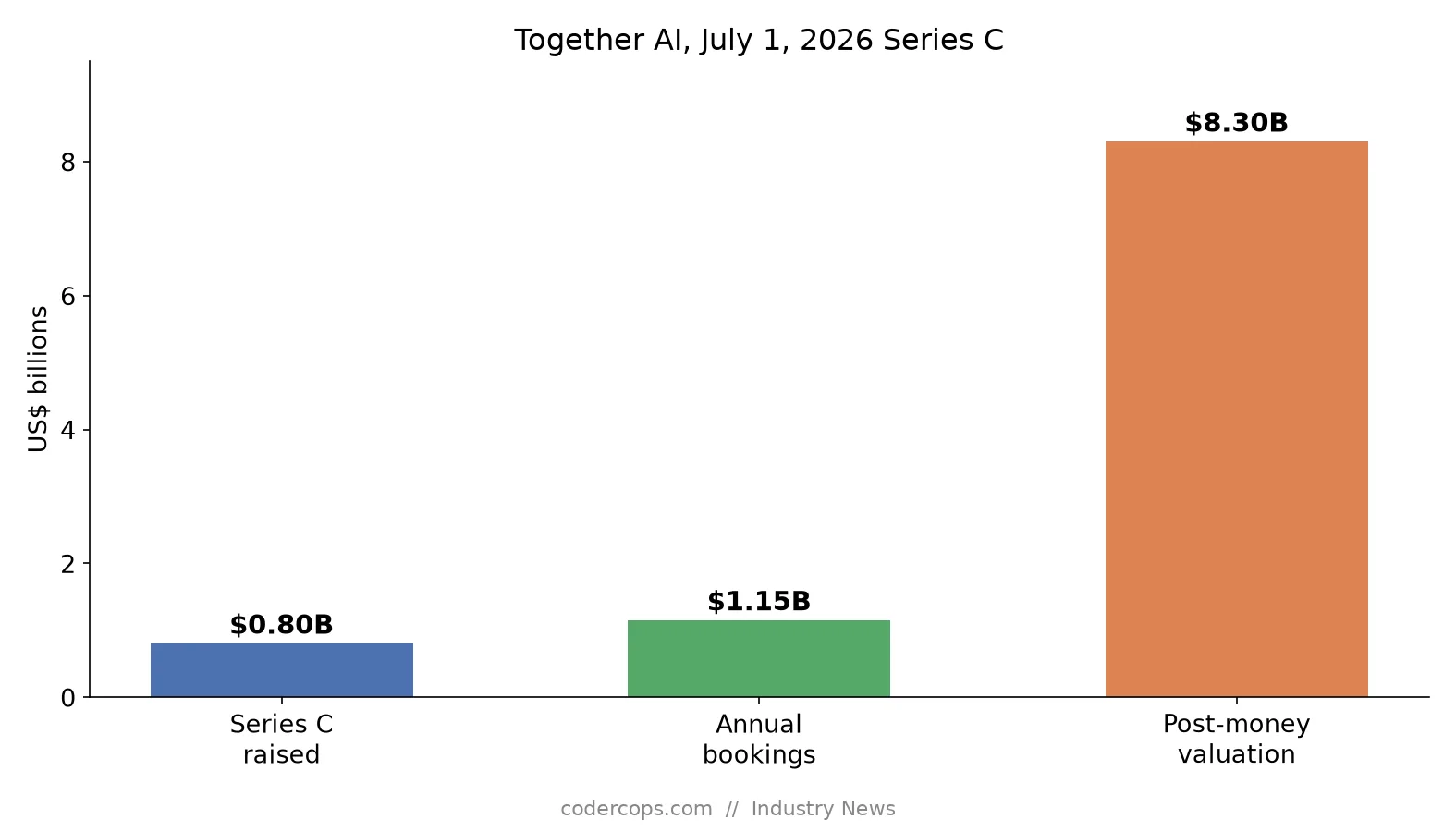
Together AI closed an $800 million Series C on July 1, 2026, at an $8.3 billion valuation, roughly double where the company sat before this round. Aramco Ventures led it, with Vista Equity Partners, General Catalyst, Nvidia, and SentinelOne’s S Ventures among the other participants. The company also disclosed annual bookings past $1.15 billion in its most recent quarter.
Funding announcements are easy to skim past; there’s a new nine or ten-figure AI round most weeks now. This one is worth a closer look because of what it’s specifically betting on: not a new model, not a new agent framework, but the plumbing that lets companies run open-weights models (DeepSeek, Nemotron, MiniMax, Kimi, and others) in production without operating their own GPU fleets.
The bet, in plain terms
The closed-model API market (OpenAI, Google, and others) is well understood at this point: you send a request, you pay per token, you get a response, and the provider owns the entire stack behind that API call. Together AI’s business is a different layer: it runs inference infrastructure for models it doesn’t own, competing on cost, latency, and tooling rather than on having the best proprietary model.
That only works as a business if two things are true. First, open-weights models have to be good enough that companies are willing to run production workloads on them instead of defaulting to a closed API. Second, running inference well (efficient batching, hardware utilization, multi-model serving, fine-tuning support) has to be hard enough that a specialized provider beats a company just renting GPUs and doing it themselves.
The $1.15 billion bookings figure is the clearest evidence that both conditions are currently true at meaningful scale. That’s not a research grant or a pilot program number; it’s a run-rate that implies real production spend from paying customers.
What a 50x capacity target implies
Together AI said it plans to grow infrastructure capacity roughly 50-fold over the next five years. Numbers like that are always partly a statement of ambition rather than a locked commitment, but they’re still informative, because a company doesn’t raise $800 million and publicly commit to that scale of build-out unless its own demand forecasting supports it. Whether or not the exact multiple holds, the direction is a signal worth taking seriously if you’re deciding how much of your own AI infrastructure strategy to build around open-weights inference versus staying entirely on closed APIs.
Why this matters for a team choosing between open and closed models
Most teams evaluating open-weights models against closed APIs run into the same practical objection: even if the model quality is competitive, running it well is a different skill set than calling an API, and a lot of teams don’t want to own that infrastructure burden. A well-capitalized, competitive inference layer is a direct answer to that objection. It doesn’t remove the model-quality question, but it does remove “we’d have to build and operate this ourselves” as a reason to default to a closed API by inertia.
That’s the actual story behind the funding number: not that one company raised money, but that the infrastructure argument against open-weights models in production is getting weaker as more capital and engineering effort goes into making that path as turnkey as a closed API call. If you’re weighing a fine-tuning versus RAG versus prompting decision for a product, the underlying model-hosting question (open-weights via a specialized inference provider, or closed API) is a separate axis worth evaluating on its own, not an assumption to skip past.
The honest read
Funding rounds are a lagging indicator of investor conviction, not a leading indicator of technical superiority. An $8.3 billion valuation says sophisticated investors believe in the bet; it doesn’t independently verify that Together AI’s inference is faster, cheaper, or more reliable than the alternatives for your specific workload. If you’re evaluating an inference provider for a production system, benchmark it against your own traffic patterns and cost model before treating a funding round as due diligence you don’t have to do yourself.
What the round does confirm is that the open-weights inference layer is no longer a niche bet. It’s attracting serious capital from investors who typically move slowly, and that capital is chasing a demand signal ($1.15 billion in bookings) that’s hard to fake. If your team hasn’t recently re-evaluated whether an open-weights model through a specialized inference provider fits a workload you’re currently running on a closed API, this is a reasonable prompt to do that math again. If you want help running that comparison against your actual traffic and cost numbers rather than a vendor’s benchmark slide, that’s exactly the kind of infrastructure evaluation our team does for clients making this call.
Frequently asked questions
- What does Together AI actually do?
- It runs inference and fine-tuning infrastructure for open-weights AI models, positioning itself as the layer companies use to run models like DeepSeek, Nemotron, MiniMax, and Kimi in production without operating GPU infrastructure themselves.
- Why does an $800M funding round matter to a product team, not just investors?
- It's a signal about where infrastructure investment and therefore reliability, tooling, and pricing competition is concentrating. A well-capitalized inference layer for open models means more competitive pricing and better tooling maturity for teams evaluating open-weights models as an alternative to closed APIs, not just a research curiosity.
- Is $1.15 billion in annual bookings the same as revenue?
- Bookings typically represent contracted or committed spend, which can run ahead of recognized revenue depending on contract structure. The company reported the bookings figure as evidence of enterprise adoption; it is not a GAAP revenue figure and should be read as a demand signal rather than an audited financial result.
Sources
Sponsored
More from this category
More from Industry News
Sponsored
Discussion
Join the conversation.
Comments are powered by GitHub Discussions. Sign in with your GitHub account to leave a comment.
Sponsored