AI Integration · Model Releases
Gemini 3.5 Pro Is Finally Generally Available: What the 2M Context Window Changes
After slipping from a June target, Google's Gemini 3.5 Pro is rolling out to general availability in July 2026 with a 2 million token context window and a gated Deep Think reasoning mode. Here's what actually changes for product teams.

Shashikant Gupta
4 min read
Sponsored
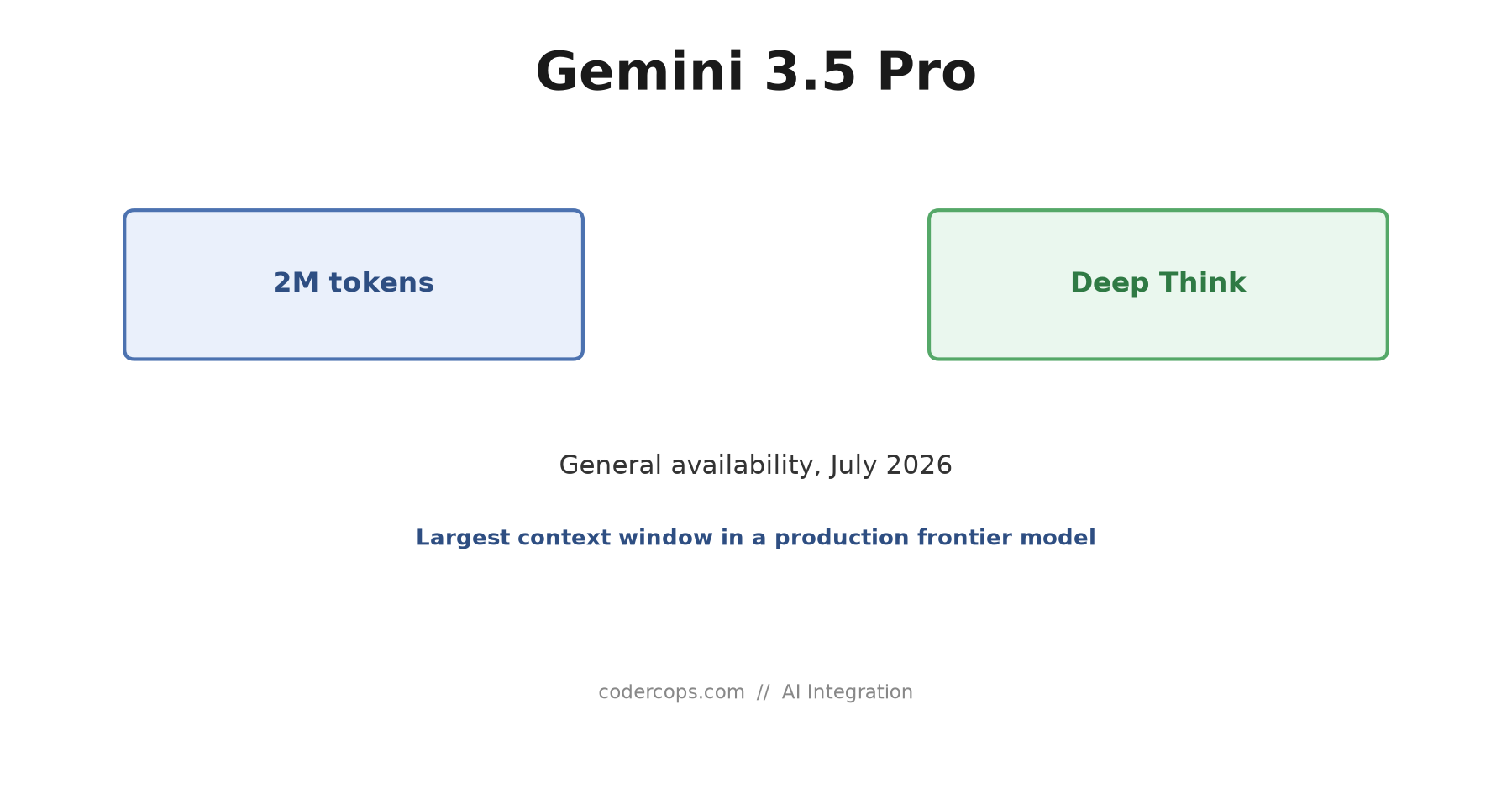
Google’s Gemini 3.5 Pro finally has a real release window. After slipping from an initial June 2026 target, Google confirmed the model is cleared for general availability in July, more than six weeks after it was first previewed at I/O on May 19. The headline number is a 2 million token context window, twice the size of Gemini 3.5 Flash’s, and the largest deployed in any production frontier model right now.
That’s a big number. Whether it changes anything for your product depends entirely on what you’re currently bottlenecked on.
What actually shipped
Two things distinguish Gemini 3.5 Pro from the Flash tier Google already released:
A 2 million token context window. For scale, that’s large enough to hold most monorepos’ source files, a few hundred pages of technical documentation, or hours of transcribed audio content in a single request, without chunking, without a retrieval layer deciding what to include and what to leave out.
Deep Think, a gated reasoning mode. Deep Think is built for problems that benefit from extended internal reflection, multi-step reasoning chains rather than a single fast pass at an answer. Google has restricted it to the $250-per-month Ultra subscription tier rather than shipping it as a standard Pro capability, which tells you where Google expects the actual demand and willingness to pay to sit: not the median API call, but the harder tail of problems worth paying a premium for.
The model handles text and images. No video or audio support has been announced for this release, which is worth flagging if your roadmap assumed Gemini 3.5 Pro would extend multimodal input further than it does today.
Why context window size isn’t the whole story
A bigger context window solves one specific problem: fitting more into a single call without a retrieval or chunking layer deciding what’s relevant. It does not automatically make the model reason better over that content, and it doesn’t replace retrieval-augmented generation for every use case.
Where a 2M window genuinely changes what’s possible:
- Whole-codebase code review or refactoring assistance, where fragmenting a monorepo across multiple calls loses cross-file context that actually matters for correctness.
- Long-document analysis, contracts, research papers, regulatory filings, where splitting the document risks missing a clause or reference that only makes sense alongside content pages away.
- Extended conversation or agent memory, where an agent’s full interaction history can stay in-context rather than being summarized down and losing detail.
Where it changes less than the spec sheet implies:
- Search over a large, mostly-irrelevant corpus. If you’re searching across a codebase or document set where most content is irrelevant to a given query, retrieval still beats brute-force context stuffing on both cost and, often, accuracy. Sending everything and hoping the model finds the needle isn’t free, and it isn’t always more accurate than retrieving the right passage first.
- Latency-sensitive interactions. Larger context means more tokens processed per call, which means real latency and real cost, even before Deep Think enters the picture. A 2M-token capability doesn’t mean every call should use anywhere near that much.
The Deep Think gate is the more interesting signal
Restricting Deep Think to a $250-per-month tier is a clearer business decision than a technical one. It tells you Google is pricing reasoning depth as a distinct, premium product line rather than folding it into the base Pro offering, the same way OpenAI and Anthropic have positioned their own extended-reasoning modes above standard tiers. If your product’s economics depend on Deep Think-level reasoning at scale, budget for Ultra-tier pricing specifically, not standard Pro API rates, and confirm the math works at your actual call volume before committing.
What to actually test before migrating
Don’t move a working pipeline to Gemini 3.5 Pro because the spec sheet is bigger. Instead:
- Identify where your current model is actually failing, on context length, reasoning depth, or something else entirely (latency, cost, a specific task type it handles poorly).
- Test Gemini 3.5 Pro against your real inputs, not a benchmark prompt, using documents or codebases at your actual scale.
- Compare cost per successful task, not cost per token. A larger context window that lets you skip a retrieval layer might net out cheaper even at higher per-call token pricing, or it might not; that only shows up when you measure the full task, not the raw token rate.
If you’re weighing this release against reducing your existing LLM API costs rather than chasing a bigger model, that’s often the better first question to answer. A 2M-token window is a genuinely new capability. It’s not automatically the right tool for whatever you’re currently building.
Frequently asked questions
- When did Gemini 3.5 Pro actually become available?
- Google originally announced Gemini 3.5 Pro at I/O on May 19, 2026, targeting a June general-availability launch. That slipped, and Google confirmed the model was cleared for a July 2026 rollout, citing quality refinements following early enterprise testing rather than a technical blocker.
- How big is the context window and why does that matter?
- Gemini 3.5 Pro ships with a 2 million token context window, double the window on Gemini 3.5 Flash and the largest in any production frontier model currently available. In practice that's roughly the size of a large monorepo's source files, or several hundred pages of documents, in a single request without chunking or retrieval.
- What is Deep Think and who can use it?
- Deep Think is a reasoning mode aimed at complex, multi-step problems that benefit from extended internal reflection before answering, rather than a single fast pass. It's gated to Google's $250-per-month Ultra subscription tier, not included with standard Gemini 3.5 Pro API or app access, which positions it as a premium capability rather than a default mode.
- Does Gemini 3.5 Pro handle video or audio input?
- Not in this release. Gemini 3.5 Pro's multimodal support covers text and images, following the pattern of earlier Gemini releases. Google hasn't announced a timeline for video or audio input on this model.
- Should I migrate a pipeline built on Gemini 3.5 Flash or another model to Pro?
- Only if your actual bottleneck is context length or reasoning depth on multi-step tasks. A bigger context window doesn't automatically improve output quality, and Pro-tier pricing and latency are higher than Flash's. Test against your real documents or codebase and your real prompts before committing a production pipeline to the switch.
Sources
Sponsored
More from this category
More from AI Integration
 R.01
R.01 DeepSeek V4 Is Now the Only Option: The Legacy API Cutoff and What Actually Changed
 R.02
R.02 pgvector vs Pinecone vs Weaviate vs Qdrant: Which Vector Database Should You Actually Use in 2026
 R.03
R.03 OpenAI Presence: What a Guardrailed Enterprise Agent Platform Means for Product Teams
Sponsored
Discussion
Join the conversation.
Comments are powered by GitHub Discussions. Sign in with your GitHub account to leave a comment.
Sponsored