AI Integration · Model Releases
Meta Muse Spark 1.1: Its First Metered Model
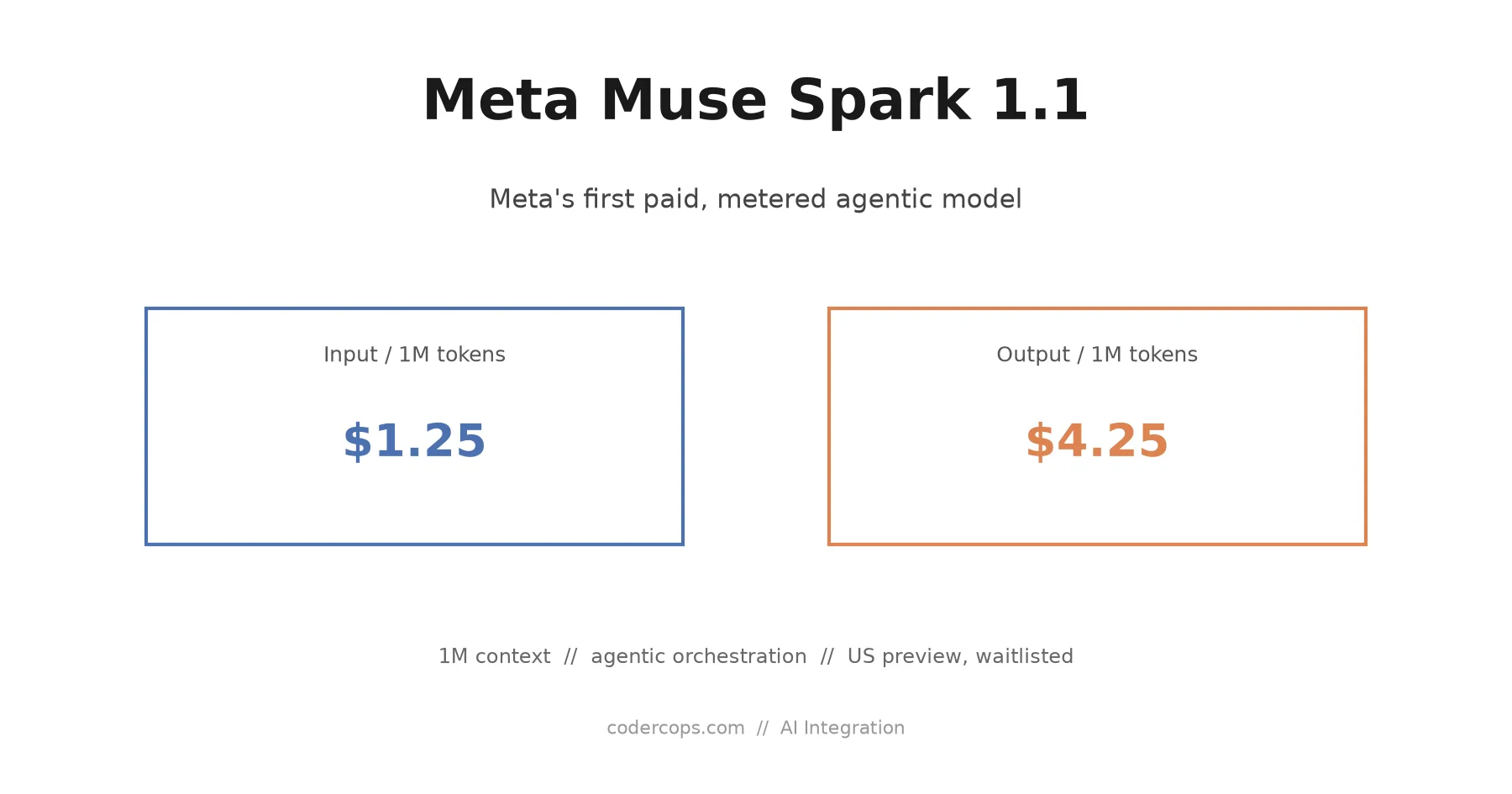
Muse Spark 1.1 is Meta's first pay-as-you-go model at $1.25/$4.25 per million tokens, with a 1M context and subagent orchestration. Who should skip it.

Abhishek Gupta
5 min read
Sponsored
Meta has sold plenty of AI to advertisers. Muse Spark 1.1, which launched in public preview on July 9, is the first time it’s asked developers to pay for a model directly, by the token, the way OpenAI, Anthropic, and Google have for years. That shift matters more than any individual benchmark in the announcement.
What Meta actually shipped
Muse Spark 1.1 comes out of Meta Superintelligence Labs, the group Meta reorganized around after its restructuring push into frontier model development. It’s natively multimodal, meaning text, images, and audio run through a single architecture rather than bolted-together specialist components, and it works through problems step by step before producing an answer, the now-standard “reasoning model” pattern.
The context window is a full million tokens, on par with the larger context windows other frontier labs have shipped this year. More notable is what Meta built around the model rather than into it: native primary-agent and subagent orchestration, direct support for MCP servers, custom skills, and direct computer control. That’s the same feature set defining the current generation of coding-agent products, not the feature set of a chatbot.
The pricing tells you who it’s for
$1.25 per million input tokens and $4.25 per million output tokens puts Muse Spark 1.1 in the same tier conversation as OpenAI’s mid-range offerings, priced below a flagship model but well above a bargain-bin one. New Meta Model API accounts start with $20 in free credits, enough for real evaluation without a purchase order.
That pricing decision is a signal about ambition. Meta isn’t trying to out-price everyone at the bottom of the market; it’s trying to be a credible mid-tier option for the agentic coding and automation workloads that Cursor, Claude, and GPT-5.6’s Terra tier are already fighting over. Pay-as-you-go, metered by actual usage, is also a different business model than Meta AI’s free consumer product, and it’s worth watching whether Meta keeps them as genuinely separate products or eventually folds the API tier’s capabilities back into the free one.
The catch: US-only, waitlisted
The public preview is limited to the US and requires joining a waitlist. That’s a meaningful caveat for any team outside the US, and even for US teams it means Muse Spark 1.1 isn’t a same-day production option regardless of how the benchmarks read. If your team is picking a model for an agentic workflow this month, the realistic choice set is still Claude, GPT-5.6, and Gemini; Muse Spark 1.1 is worth requesting access to and evaluating in parallel, not worth blocking a decision on.
Where it sits against the field
| Model tier | Input / 1M tokens | Output / 1M tokens | Positioning |
|---|---|---|---|
| GPT-5.6 Sol | $5.00 | $30.00 | Flagship, hardest coding and agentic tasks |
| GPT-5.6 Terra | $2.50 | $15.00 | Mid-tier, GPT-5.5 replacement |
| Muse Spark 1.1 | $1.25 | $4.25 | Agentic coding, cost-conscious |
| GPT-5.6 Luna | $1.00 | $6.00 | High-volume, low-complexity calls |
Lined up against OpenAI’s current three-tier lineup, Muse Spark 1.1 lands closest to Luna on input price but well above it on output price, and comfortably below Terra on both. That puts it in an odd but deliberate spot: cheaper than a mid-tier flagship competitor, but pitched at Terra’s job, agentic coding and orchestration, rather than Luna’s job of cheap, high-volume, low-complexity calls. Whether that pricing holds up depends entirely on how the model performs against Terra-class work once independent benchmarks and real production usage start coming in, which hasn’t happened yet given the waitlist.
What this means for teams choosing a model
The practical move here is the same one that applies every time a new entrant shows up in the agentic coding space: don’t adopt on the announcement, adopt on your own benchmark. Run your actual prompts, your actual tool-calling patterns, and your actual cost math against the new model once you have access, and compare it honestly against whatever’s currently in production. A model that scores well on a published benchmark and a model that handles your specific codebase’s conventions well are not guaranteed to be the same model.
This is also a useful moment to revisit how your team picks models at all. Teams that treat model selection as a one-time decision, made once and left alone, tend to overpay as pricing shifts underneath them or underuse a genuinely better fit that showed up later. The teams that do this well keep a standing evaluation harness, a fixed set of real prompts and expected outputs pulled from their own workload, and rerun it against every credible new entrant instead of relying on vendor benchmarks or launch-day hype. That use is cheap to build once and pays for itself the first time a $1.25/$4.25 model turns out to be a better fit for a workload than the $5/$30 one it’s tempting to default to.
What Muse Spark 1.1 does confirm is where the competitive pressure in this market currently sits: not consumer chat, but agentic coding and orchestration, priced by the token, competing directly on cost-per-capability against Anthropic, OpenAI, and Google. Meta joining that fight, on those terms, with real metered pricing instead of a subsidized freebie, is the actual news here. The specific benchmark numbers will look dated within a quarter; the fact that Meta decided this market was worth charging for won’t.
Frequently asked questions
- What is Muse Spark 1.1?
- It's a multimodal reasoning model from Meta Superintelligence Labs, released July 9, 2026, as Meta's first model available through a metered API with real usage-based pricing rather than being bundled free into a consumer product. It handles text, images, and audio in a single architecture and is built around agentic workflows: orchestrating subagents, calling MCP servers, and taking direct computer control actions.
- How much does it cost?
- Through the Meta Model API, Muse Spark 1.1 is priced at $1.25 per million input tokens and $4.25 per million output tokens. New API accounts get $20 in free credits to start. That places it below GPT-5.6 Terra's $2.50/$15 and well below Sol's $5/$30, positioning it as a mid-to-low cost option rather than a flagship-tier price.
- Can I use it outside the US?
- Not yet in practice. The public preview that launched July 9 is US-only and waitlisted. Developers outside the US who need a frontier agentic model in production today are still choosing between Claude, GPT-5.6, and Gemini, and should plan around Muse Spark's availability rather than assuming near-term access.
- What makes it 'agentic' rather than just another chat model?
- Native support for primary-agent and subagent orchestration (splitting a task across coordinated model instances rather than one linear conversation), direct MCP server integration, custom skills, and direct computer control actions. These are the same primitives that define Claude's agentic tooling and OpenAI's Sol Ultra mode, built into the model and API rather than added as a wrapper on top.
- Should my team switch to it?
- Not on day one. It's a US-only waitlisted preview, which rules it out for production dependency right now regardless of the benchmarks. The right move is to request access, run it against your actual workload once you have it, and compare real output quality and cost against whatever you're running today, the same evaluation discipline that should apply to any new model release, not just this one.
Sources
Sponsored
More from this category
More from AI Integration
Sponsored
Discussion
Join the conversation.
Comments are powered by GitHub Discussions. Sign in with your GitHub account to leave a comment.
Sponsored