AI Integration · Retrieval & Search
pgvector vs Pinecone vs Weaviate vs Qdrant
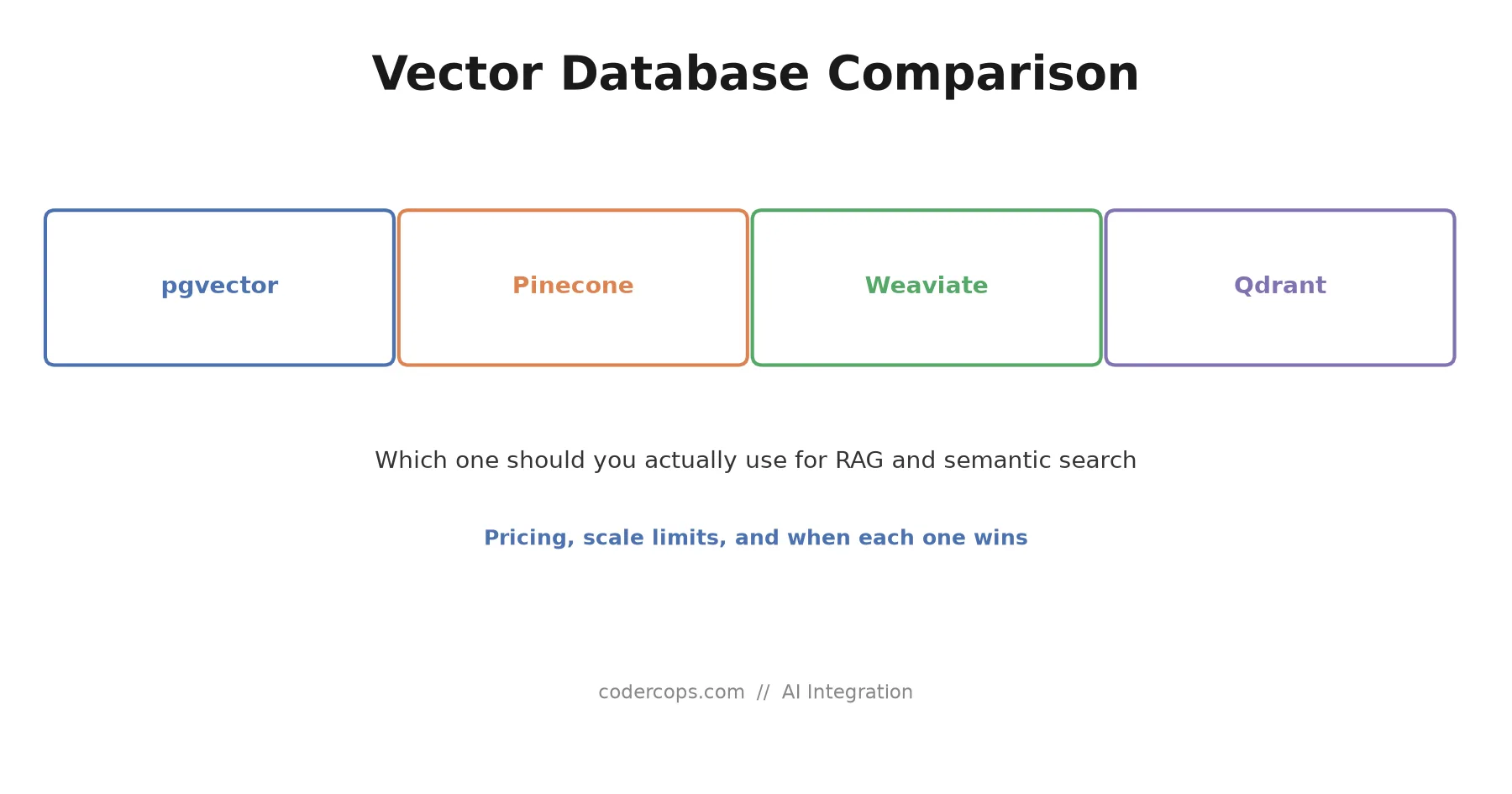
A practical comparison of the four vector databases teams actually shortlist for RAG, with real pricing, when each wins, and the question that decides it.

Abhishek Gupta
5 min read
Sponsored
The honest answer to “which vector database should I use” is that most teams asking the question don’t need to pick one at all, because they already run Postgres and haven’t checked whether pgvector covers them. But once you’re past that first check, or you already know you need a dedicated system, the real shortlist in 2026 is four names: pgvector, Pinecone, Weaviate, and Qdrant. Here’s how they actually differ, not in marketing copy, but in the decisions that determine which one you’ll be glad you picked six months in.
The one question that should decide this
Before comparing features, answer this: does your data already live in a relational database, and are you under roughly 10 to 20 million vectors? If yes, pgvector is very likely your answer, and the rest of this comparison is something to bookmark for later, not act on now. Running a second, dedicated database for vector search when Postgres already handles it adds an operational dependency, a second set of credentials to manage, and a consistency problem, keeping two data stores in sync, that you don’t have today. Teams reach for Pinecone or Weaviate before confirming pgvector can’t handle their scale more often than the reverse, and it’s almost always the more expensive path for no real benefit at that stage.
The comparison
| pgvector | Pinecone | Weaviate | Qdrant | |
|---|---|---|---|---|
| Model | Postgres extension | Managed, serverless-only | Managed cloud or self-hosted | Managed cloud or self-hosted |
| License | PostgreSQL License (open) | Proprietary | BSD-3 (open core) | Apache 2.0 (fully open) |
| Best at | Staying in one database | Zero-ops, fast to ship | Hybrid (vector + keyword) search | Raw query speed, filtered search |
| Multi-tenancy | Manual (schemas/RLS) | Manual (namespaces) | Native, built-in | Manual (collections) |
| Practical scale ceiling | ~10-20M vectors before HNSW performance degrades | Scales far beyond that; you pay for it | Scales far beyond that | Scales far beyond that |
| Entry cost | Free (it’s Postgres) | Free tier, then pay-per-read/write-unit | Free sandbox, then ~$45/mo+ | Free tier, then ~$30-200/mo+ |
| Self-host option | Yes (it’s Postgres) | No | Yes | Yes |
Where each one actually wins
pgvector wins when the question isn’t “which vector database” but “do I need one at all.” If your embeddings need to be joined against orders, users, or any other relational data in the same query, pgvector does that natively with a normal SQL JOIN. A dedicated vector database can’t, you’d fetch nearest neighbors, then make a second call to your relational database to hydrate the results. That round trip is small until it isn’t, and it’s a real latency and complexity cost that pgvector simply avoids.
Pinecone wins on time-to-production. There’s no cluster to size, no index to tune, no infrastructure decision to make before your first query. That’s genuinely valuable for a team validating a product idea, where the cost of getting infrastructure wrong (over-provisioning, under-provisioning, picking the wrong instance type) is higher than the cost of Pinecone’s usage-based pricing. The tradeoff is that you’re paying for that simplicity per operation, and at high, sustained query volume, the bill scales with usage rather than flattening out the way self-managed infrastructure can.
Weaviate wins when hybrid search is a real requirement, not a nice-to-have. Pure vector similarity search misses exact keyword matches that users expect to find, product SKUs, names, error codes. Weaviate combines BM25 keyword ranking with vector similarity in a single query natively, which most of the alternatives require you to bolt together yourself. It’s also the strongest option here for multi-tenant SaaS, where you’re serving isolated vector search to hundreds or thousands of customers from shared infrastructure, because tenant isolation is a first-class concept rather than something you simulate with metadata filters.
Qdrant wins on raw performance and licensing clarity. If you’re filtering on metadata alongside vector similarity, find products under $50 that look like this image, and you need that filtered query to stay fast at scale, Qdrant is consistently the strongest performer among the open options. It’s also the cleanest choice if open source matters to your procurement process specifically, Apache 2.0, no open-core asterisk, full feature parity between what you can self-host and what the managed cloud runs.
What this looks like in practice
A typical path we see work well: start with pgvector because you’re already running Postgres and shipping fast matters more than optimizing for a scale you don’t have yet. If you hit real limits, slow queries past 10-20 million vectors, a genuine need for hybrid search, multi-tenant isolation that’s getting awkward to fake with row-level security, migrate the specific piece that’s actually failing, not the whole stack preemptively. Keep your retrieval logic behind an interface in your application code so that migration, when it comes, is a matter of swapping an implementation rather than rewriting your product.
If you’re building retrieval into an AI product and want a second opinion on whether your current setup will hold up at the scale you’re planning for, that’s the kind of architecture question worth getting right before it’s expensive to change, and one our engineering team walks through with clients regularly. For a broader look at how retrieval fits into the rest of a RAG pipeline beyond just the database choice, our 2026 RAG architecture breakdown covers the surrounding decisions.
Frequently asked questions
- Do I need a dedicated vector database, or is pgvector enough?
- For most teams starting out, pgvector is enough. It handles workloads up to roughly 10-20 million vectors with acceptable HNSW query performance, and because it lives inside Postgres, you keep transactional guarantees and can join vector search results against your regular relational data in one query. Reach for a dedicated vector database when you outgrow that scale, need sub-10ms latency at very high query volume, or need features like built-in multi-tenancy that Postgres doesn't provide natively.
- Which vector database is cheapest?
- It depends on your traffic shape. Qdrant self-hosted is free (Apache 2.0 license) and the most cost-efficient at scale if you're willing to run and manage the infrastructure yourself. Pinecone's serverless model can be cheaper at low, spiky volume because you pay per read/write unit with no idle infrastructure cost. Weaviate and Qdrant Cloud both charge for allocated resources, which is more predictable but means you pay for capacity even during quiet periods.
- What's the real difference between Pinecone, Weaviate, and Qdrant?
- Pinecone is the most hands-off: fully serverless, minimal configuration, strong for teams that want to ship fast and not think about infrastructure. Weaviate leads on hybrid search (vector plus keyword) and native multi-tenancy, which matters if you're building a multi-customer SaaS product. Qdrant leads on raw query throughput and filtered search performance, and it's the most credible fully open-source option if you want to self-host without licensing friction.
- Can I switch vector databases later if I outgrow pgvector?
- Yes, and this is worth planning for rather than avoiding. Keep your embedding generation and retrieval logic behind a thin interface in your application code, rather than writing query logic that assumes a specific database's API everywhere. Migrating vectors themselves is usually the easy part, re-embedding is cheap and deterministic. The harder part is re-implementing whatever filtering, hybrid search, or multi-tenancy logic you built up around your first choice.
Sources
Sponsored
More from this category
More from AI Integration
Sponsored
Discussion
Join the conversation.
Comments are powered by GitHub Discussions. Sign in with your GitHub account to leave a comment.
Sponsored