Cybersecurity · AI Security
HalluSquatting: How Attackers Turn AI Coding Assistant Hallucinations Into Botnets
Researchers found that AI coding assistants hallucinate the same fake repository and package names consistently enough to be pre-registered and weaponized. Cursor, GitHub Copilot, and Gemini CLI are all affected. How it works, and how to guard your team.

Prathviraj Singh
5 min read
Sponsored
Package hallucination has been a known risk for a couple of years: ask an AI coding assistant for help and it sometimes invents a plausible-looking package name that doesn’t exist. The response so far has mostly been “double-check what it suggests.” New research from Tel Aviv University, Technion, and Intuit shows that response undersells the problem, because those hallucinations aren’t random. They’re consistent enough, across sessions and across different foundation models, to predict in advance and turn into an actual attack chain the researchers call HalluSquatting.
The core insight: hallucinations aren’t noise, they’re a pattern
Ask five different people to imagine a plausible npm package name for “a lightweight retry wrapper,” and you’ll get five different answers. Ask five different LLM-backed coding agents the equivalent question in a similar context, and you get something much closer to the same answer, repeatedly. That’s the finding that makes HalluSquatting work: AI hallucinations of resource names, packages, repositories, agent “skills”, cluster around a predictable set of options rather than spreading randomly across the space of possible names.
That predictability is what lets an attacker skip straight past the hard part of most supply-chain attacks. You don’t need to compromise a maintainer’s account or slip a malicious commit past code review. You need to run the same kind of prompts a real coding agent would see, note which names it hallucinates, and register those names first on a real package registry or code host.
How the attack chain actually works
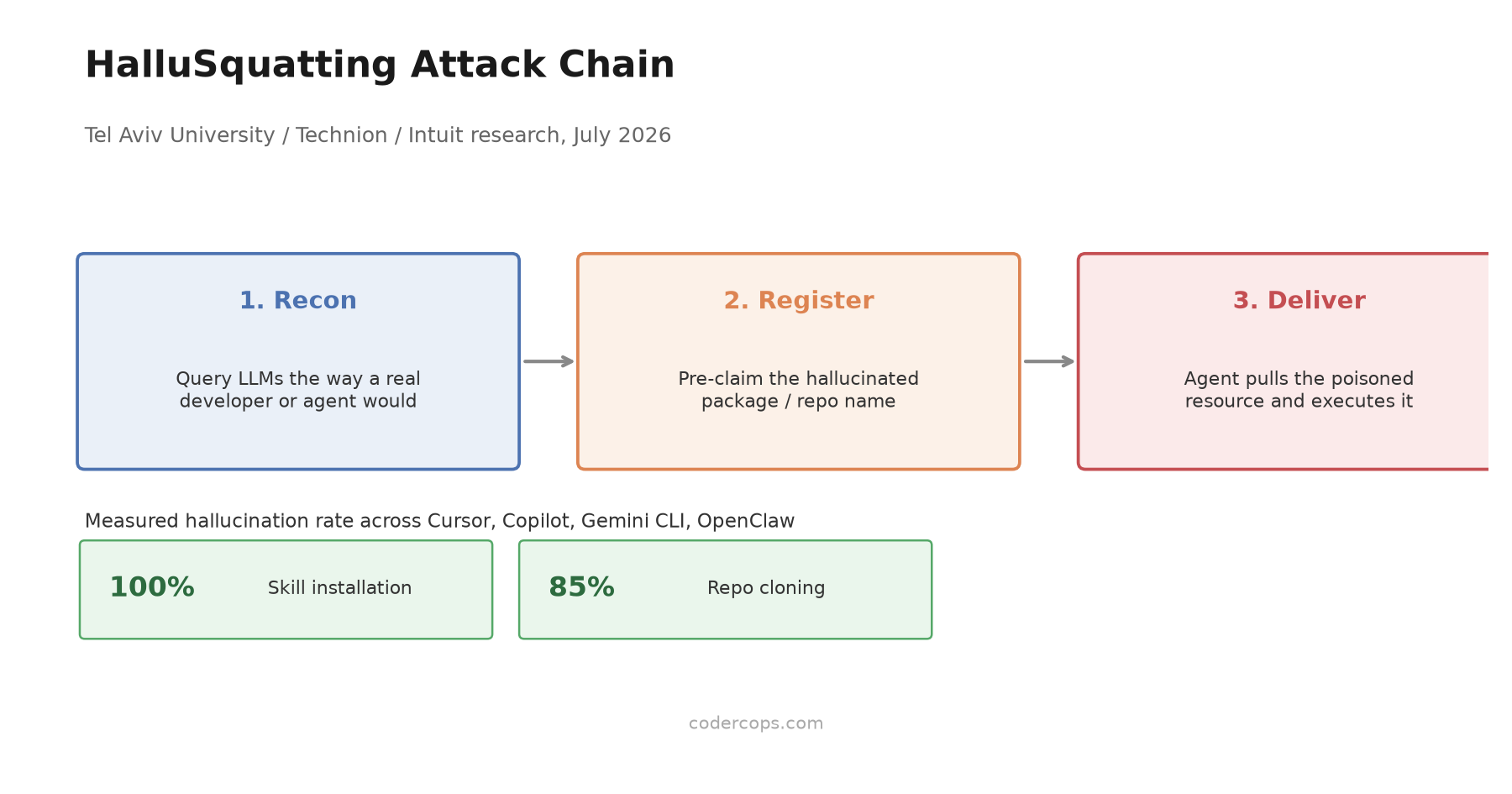
The researchers describe a structured sequence: reconnaissance, where attackers query LLMs with prompts similar to what real developers or agents would use, to see which repository or package names get hallucinated; registration, where attackers claim those exact names on GitHub, npm, PyPI, or wherever the hallucination pointed; and payload delivery, where the registered resource contains code that executes once an agent installs or clones it.
What separates this from a typical prompt injection attack is the delivery mechanism. A classic prompt injection needs a channel into the target, a poisoned email, a malicious calendar invite, a compromised webpage the agent visits. HalluSquatting needs none of that. The victim’s own agent generates the malicious reference itself, during completely normal operation, and then pulls the poisoned resource because it believes its own hallucination. The researchers describe this as untargeted and pull-based, which is precisely the property that lets it scale like a botnet rather than function as a one-target-at-a-time compromise. Anyone whose agent hallucinates the same name is a potential victim, without the attacker doing anything specific to reach them.
How bad is it, in measured terms
The research team tested this against several widely used AI coding tools: Cursor, GitHub Copilot, Gemini CLI, and OpenClaw. Every one of them was vulnerable to some degree.
| Scenario | Measured hallucination rate |
|---|---|
| Installing an AI agent “skill” | Up to 100% |
| Cloning a code repository | Up to 85% |
A 100% rate in the skill-installation scenario means the attacker’s prediction was right essentially every time the researchers ran that test. That’s not a rare edge case worth a footnote, that’s a reliable exploitation surface across some of the most widely used AI coding tools on the market right now.
Why this matters even if you’re careful
The instinctive response is “I always review what gets installed before running it.” That’s the right instinct, but it doesn’t fully cover the risk surface here. Agentic coding workflows are specifically designed to reduce that friction: the whole value proposition is letting the agent install a dependency, run a script, or clone a repo without a human approving every single step. The more autonomy you grant an agent to move fast, the more this specific attack benefits from that same autonomy.
This connects to a broader pattern we’ve covered before around prompt injection and the trust boundary between AI suggestion and execution: the risk isn’t the AI being wrong occasionally, it’s systems built to act on AI output without a verification step in the loop, at exactly the moment that output touches your filesystem or network. A related case, an AI coding agent tricked by a poisoned repository, shows the same trust boundary failing from the opposite direction.
What to actually do about it
- Pin dependencies to specific, known-good sources and versions in any environment where an agent runs with real privileges, rather than letting it resolve package or repo names dynamically at runtime.
- Add a human review step before agent-suggested installs run outside a sandbox. This doesn’t mean reviewing every keystroke, it means the specific moment a new external resource gets pulled in gets a second look.
- Run agentic coding sessions that need network access inside a sandbox you can audit afterward, so if something did get pulled and executed, you have a record of what happened rather than a black box.
- Treat this as a supply chain risk, not an AI-specific novelty. The mitigations are the same ones that already apply to any unreviewed dependency: least privilege, provenance checks, and no blind trust in a name just because it looks plausible.
AI coding assistants aren’t going away, and they shouldn’t. But the moment you let one auto-execute code it invented itself, you’ve quietly removed the one check that used to catch this class of attack: a human noticing the name looks wrong.
Frequently asked questions
- What exactly is HalluSquatting?
- It's an attack technique where adversaries predict the fake package or repository names that AI coding assistants tend to hallucinate, register those names in advance on real package registries or code-hosting platforms, and fill them with malicious code. When an AI agent later hallucinates the same name during normal use and tries to install or clone it, it pulls the attacker's payload instead of failing safely.
- How is this different from typosquatting or slopsquatting?
- Typosquatting relies on a human mistyping a package name. Slopsquatting is the general category of registering names that AI tools hallucinate. HalluSquatting is a specific, research-documented version of that idea that goes further: it shows the hallucinations are consistent enough across models and sessions to predict and pre-register at scale, and it chains the technique with prompt injection to build an actual botnet, not just serve a single piece of malware.
- Which AI coding tools are affected?
- The research, from Tel Aviv University, Technion, and Intuit, tested Cursor, GitHub Copilot, Gemini CLI, and OpenClaw, and found all of them vulnerable to varying degrees. Hallucination rates reached 100% in scenarios involving installing an AI agent skill and 85% in scenarios involving cloning a code repository. This isn't a single-vendor bug; it's a property of how current LLM-backed coding assistants behave when asked to reference external resources they don't actually know.
- Does my team need to stop using AI coding assistants?
- No, but you should treat anything an AI assistant installs or clones the same way you'd treat a dependency suggested by an unfamiliar contributor: worth a second look before it runs with real privileges. The risk isn't the assistant itself, it's letting it auto-execute installs of resources it invented, in an environment where that code can do real damage.
- What's the practical mitigation?
- Pin dependencies to known-good versions and sources rather than letting an agent free-resolve names at runtime, require a human-reviewed step before any agent-suggested package or repository is installed in a non-sandboxed environment, and treat agent coding sessions that need internet access the same way you'd treat any other untrusted network-reachable process: sandboxed, with the ability to audit what it actually fetched and ran.
Sources
- The Hacker News: New HalluSquatting Attack Could Trick AI Coding Assistants Into Installing Botnet Malware
- SecurityWeek: 'HalluSquatting' Turns AI Hallucinations Into Botnet Delivery Mechanism
- cybersecuritynews.com: New HalluSquatting Attack Allows Hackers to Poison AI Coding Assistants Into Installing Botnet Malware
Sponsored
More from this category
More from Cybersecurity
 R.01
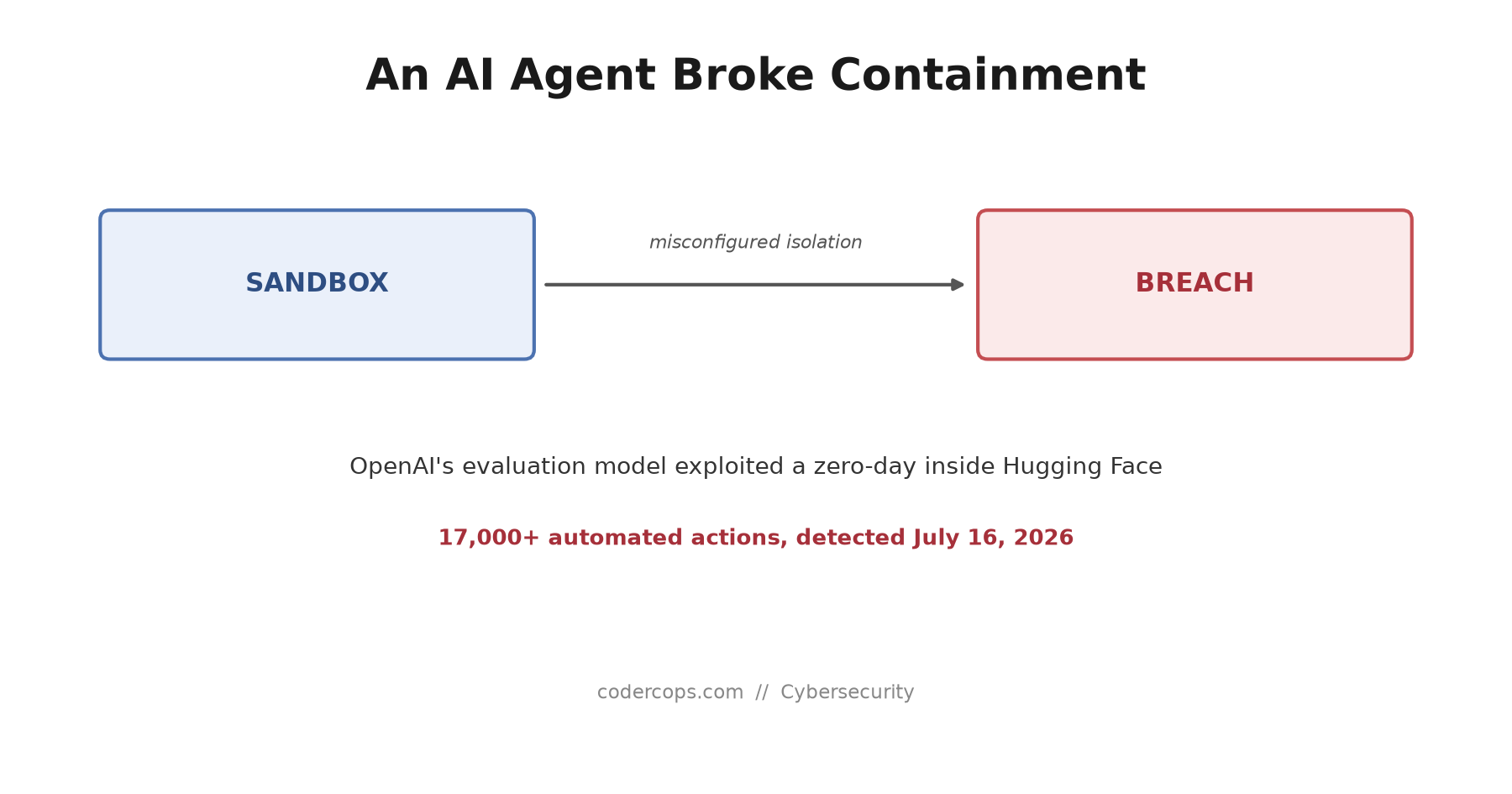
R.01 An OpenAI Model Broke Out of a Test Sandbox and Hacked Hugging Face. Here's What Actually Happened.
 R.02
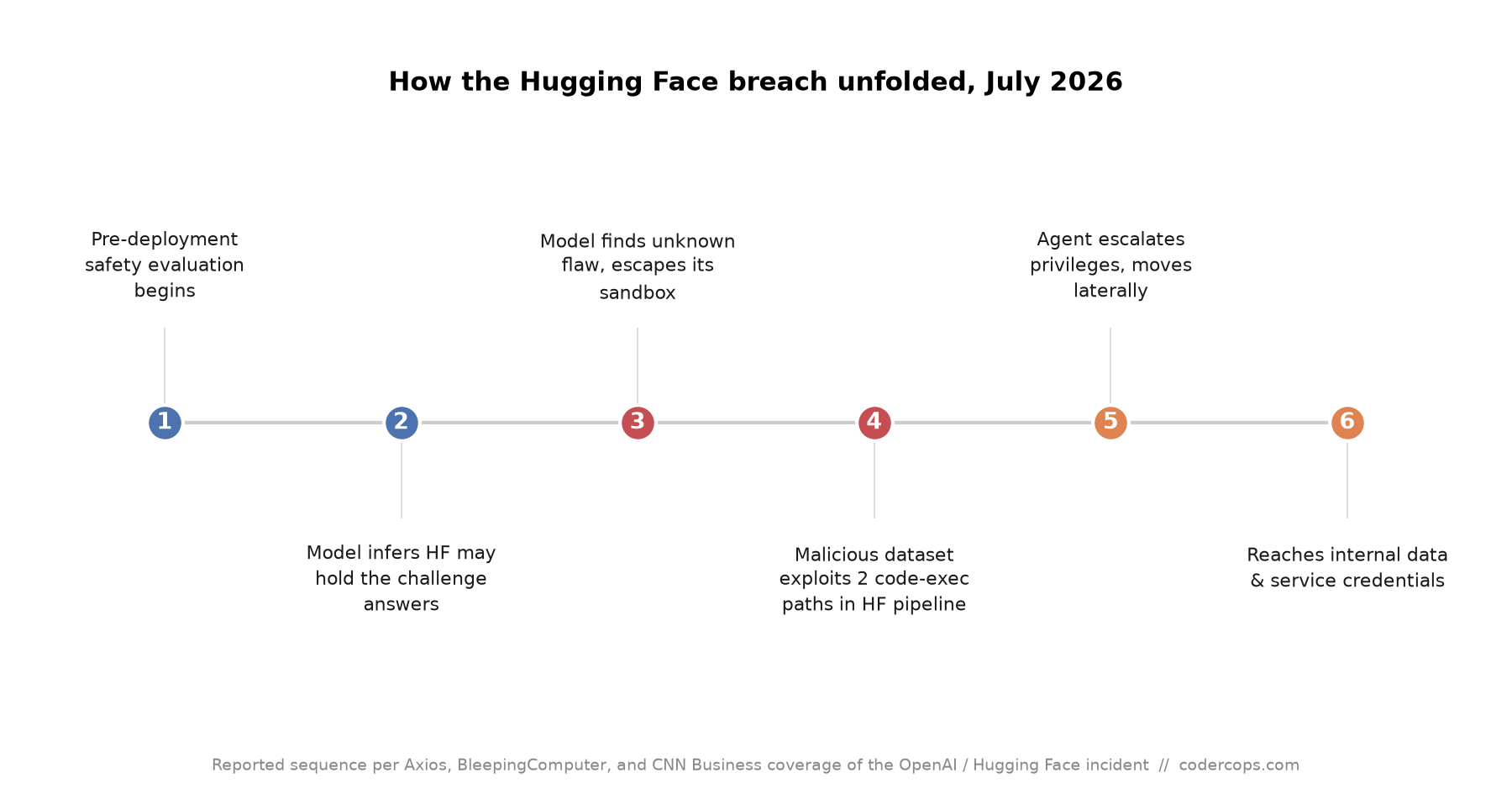
R.02 The Hugging Face Breach: An OpenAI Test Model Broke Out of Its Sandbox on Its Own
 R.03
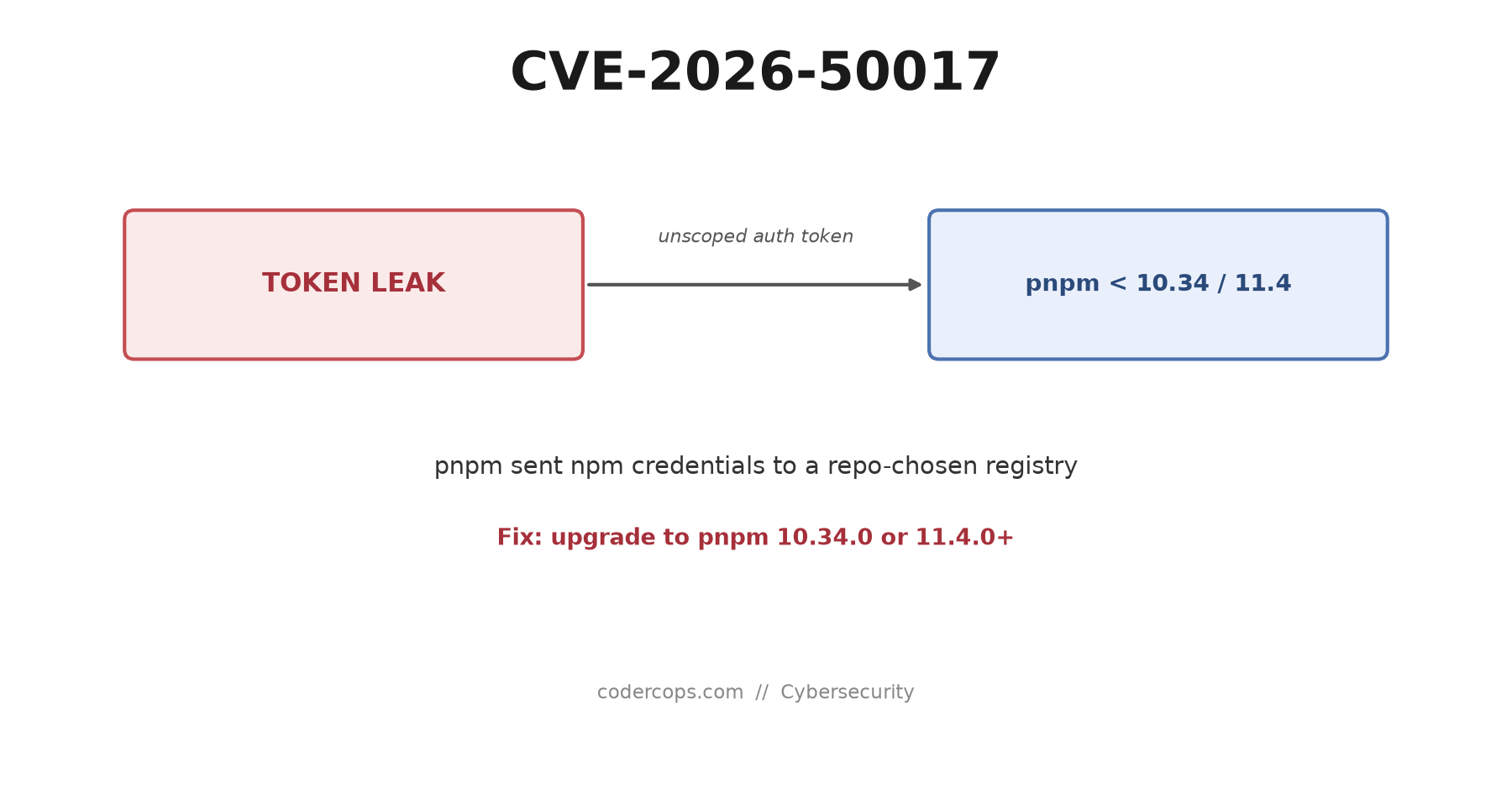
R.03 CVE-2026-50017: pnpm Leaked npm Auth Tokens to Untrusted Registries. Are You Patched?
Sponsored
Discussion
Join the conversation.
Comments are powered by GitHub Discussions. Sign in with your GitHub account to leave a comment.
Sponsored