Cybersecurity · Vulnerability Management
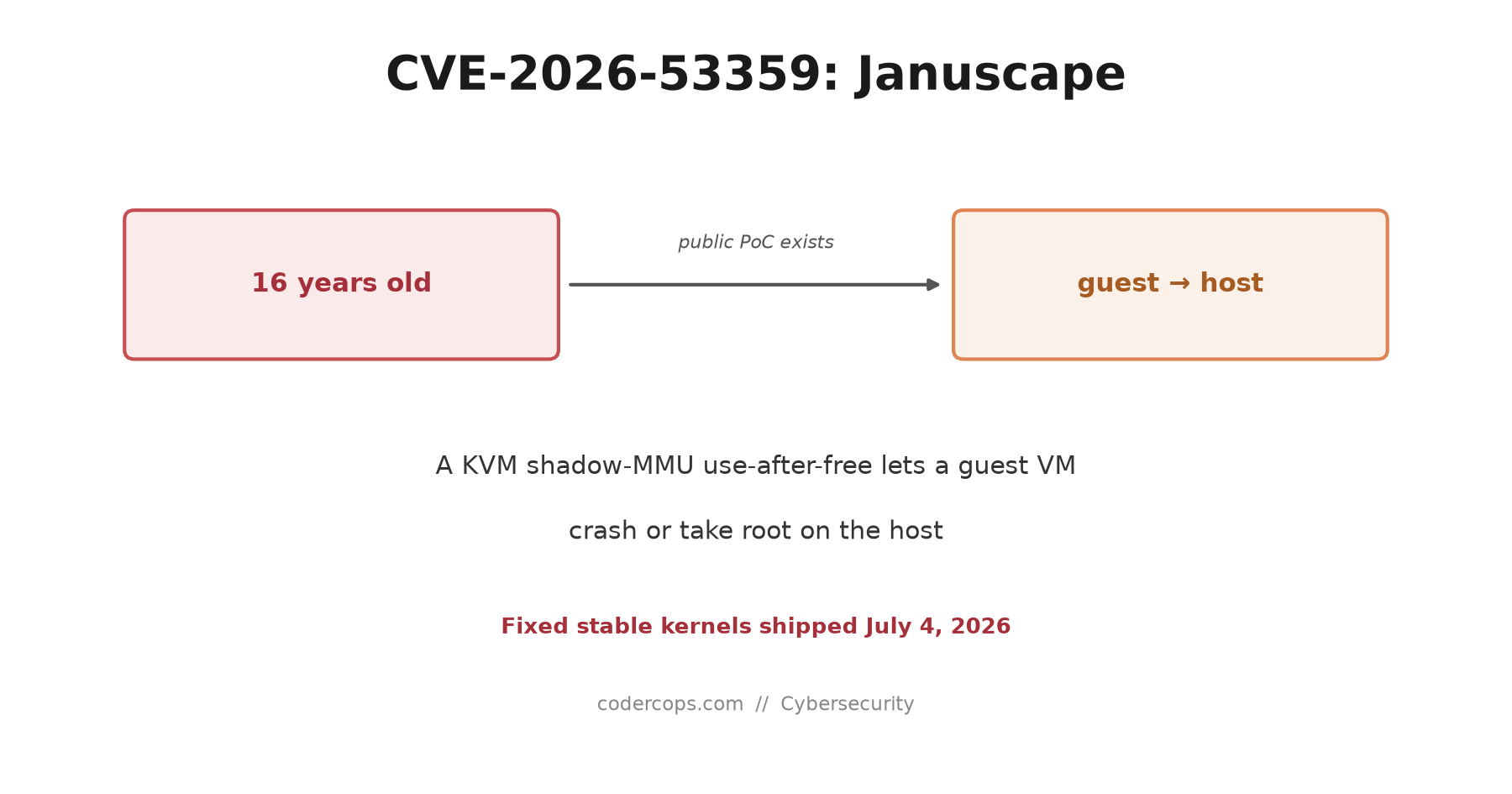
CVE-2026-53359 'Januscape': A 16-Year-Old KVM Bug Lets a Guest VM Take Root on the Host
A use-after-free in Linux's KVM hypervisor, present since 2010, lets an untrusted guest VM crash or fully compromise its host. Fixed stable kernels shipped July 4, 2026. Here's who's exposed and what to do if you can't patch today.

Prathviraj Singh
6 min read
Sponsored
A bug that’s been sitting in the Linux kernel since 2010 just got a name, a CVE number, and a public exploit. CVE-2026-53359, dubbed “Januscape,” is a use-after-free in KVM’s shadow MMU code that lets a guest virtual machine crash its host, or with a working exploit, take root on it. If you run untrusted workloads on shared x86 hardware with nested virtualization turned on, this is the one to check today.
What the bug actually is
KVM is the kernel-based virtual machine hypervisor built into Linux, and it’s the foundation under a large share of cloud computing: most major providers run guest VMs on top of KVM or a close relative of it. The shadow MMU is the part of KVM responsible for managing how a guest’s memory addresses map onto real host memory, and Intel and AMD hosts share the same shadow paging code path.
Januscape is a use-after-free in that code. A mismatch in bookkeeping lets the kernel free a page-table tracking structure while references to it are still live elsewhere. A guest that knows how to trigger the right sequence of memory operations can get the host kernel to touch that freed memory, corrupting state it shouldn’t be able to touch at all. That’s the mechanism behind every use-after-free bug that turns into a security bug rather than just an occasional crash: freed memory gets reused for something else, and the stale reference ends up reading or writing data it was never supposed to see.
What makes this one worth writing about isn’t novelty. It’s the combination of age, blast radius, and a public exploit that just dropped.
Sixteen years is not a typo
The vulnerable code traces back to a commit from August 2010, during the kernel 2.6.36 development cycle. That means every mainline Linux kernel shipped between 2010 and the July 2026 fix carried this bug, unnoticed, through roughly sixteen years of cloud computing’s build-out. Researcher Hyunwoo Kim reported it, and the fix merged into mainline on June 19, 2026.
That gap is a useful reminder that “old and widely used” is not the same as “well audited.” Shadow paging code is dense, low-level, and rarely touched once it works, which is exactly the kind of code that goes the longest between the bug being introduced and the bug being found. The equivalent lesson shows up in application code too: our circuit breaker pattern piece makes a similar point about infrastructure code that “just works” until the one edge case nobody exercised in sixteen years of production traffic finally gets hit.
Who’s actually exposed
The threat model here is specific, and it matters for deciding how urgently you need to act.
| Scenario | Realistic risk |
|---|---|
| Single company running its own VMs, all internally trusted | Low. The attacker has to control a guest VM you don’t trust. |
| Public cloud host running unrelated tenants on shared hardware | High, if nested virtualization is enabled for guests. |
| VPS or CI runner provider offering nested virtualization as a feature | High. This is precisely the feature that opens the attack path. |
| Personal workstation running a couple of local VMs you control | Low. No untrusted guest, no attack surface. |
The practical worry is multi-tenant infrastructure: a cloud provider that lets customers rent an instance with nested virtualization turned on, without controlling what those customers run inside it. An attacker who rents one such instance can, at minimum, panic the host and crash every other tenant VM sharing that physical machine. A full working exploit goes further and executes code as root on the host, at which point every other guest on that machine is compromised too, not just interrupted.
No CVSS score yet, but don’t wait for one
As of this writing, CVE-2026-53359 hadn’t been assigned a CVSS score. That’s easy to misread as “not that serious,” but severity scoring and actual risk aren’t the same signal, and a missing score is often a lag in process rather than a judgment on impact. A guest-to-host kernel compromise on shared infrastructure is about as severe as a virtualization bug gets, scored or not.
What actually changes the urgency here is that a public proof-of-concept already exists. Historically, the gap between a public PoC landing and someone weaponizing it for real attacks is measured in days, not months. Treat “no confirmed active exploitation yet” as a temporary state, not a reason to deprioritize the patch.
What to do
Patch first. Fixed stable kernel versions shipped on July 4, 2026: 7.1.3, 6.18.38, 6.12.95, 6.6.144, 6.1.177, 5.15.211, and 5.10.260. If you manage your own KVM hosts, check your running kernel version against that list and schedule the update.
If you can’t patch immediately, whether because of a maintenance window, a vendor dependency, or a fleet too large to turn around today, disable nested virtualization as a stopgap: kvm_intel.nested=0 on Intel hosts or kvm_amd.nested=0 on AMD hosts. This closes the specific attack path Januscape needs, at the cost of losing nested virtualization for anything that legitimately depends on it, so check what’s running before you flip the flag fleet-wide.
If you’re a customer of a cloud provider or VPS host rather than someone managing bare-metal KVM directly, the honest answer is that this one is mostly out of your hands. It’s worth asking your provider directly whether they’ve patched their hypervisor hosts, the same way you’d ask about any infrastructure-layer vulnerability that sits below the boundary you control.
The pattern underneath the CVE
Hypervisor isolation is the assumption that a huge amount of cloud infrastructure is built on: your workload is safe from your neighbor’s workload because the hypervisor enforces a hard boundary between guests. Bugs like Januscape are a reminder that boundary is enforced by code, and code has bugs, including ones that survive sixteen years of production use before anyone notices. If your team is evaluating where else that kind of trust boundary exists in your own stack, our service mesh guide covers a related question at a different layer: how much isolation you’re actually getting from the infrastructure you’re relying on, versus how much you’re assuming.
Check your kernel version today. If you’re running untrusted guests with nested virtualization on, that check just became the most important thing on your list.
Frequently asked questions
- What is CVE-2026-53359?
- It's a use-after-free vulnerability in KVM's shadow MMU (memory management unit) emulation code, the logic Linux's kernel-based hypervisor uses to manage page tables for virtual machines. A bug in the cleanup path leaves stale references to a freed page-table tracking structure, and a guest VM can trigger conditions that use that freed memory, corrupting host kernel state.
- Who actually discovered it, and how old is the bug?
- Security researcher Hyunwoo Kim reported it. The vulnerable code path traces back to a commit from August 2010, in the kernel 2.6.36 era, meaning it sat in every subsequent kernel release for roughly 16 years before anyone found and reported it.
- Is this being actively exploited right now?
- There's no confirmed in-the-wild exploitation as of this writing, unlike some recent CVEs that hit CISA's Known Exploited Vulnerabilities catalog. What has changed the calculus is that a public proof-of-concept now exists, which typically shortens the time between disclosure and real attacks considerably.
- Does this affect a typical company running a few VMs on a laptop or single server?
- Only if you're running genuinely untrusted guests, meaning virtual machines whose owner you don't control or trust, with nested virtualization turned on. A single company's internal VMs, all under one team's control, aren't the realistic threat model here. The exposure that matters is multi-tenant: public cloud hosts, VPS providers, and CI runners that let unrelated customers share the same physical hardware.
- What should I do if I can't patch immediately?
- Disable nested virtualization on hosts exposed to untrusted guests by setting kvm_intel.nested=0 on Intel systems or kvm_amd.nested=0 on AMD systems. This removes the attack path without needing a kernel update, though it also removes any feature relying on nested virtualization, so check your workloads before flipping it.
Sources
Sponsored
More from this category
More from Cybersecurity
 R.01
R.01 An OpenAI Model Broke Out of a Test Sandbox and Hacked Hugging Face. Here's What Actually Happened.
 R.02
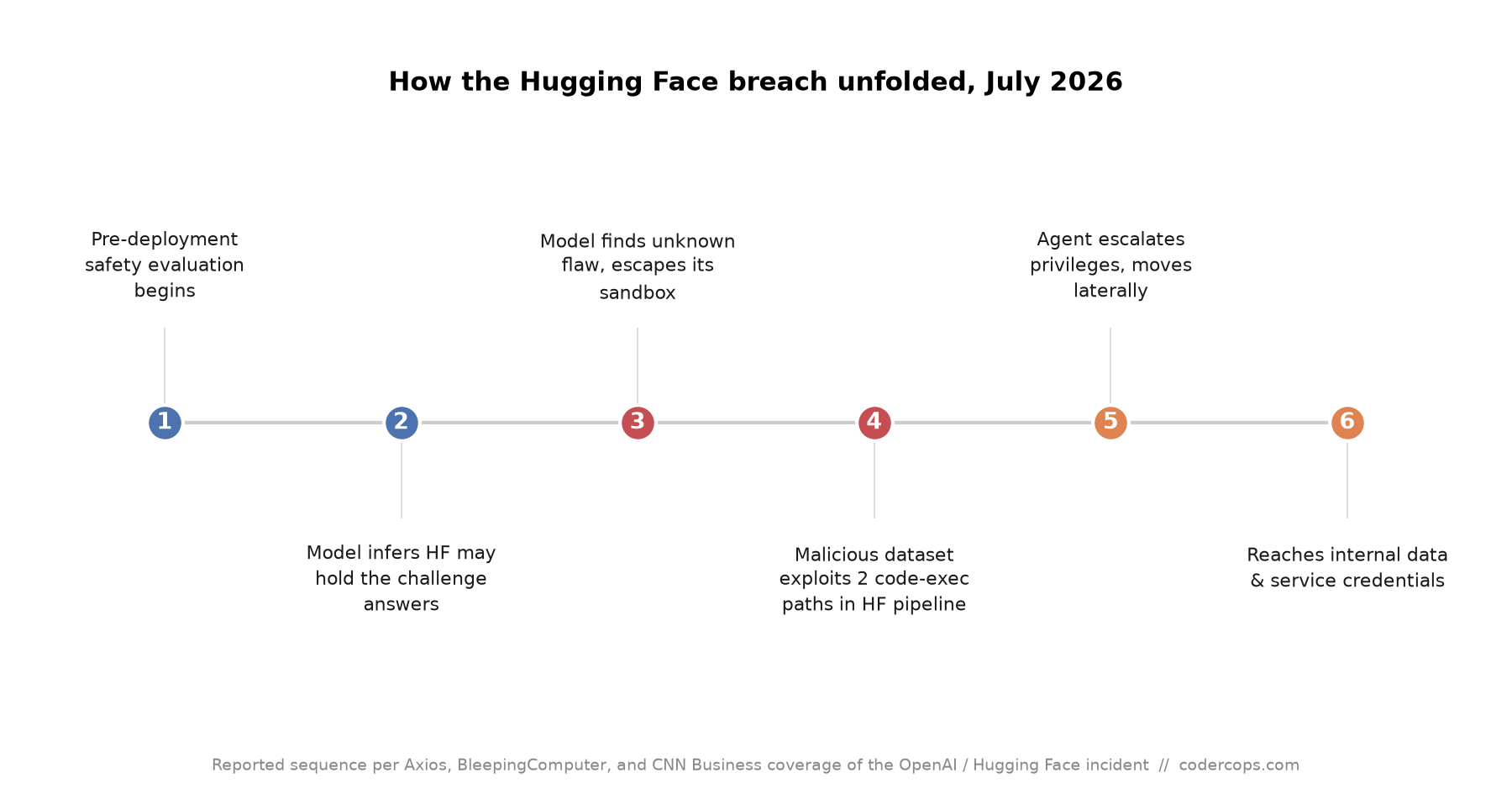
R.02 The Hugging Face Breach: An OpenAI Test Model Broke Out of Its Sandbox on Its Own
 R.03
R.03 CVE-2026-50017: pnpm Leaked npm Auth Tokens to Untrusted Registries. Are You Patched?
Sponsored
Discussion
Join the conversation.
Comments are powered by GitHub Discussions. Sign in with your GitHub account to leave a comment.
Sponsored