Career · Hiring
How to Hire a Platform Engineer, Not a DevOps One
Platform engineering has its own hiring cluster now, distinct from DevOps, SRE, and cloud architecture. How to screen for product thinking over ticket-taking.

Anurag Verma
6 min read
Sponsored
Job boards are full of “Platform Engineer” postings that are really DevOps roles with a trendier title attached, and full of DevOps postings for teams that actually need platform engineering and don’t know the distinction exists. Both mistakes are expensive. Hire the wrong profile and you’ll either overpay for ticket-taking or watch a product-minded engineer burn out doing reactive infrastructure work they didn’t sign up for.
Here’s how to hire for the role that’s actually different, not just relabeled.
What a platform engineer actually does
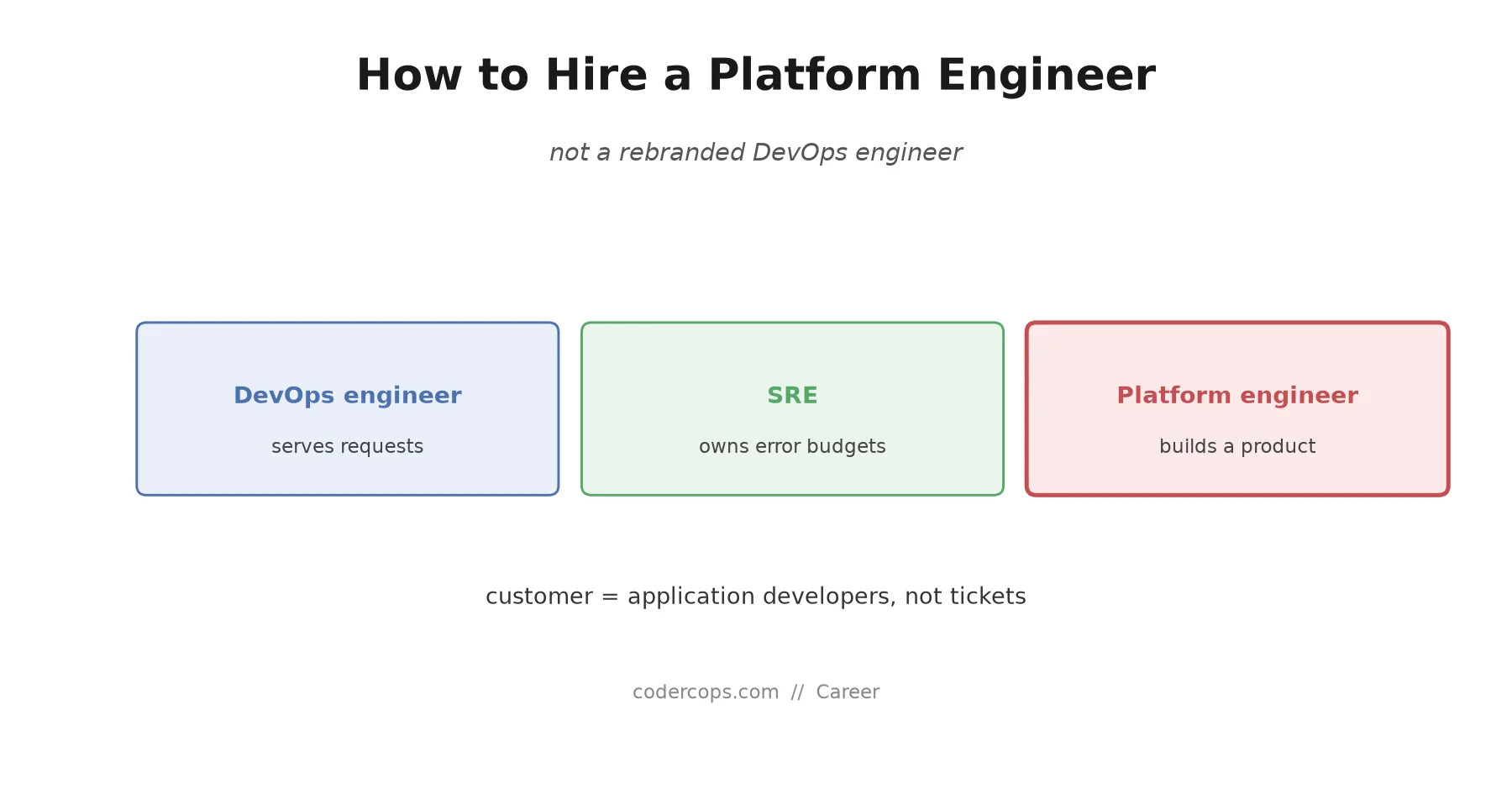
The core distinction is who the platform engineer’s customer is. A traditional infrastructure or ops role serves requests: someone needs a database, they file a ticket, ops provisions it. A platform engineer builds a self-service product that lets developers provision that database themselves, safely, without a ticket, inside guardrails the platform team designed in advance.
That shift changes the daily work. A platform engineer’s week includes designing and maintaining golden paths (the default, paved-road way to create a new service, deploy it, and hook up observability), building or operating an internal developer platform (Backstage, Port, Cortex, or a homegrown equivalent), setting policy-as-code guardrails so self-service doesn’t mean unsupervised, and treating template adoption and developer satisfaction as metrics they’re accountable for, not just uptime.
Our deep dive on platform engineering maturity covers the tooling options and adoption data in more depth if you’re deciding whether your org needs this function at all before you start hiring for it.
Platform engineering vs. the roles it gets confused with
| Role | Primary customer | Defining measure of success |
|---|---|---|
| DevOps engineer | Whoever files the request | CI/CD pipelines run, environments get provisioned |
| SRE | The production system | Error budgets, SLOs, incident response |
| Cloud architect | Leadership, the org’s cloud strategy | Architecture decisions, cost, compliance |
| Platform engineer | Application developers | Self-service adoption, golden path usage, time-to-first-deploy |
These roles overlap in practice, and a strong candidate for any of them can often grow into another. But the interview should be testing for the specific one you’re actually hiring, and “we need someone who does all of this” usually means you need two hires, not one generalist stretched thin.
Where good candidates come from
DevOps or SRE engineers who got tired of firefighting. These candidates have strong operational instincts and know exactly what toil looks like, because they’ve lived it. What to probe: have they ever built something proactively, a template, a self-service tool, rather than always responding to what broke or what was requested?
Backend engineers who kept getting pulled into infrastructure work. These candidates bring strong software engineering discipline and often write better platform tooling code than infrastructure specialists do, because they think of the platform as a codebase with users, not a pile of scripts. What to probe: do they have enough depth in Kubernetes, networking, and cloud provisioning to make good infrastructure decisions, or have they only automated what someone else already designed?
Infrastructure specialists who taught themselves product thinking. The rarest and often strongest profile: deep infrastructure knowledge paired with genuine curiosity about developer experience, adoption metrics, and why a platform gets used or ignored. What to probe: ask them to describe an internal tool they built that developers actually chose to use voluntarily, and what told them it was working.
The screen
The golden path question. “Describe a golden path or paved road you built or maintained. What made developers actually choose it instead of doing things manually? How did you know it was working?” This is the single best question in the interview. A strong answer talks about adoption data, developer feedback loops, and iterating on the template based on where teams deviated from it. A weak answer describes a template that exists but can’t say whether anyone uses it.
The self-service tradeoff. “A team wants to provision a production database through your self-service platform with no approval step. What do you build, and where do you draw the line on what’s automated versus what needs a human in the loop?” Listen for tiered thinking: not everything should be one-click, and a candidate who defaults to either “automate everything” or “approve everything” hasn’t actually operated a platform at scale.
The adoption failure story. “Tell me about a platform capability you built that developers didn’t adopt. What did you do?” Every platform engineer with real experience has one of these. The answer reveals whether they treat low adoption as a developer-experience problem to investigate, or a compliance problem to mandate around. The first instinct is the one you want.
Infrastructure-as-code fluency. Have them walk through a Terraform module or Crossplane composition they’ve written. You’re checking for genuine authorship versus copy-pasted boilerplate, and whether they can explain the tradeoffs in how they structured it.
Red flags
“I did DevOps, but we called it platform engineering.” Ask directly whether their team had a product roadmap, tracked adoption metrics, and could say no to feature requests that didn’t fit the platform’s direction. If the answer is “we just did whatever infra work came up,” the title was aspirational.
No opinions about developer experience. A platform engineer who can’t articulate what makes a good versus bad internal tool, using specifics rather than generic phrases like “easy to use,” probably hasn’t had to win developer adoption the hard way.
Automation with no guardrails, or guardrails with no automation. Both extremes are red flags. A candidate who talks only about locking things down hasn’t internalized that the point of the platform is removing friction. A candidate who talks only about automating everything hasn’t thought about blast radius.
Full-time hire or fractional engagement
If your organization is standing up its first internal developer platform from nothing, a short fractional or contract engagement to design the initial golden paths and self-service scaffolding often delivers more value than a full-time hire out of the gate. That early work, deciding what the paved road looks like, shapes everything the platform becomes afterward. Contract platform engineering work for this kind of build typically bills $150 to $300 per hour depending on scope and seniority.
A full-time hire earns its keep once the platform needs an actual product owner: measuring adoption, retiring stale templates, and fielding a growing number of application teams with competing infrastructure needs. Below roughly 20 engineers, this is rarely worth a dedicated headcount yet; good defaults, solid documentation, and a DevOps generalist usually cover the gap. If you’re evaluating whether to build this function internally or bring in outside help to get it off the ground, the honest answer depends less on company size than on how many teams are currently reinventing the same infrastructure wheel independently. If that number is more than one, it’s already costing you more than the hire would.
Frequently asked questions
- What's the difference between a platform engineer and a DevOps engineer?
- DevOps is a philosophy about shared ownership between development and operations, implemented however a team chooses. Platform engineering is a specific practice within that philosophy: building internal tooling, self-service infrastructure, and paved-road templates that let application developers deploy and operate services without becoming infrastructure experts themselves. A DevOps engineer often responds to requests. A platform engineer builds a product that removes the need for the request in the first place.
- What's the difference between a platform engineer and an SRE?
- SRE is defined by reliability math: SLOs, error budgets, and the discipline to slow feature work when the error budget runs out. Platform engineering is defined by developer experience: paved paths, service catalogs, and self-service provisioning. The two overlap in practice, since a good platform reduces the toil an SRE would otherwise absorb, but they optimize for different outcomes. Many teams need platform engineering before they need dedicated SRE headcount.
- What does a platform engineer cost in 2026?
- Base pay clusters between $128K and $205K depending on level and location, with senior engineers (4-7 years) in the $165K-$210K base range and staff-level (7-12 years) reaching $200K-$260K base. Total compensation, including equity and bonus, pushes senior and staff-level offers above $260K at well-funded companies. Contract or fractional platform engineering engagements, common for teams standing up their first internal platform, typically bill $150-$300 per hour depending on scope.
- When should a company make its first platform engineering hire?
- When more than one product team is independently solving the same infrastructure problem, when onboarding a new engineer to their first production deploy takes more than a few days, or when senior application engineers are spending a meaningful chunk of their week on infrastructure work instead of product work. Below roughly 20 engineers, this is usually better solved by good defaults and documentation than a dedicated hire.
- Should I hire a platform engineer or use a platform engineering consultant first?
- For a team standing up its first internal developer platform, a short fractional engagement to build the initial golden paths and self-service scaffolding often delivers more value than a full-time hire, because the work that matters most (deciding what the paved road looks like) happens early and shapes everything after it. A full-time hire earns their keep once the platform needs ongoing product management: measuring adoption, deprecating stale templates, and responding to a growing set of application teams.
Sources
Sponsored
Sponsored
Discussion
Join the conversation.
Comments are powered by GitHub Discussions. Sign in with your GitHub account to leave a comment.
Sponsored