Business · Hiring
How to Hire a React Native Developer in 2026
React Native's New Architecture is the default now. Screening for JS and native boundaries, Expo tradeoffs, and knowing when cross-platform is wrong.

Aman Chaudhary
7 min read

Sponsored
React Native hit its stride in 2026. The New Architecture is no longer an opt-in experiment. It has been the default since RN 0.74, Expo has grown capable enough to handle most production use cases without ejecting, and the ecosystem has stabilized after years of churn. That’s the good news. The challenge for hiring managers is that the talent pool ranges from developers who have genuinely kept up to those who learned RN in 2021 and haven’t noticed how much changed.
Here’s what to look for and how to find it.
Two different profiles under one title
Before writing the job description, decide which type of React Native developer you need.
Product-layer engineers build screens, navigation flows, API integrations, and the business logic of the app. They write TypeScript, use React Navigation, connect to REST or GraphQL APIs, and handle state with Zustand or Redux Toolkit. Their mental model is mostly JavaScript with native flavor. Most React Native roles are this profile.
Native-bridge engineers write native modules, integrate native SDKs (Bluetooth, camera, background location), work directly in Swift/Kotlin, and understand how JavaScript and native code communicate at the JSI layer. This is a smaller, more specialized pool. If your app involves hardware integration, custom native SDKs, or heavy media processing, you need someone with genuine native exposure, not a pure JS developer who says they “can learn native if needed.”
Knowing which profile you need affects everything: job description, interview questions, take-home task, and compensation.
The New Architecture question
Ask this early: “Walk me through how React Native’s New Architecture is different from the old bridge, and what it means for a library that hasn’t migrated.”
A candidate who genuinely knows React Native in 2026 will tell you:
- The old architecture used a JSON message bus (the bridge) to serialize and deserialize every call between JavaScript and native code. This introduced overhead and made synchronous calls between threads impossible.
- The New Architecture uses JSI (JavaScript Interface), which gives JavaScript direct access to C++ objects without serialization. This makes synchronous native calls possible and significantly reduces overhead for frequent operations.
- Libraries that depend on the old bridge’s async message model need to be rewritten or wrapped. A project using RN 0.75+ may hit compatibility issues with third-party libraries that haven’t adopted the New Architecture. The candidate should know to check library compatibility on react-native-directory.expo.dev before committing to a dependency.
A candidate who gives a vague answer about “it’s faster now” has not worked with the New Architecture in practice.
Expo and when not to use it
In 2025 and 2026, Expo became the right default for most React Native projects. The Expo SDK covers GPS, camera, notifications, biometrics, SQLite, and dozens of other native APIs. EAS Build handles iOS and Android CI pipelines cleanly. EAS Update provides over-the-air updates without going through App Store review for JS changes.
Ask: “When would you reach for a bare React Native project instead of Expo Managed Workflow?”
Good answers name specific scenarios: a custom native SDK that Expo doesn’t support (some Bluetooth SDKs, proprietary device integrations, heavily customized push notification delivery), background audio that needs native OS hooks, or cases where the Expo SDK version support matrix creates a conflict with a required native library. “When I need more control” is not a good answer, it signals someone who associates control with complexity rather than with specific requirements.
A candidate who defaults to bare React Native for every project hasn’t noticed how capable Expo has become. A candidate who can’t name any reason to leave Expo hasn’t hit a real-world ceiling yet.
JavaScript thread vs UI thread
This is the question that separates developers who write smooth-feeling mobile apps from those who produce acceptable-but-janky ones.
Ask: “Your list screen feels choppy when scrolling through 500 items. Where do you start debugging, and what are the likely causes?”
A strong answer covers multiple layers. At the JS thread: heavy renders caused by missing memoization (React.memo, useCallback, useMemo), expensive list item renders, unnecessary state updates triggering re-renders. At the animation layer: animations running on the JS thread (missing useNativeDriver) rather than the UI thread. At the data layer: synchronous storage reads blocking the thread, or transforming large datasets inline in the render path. A senior candidate also mentions the tooling: Flipper’s performance plugin, Perfetto traces on Android, or the built-in React DevTools profiler.
If the candidate jumps immediately to “I’d paginate the list” without discussing why the thread separation matters, they know what to Google but not why the problem exists.
Reanimated and gesture handling
React Native Gesture Handler and Reanimated v3 have become the de facto way to handle performant animations and gestures. Ask any candidate building UI-heavy screens whether they’re familiar with them.
Specifically: “How does Reanimated’s worklet system improve animation performance, and when would you reach for it over React Native’s built-in Animated?”
The answer: Reanimated runs animation logic on the UI thread via worklets (small JS functions that execute in a separate JS runtime on the native side). This means animations don’t block on the JS thread and don’t drop frames during heavy computation. You’d reach for Reanimated when you need gesture-driven animations (swipe-to-delete, drag-to-reorder, interactive transitions), physics-based animations, or any animation that needs to stay smooth while the JS thread is busy. Built-in Animated is fine for simple opacity/transform transitions where useNativeDriver: true covers your needs.
Navigation and state
React Navigation is the dominant navigation library. Ask candidates about their navigation architecture for non-trivial apps: how they handle nested navigators, deep linking, authentication flow (swapping the auth stack for the app stack), and tab/drawer combinations. Navigation architecture errors cause bugs that are expensive to fix later.
For state, the answer in 2026 is usually Zustand for simpler apps, Redux Toolkit for large teams or apps where time-travel debugging and middleware (RTK Query) matter, or Jotai for fine-grained atom-based state. Candidates should have a reason for their choice beyond “it’s what I know.”
TypeScript
React Native and TypeScript are a standard combination in 2026. Most serious RN projects are typed. A candidate working in untyped JS for new projects is raising a process flag.
Screening for cross-platform judgment
The highest-signal question for any React Native candidate: “When would you not recommend React Native for a project?”
Good answers include: apps with very complex custom rendering (video game UIs, heavy custom drawing), apps that need to be deeply integrated with platform-specific OS features where the native ecosystem is significantly ahead (CarPlay, watchOS, some ARKit features), high-performance games, or teams where the existing native iOS and Android teams are strong and would be slowed down by a shared codebase rather than helped by one. The candidate should reason about the specific trade-offs, not just recite a framework preference.
A candidate who says “React Native is always the right choice for cross-platform” is a framework loyalist. You want a cross-platform pragmatist. See our broader guide on what it costs to hire a developer for rate context across mobile specializations.
Rates in 2026
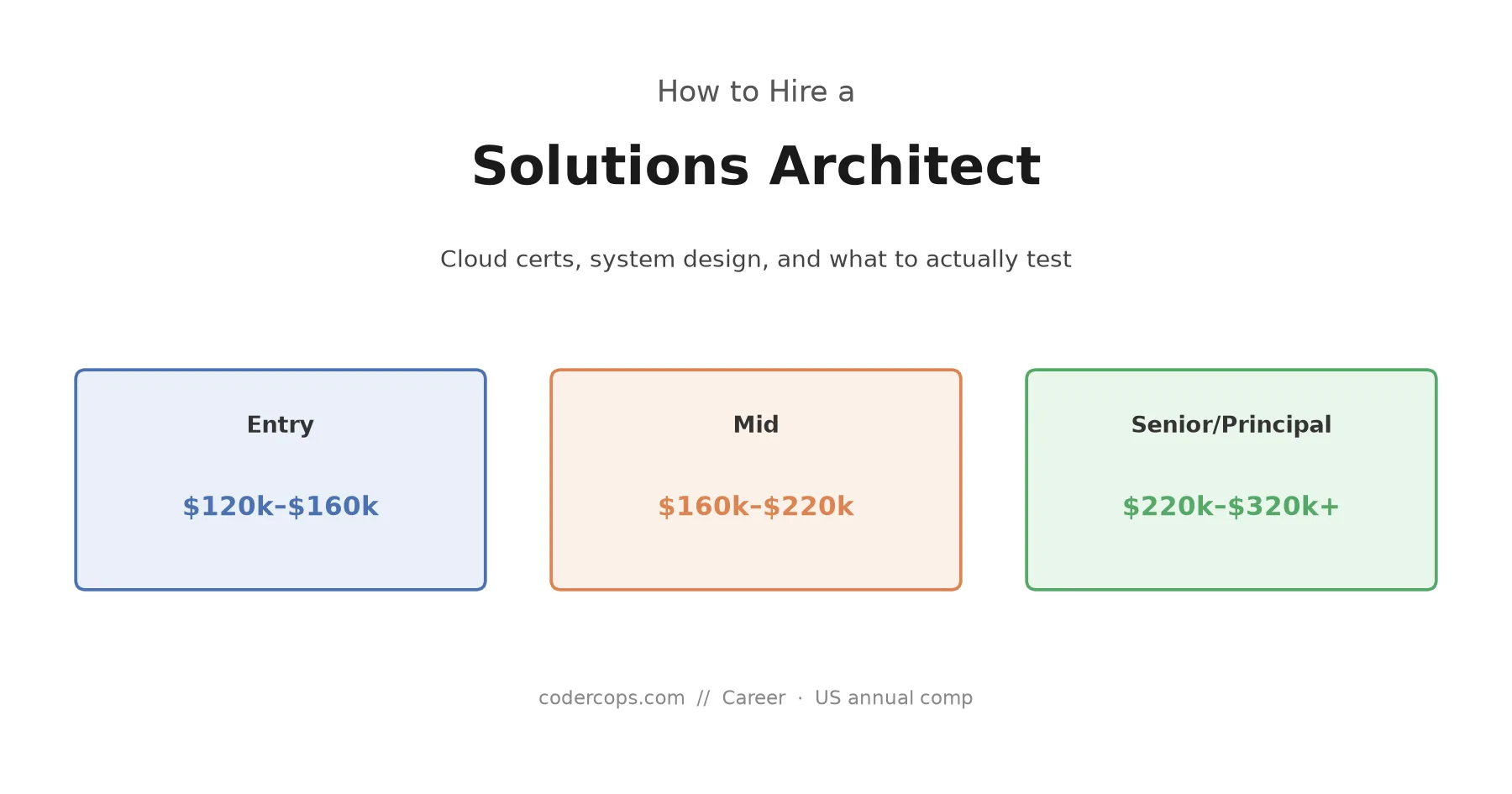
Mid-level React Native engineers in the US run $90,000–$130,000. Senior engineers with New Architecture experience or native module expertise sit at $140,000–$190,000. Contractors bill $70–$120/hr at the senior end. Remote developers in India with verifiable production RN experience (not just portfolio apps) run $18,000–$45,000 annually depending on seniority and track record.
The gap between a developer who built one app and a developer who shipped five (with App Store reviews, crash analytics, performance optimization, and real users), is larger in mobile than most other disciplines. Ask for TestFlight or Play Store links during screening.
If you would rather skip the search, codercops screens React Native developers and hands you a vetted shortlist. See available React Native developers on codercops and post your role to get matched.
Frequently asked questions
- What is React Native's New Architecture and why does it matter for hiring?
- The New Architecture replaces the old JS bridge (a serialized JSON message bus between JavaScript and native code) with JSI (JavaScript Interface), which allows direct synchronous calls between JS and C++ without serialization overhead. Fabric is the new UI rendering system; TurboModules replaces the old native module system. It's been enabled by default since RN 0.74 in 2024. Candidates who don't know this are working with a mental model two years out of date, which matters because third-party libraries that haven't migrated will break or require workarounds in New Architecture projects.
- Expo vs bare React Native — which should I ask candidates about?
- Both. Expo is the right starting point for most 2026 projects — the Expo SDK covers the vast majority of use cases, and Expo Application Services (EAS) handles builds and OTA updates far better than manual Fastlane pipelines. Candidates should be comfortable with Expo's managed workflow and understand when to switch to a bare workflow (native modules not in Expo SDK, custom native builds, specific background processing requirements). A candidate who defaults to bare React Native for everything hasn't kept up with how capable Expo has become.
- How is React Native different from Flutter for hiring purposes?
- React Native uses JavaScript and renders through native components (meaning a button looks and behaves like a native iOS button). Flutter uses its own rendering engine (Skia/Impeller) and draws everything itself, which gives pixel-perfect consistency across platforms but produces widgets that don't inherit platform conventions automatically. The talent pool differs too: React Native draws from JavaScript/React developers, while Flutter requires Dart. If your team already writes React, React Native has a lower ramp. If you need pixel-perfect custom UI with no native-feel requirement, Flutter is more predictable. See our [guide to hiring a Flutter developer](/blog/hire-flutter-developer-2026/) for the Flutter-specific screen.
- What should a take-home assignment look like for a React Native candidate?
- A feature-level task, not a full app: implement a scrollable list that fetches from a public API, with pull-to-refresh, basic error handling, and a detail screen. It should take 3–5 hours for a mid-level engineer. Evaluate: component architecture, TypeScript correctness, how they handle loading/error/empty states, whether they use React Navigation properly, and whether their code is testable. Do not ask them to handle offline state, push notifications, or native modules in a take-home — that scope is unreasonable.
- What does 'JavaScript thread vs UI thread' mean in React Native and why does hiring managers need to know it?
- React Native runs JavaScript on a separate thread from the main UI thread. Expensive JS operations — state updates, data transforms, business logic — can block the JS thread, causing dropped frames. Animations and gestures that run on the JS thread are susceptible to jank. The fix is to move them to the UI thread using Reanimated v3's worklet system or React Native's Animated.useNativeDriver. Candidates who understand this distinction write smoother-feeling apps. Those who don't tend to produce UIs that feel laggy under load.
Sources
Sponsored
Sponsored
Discussion
Join the conversation.
Comments are powered by GitHub Discussions. Sign in with your GitHub account to leave a comment.
Sponsored