Web Development · Frameworks
Next.js Just Started Scheduling Its Security Patches. Here's Why That's a Big Deal
After a 13-CVE surprise release in May, Vercel is moving Next.js to a monthly, pre-announced security release cadence starting July 20, 2026. Here's what the program actually promises and how to plan your upgrade window around it.

Abhishek Gupta
4 min read · Updated Jul 22, 2026
Sponsored
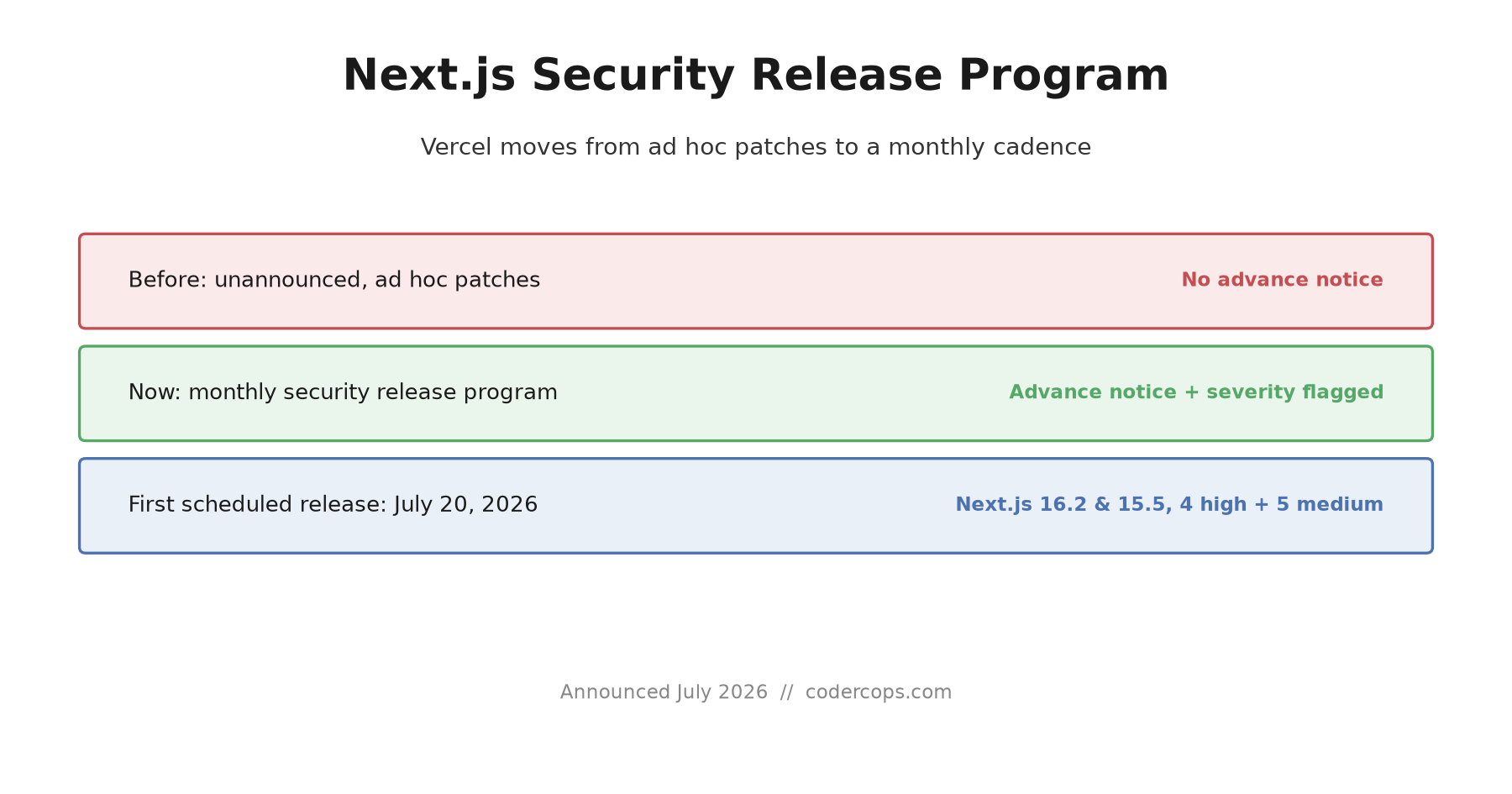
Most framework security news is about a specific bug. This one is about how Next.js decides to tell you about bugs at all, and it’s a bigger operational change than any single CVE. Vercel has launched a formal security release program for Next.js: patches on a monthly, pre-announced cadence instead of showing up unannounced whenever they’re ready.
What changes, concretely
Under the old model, a Next.js security fix landed when the team finished it, with no signal beforehand about timing or how bad it was. Teams found out by reading the changelog after the fact, or worse, by seeing a scanner flag their production deployment.
The new program gives roughly a month’s advance notice before each scheduled release. Vercel states in advance which release lines will be patched and the highest severity level involved, but deliberately withholds the specific vulnerabilities, CVE numbers, and affected code paths until the release actually ships. That’s a real tradeoff, not just process theater: teams get planning time, but they don’t get early technical detail they could accidentally leak or that attackers could reverse-engineer from a partial disclosure.
The first scheduled release under this program ships July 20, 2026, for Next.js 16.2 and 15.5, and Vercel has already told the world it covers 4 high-severity and 5 medium-severity issues. As of this writing, that’s all that’s public. The point of writing about this now, three days before the release, is that the notice itself is the news: you have a known date and a known severity ceiling to plan around, which is exactly what the old model never gave you.
Why this is happening now
The timing lines up with what May 2026 looked like for teams running Next.js in production. That release patched 13 security advisories at once: 6 rated high severity, 3 moderate, 2 low, plus an upstream React CVE affecting App Router deployments broadly. The categories covered middleware bypass, denial of service, SSRF, cache poisoning, and cross-site scripting, all disclosed and fixed simultaneously with zero advance warning. For any team running Next.js at scale, that’s not a Tuesday afternoon patch, that’s an unplanned, all-hands upgrade sprint the same week it drops.
A scheduled, severity-flagged cadence is a direct structural response to that kind of surprise. It doesn’t make the underlying vulnerabilities less serious, but it changes an emergency into a calendar item, which is the difference between a fire drill and a fire.
What doesn’t change
Actively exploited zero-days still get emergency, out-of-band patches outside the monthly schedule, the same as before. The monthly program is for routine, responsibly-disclosed vulnerabilities, the kind that get found by researchers or the Next.js team itself before anyone’s actively abusing them in the wild. If something is being exploited right now, Vercel isn’t going to sit on it until the next scheduled window. This program adds a predictable floor under routine security maintenance; it doesn’t replace incident response.
How to actually use this
- Put the monthly cadence on your team’s calendar, not just Vercel’s. Watch for the advance notice and treat the announced date as a soft deadline to have staging ready for a same-day patch.
- Don’t wait for the CVE details to start prepping. The severity level alone (this month: 4 high, 5 medium) is enough to justify blocking upgrade time in advance, the same way you’d plan around any known-but-undetailed maintenance window.
- Keep emergency response separate from the monthly rhythm. A zero-day announcement outside the schedule still means drop everything; don’t let the existence of a predictable cadence make your team complacent about out-of-band alerts.
If your team is still handling framework upgrades reactively, whether that’s Next.js or anything else in your stack, this is a good prompt to build a real upgrade cadence into your engineering process rather than discovering the need for one during the next surprise release. We wrote about what a similarly disruptive Astro 7 upgrade actually breaks in practice; the lesson generalizes past any one framework: predictable patch schedules are worth building your calendar around, whether the vendor gives you one or you have to impose it yourself.
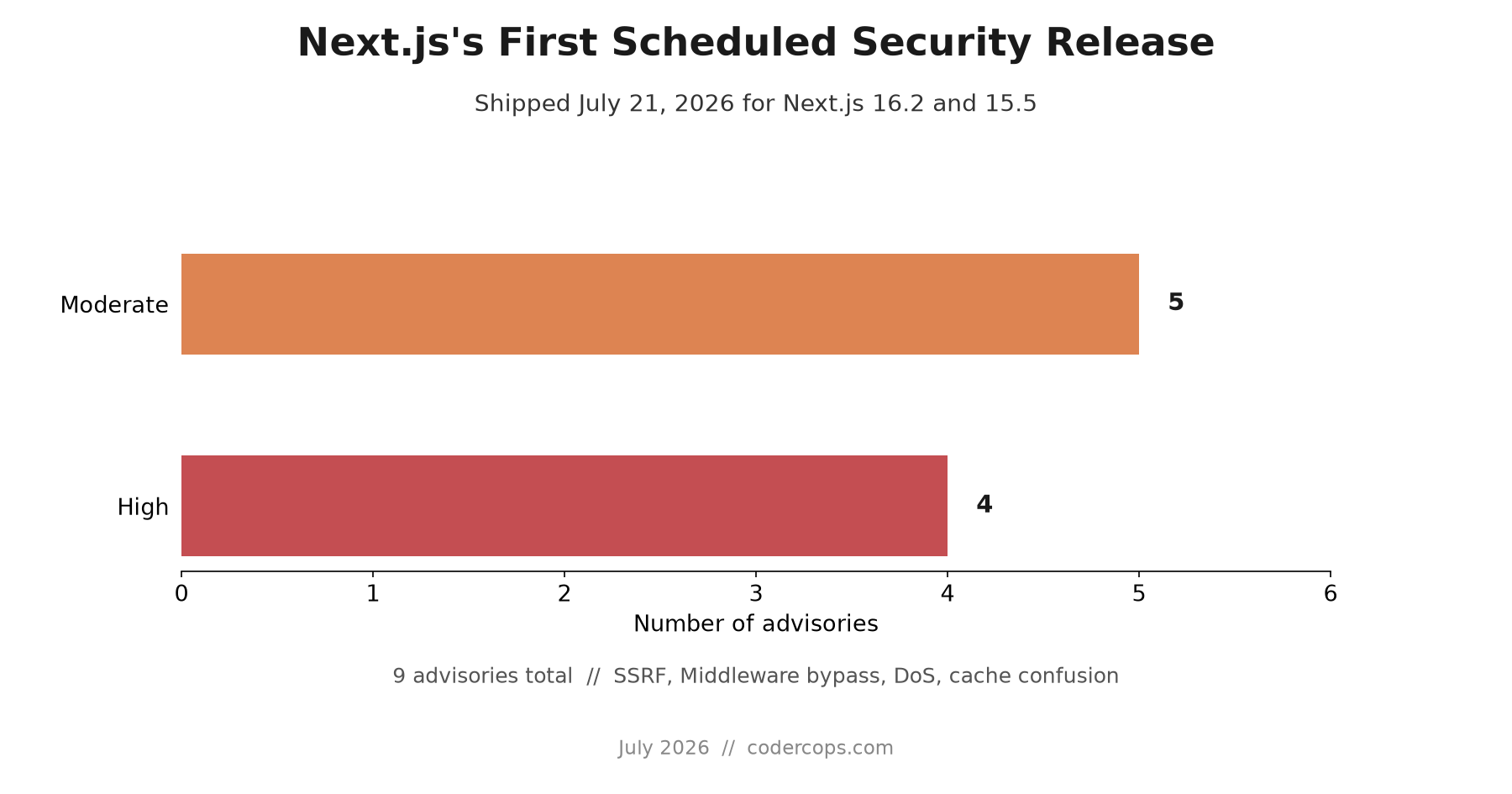
Update, July 22, 2026: The release shipped July 21, a day after the original target, with 9 advisories as promised, 4 high and 5 moderate. We broke down what actually got patched, including the specific GHSA identifiers and which parts of the framework keep showing up in these releases.
Frequently asked questions
- What exactly is Vercel changing about how Next.js ships security fixes?
- Previously, Next.js security fixes shipped when they were ready, with no advance notice of timing or severity. The new program gives roughly a month's notice before each scheduled security release, stating in advance which versions will be patched and the highest severity rating involved, without disclosing the specific vulnerabilities or CVE numbers until the release actually ships. That lets teams plan an upgrade window instead of discovering the need for one the day a patch drops.
- What's shipping in the first scheduled release on July 20, 2026?
- Patches for Next.js 16.2 and 15.5, covering 4 high-severity and 5 medium-severity issues, per Vercel's own advance notice. As of this writing, Vercel has not published CVE numbers, proof-of-concept details, or affected code paths, which is intentional: the whole point of the program is withholding specifics until the fix is available, so attackers don't get a head start on unpatched deployments.
- Why did Vercel create this program now?
- The most likely trigger is May 2026's security release, which patched 13 advisories at once, 6 rated high severity, covering middleware bypass, denial of service, SSRF, cache poisoning, and cross-site scripting, all disclosed and patched simultaneously with no advance warning. That's the kind of release that turns into an unplanned all-hands upgrade for teams running Next.js in production. A scheduled, pre-announced cadence is a direct answer to that kind of surprise.
- Does this replace emergency patches for zero-days?
- No. The monthly program covers routine, responsibly-disclosed vulnerability patching. Vercel has stated that actively exploited zero-days and other urgent issues still get emergency, out-of-band patches immediately, outside the monthly schedule. Think of the monthly cadence as the new normal path, with emergency releases remaining the exception for active exploitation.
- What should my team actually do differently because of this program?
- Build a recurring monthly check into your release calendar, roughly aligned with Vercel's advance notices, rather than treating Next.js upgrades as reactive. When Vercel announces a release date and severity level in advance, block time before that date to review your dependency tree and staging environment, so you can apply the patch same-day once it ships instead of queuing it behind other work. For anything running Next.js in a regulated or high-uptime environment, that planning lead time is the entire value of this change.
Sources
- Next.js blog: Next.js Security Release and Our Next Patch Release
- GB Hackers: Next.js Announces July Security Release to Fix 4 High-Severity and 5 Medium Flaws
- Vercel changelog: Next.js May 2026 security release
- Cloudflare changelog: WAF and framework adapter mitigations for React and Next.js vulnerabilities
Sponsored
More from this category
More from Web Development
 R.01
R.01 MySQL Now Has a Native VECTOR Type. Should You Drop pgvector For It?
 R.02
R.02 React 19.2 vs 'React 20': There Is No React 20, and Here's What's Actually New
 R.03
R.03 Next.js's First Scheduled Security Release Shipped: 9 Advisories, What to Patch
Sponsored
Discussion
Join the conversation.
Comments are powered by GitHub Discussions. Sign in with your GitHub account to leave a comment.
Sponsored