Web Development · Databases
MySQL VECTOR vs pgvector: Should You Switch?
MySQL 9 shipped a native VECTOR type and distance functions, no extension needed. How it compares to Postgres plus pgvector for real semantic search.

Abhishek Gupta
5 min read
Sponsored
If you’ve been reaching for Postgres specifically because you needed pgvector, that reason got weaker. MySQL’s 9.x series shipped a native VECTOR column type with built-in distance functions, no extension required. It doesn’t make pgvector obsolete, but it does remove the biggest argument for bringing a second database engine into a stack that’s otherwise entirely MySQL.
What MySQL actually shipped
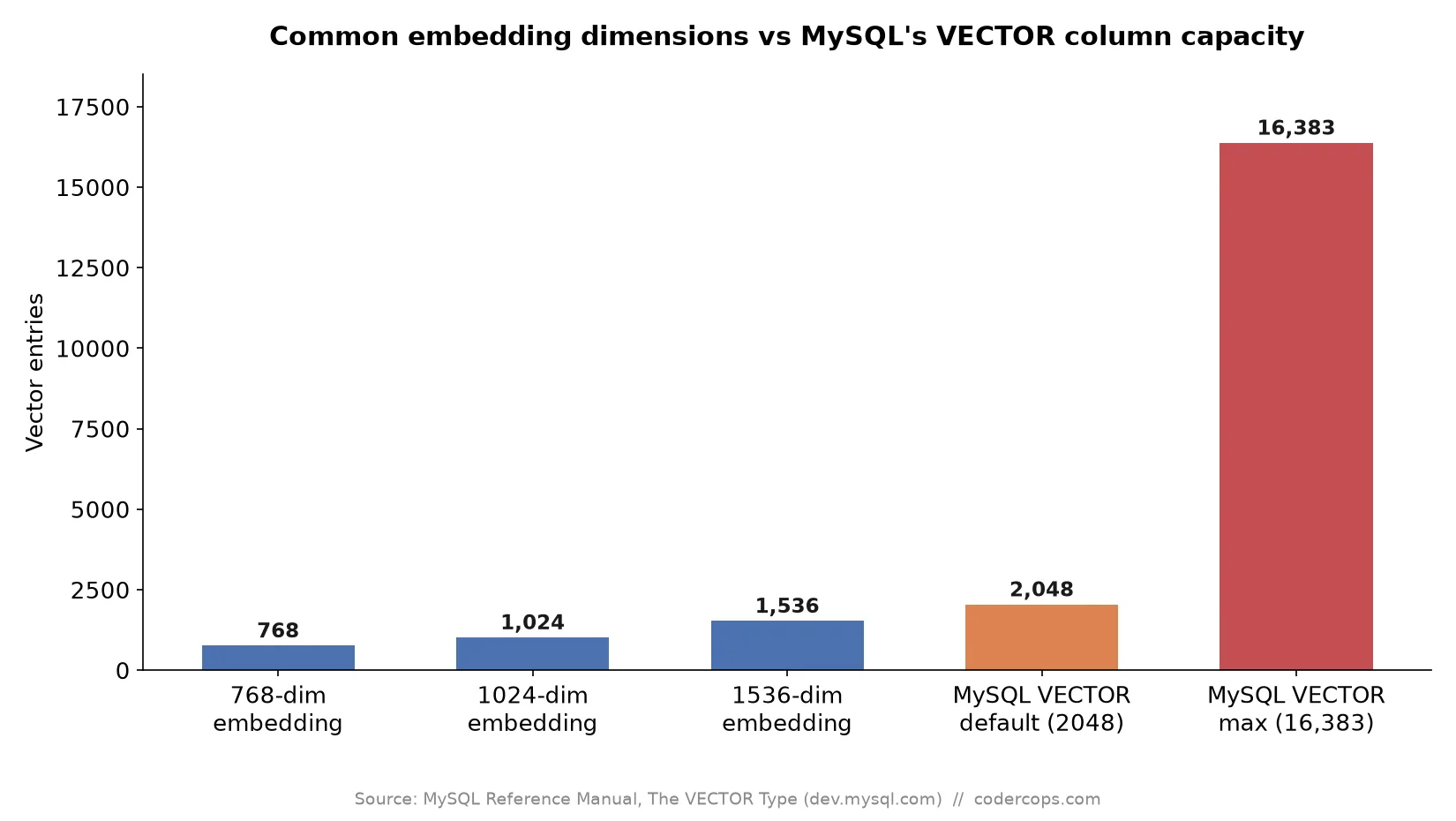
A VECTOR column stores up to 16,383 entries, each a 4-byte single-precision float, with a default length of 2048 if you don’t specify one. That range comfortably covers the embedding dimensions most teams actually use: 768 for a lot of open embedding models, 1536 for OpenAI’s text-embedding-3-small, 1024 for several current alternatives. Creating one looks exactly like creating any other typed column:
CREATE TABLE documents (
  id INT PRIMARY KEY AUTO_INCREMENT,
  content TEXT,
  embedding VECTOR(1536) NOT NULL
);
Four functions do the actual work. STRING_TO_VECTOR() converts a string representation into the binary vector format MySQL stores. VECTOR_TO_STRING() does the reverse for reading values back out in a human-readable form. VECTOR_DIM() returns how many entries a given vector holds, useful for validating that embeddings from different model versions haven’t gotten mixed into the same column. DISTANCE() computes similarity between two vectors using a specified metric, cosine distance being the one most semantic search workloads reach for:
SELECT id, content,
       DISTANCE(embedding, STRING_TO_VECTOR(:query_vector), 'cosine') AS similarity
FROM documents
ORDER BY similarity
LIMIT 10;
That’s the entire API surface for basic semantic search. No extension to install, no separate package to track across major-version upgrades, no CREATE EXTENSION vector step that someone forgets to run on a new environment.
Where this actually changes a decision
The honest comparison isn’t “MySQL vector search vs pgvector,” feature for feature, it’s “does this remove a reason you were avoiding MySQL.” For a lot of teams, it does. If your application data already lives in MySQL because that’s what your ORM, your hosting provider, or your existing team’s expertise defaults to, and you’re adding a modest semantic search feature, a document similarity lookup, a “related items” feature, a basic RAG retrieval step, standing up a second database engine just to get vector storage was always a heavier decision than the feature justified. Now it doesn’t have to be one.
| Factor | MySQL native VECTOR | Postgres + pgvector |
|---|---|---|
| Setup | Built in, no extension | CREATE EXTENSION vector |
| Max entries per vector | 16,383 | No hard cap, practically similar range |
| Index types | Fewer, newer | HNSW, IVFFlat, longer track record |
| Operational overhead | None beyond the DB itself | One more extension to patch and track |
| Production maturity | New as of the 9.x series | Years of production use at scale |
| Right fit | Modest vector workloads on an existing MySQL stack | Large-scale, tuning-sensitive vector search |
Where pgvector still wins
Scale and index maturity are the real gap, not raw capability. pgvector’s HNSW index has been in production across a large number of RAG and semantic search deployments long enough that its failure modes, tuning parameters, and performance characteristics under real load are well understood. MySQL’s vector indexing is newer, and “newer” in database infrastructure means fewer people have hit its edge cases yet, not that it’s worse in principle. If your semantic search workload is large enough that index build time, recall tuning, and query latency under concurrent load are things you’re actively managing, pgvector remains the safer default in 2026, and that’s likely to stay true for at least another release cycle or two before MySQL’s implementation accumulates the same depth of production experience.
We’ve covered pgvector’s role in a Postgres-based semantic search stack in more depth if that’s the scale you’re building for. The two aren’t mutually exclusive answers to the same question, they’re answers to different questions: “what’s the lowest-friction way to add vector search to what I already run” versus “what’s the most production-proven option at real scale.”
What to actually do
If you’re starting a new project and picking a database from scratch specifically because you think you’ll need vector search, that calculus hasn’t changed enough to override other factors, pick the database that fits your team’s operational experience and your application’s other needs, then add vector search to it. If you’re already running MySQL and were contemplating standing up Postgres solely for pgvector, that’s the decision this actually affects: you likely don’t need to anymore for a modest workload. And if you’re already deep into a Postgres-based RAG pipeline with tuned HNSW indexes, there’s no case here for switching. The database that’s already working for you at scale is still the right one; this just closes a gap that used to force a choice nobody wanted to make for a feature that didn’t warrant it.
Frequently asked questions
- Do I need an extension to use vector search in MySQL now?
- No. The VECTOR type and its distance functions ship as part of MySQL 9.x itself. You create a column with the VECTOR() type the same way you'd create any other column, no CREATE EXTENSION step and nothing to enable separately.
- Is MySQL's native vector search as fast as pgvector with an HNSW index?
- For small to medium datasets, both are workable. For large-scale approximate nearest-neighbor search, pgvector's HNSW index has a longer production track record and more tuning knobs than MySQL's current vector indexing support. If your workload is index-performance-sensitive at real scale, that maturity gap is the deciding factor, not raw feature parity.
- Should I migrate my Postgres database to MySQL to get the native VECTOR type?
- No. Migrating a production database for one feature is almost never worth the operational risk, and pgvector already does the job well on Postgres. This matters for the opposite decision: if you're starting a new project or already run MySQL for other reasons, you no longer need to bring in Postgres specifically for vector search.
- What's the maximum size of a MySQL VECTOR column?
- A MySQL VECTOR value can hold up to 16,383 entries, each stored as a 4-byte single-precision float, with a default length of 2048 if you don't specify one. That comfortably covers common embedding dimensions like 768, 1024, and 1536 used by most current embedding models.
- What distance metrics does MySQL's DISTANCE() function support?
- MySQL's DISTANCE() function takes a metric argument, most commonly cosine distance for semantic similarity search, the same metric most teams use with pgvector for embedding comparisons. Check your MySQL version's reference manual for the current full list, since supported metrics have been expanding across the 9.x point releases.
Sources
Sponsored
More from this category
More from Web Development
Sponsored
Discussion
Join the conversation.
Comments are powered by GitHub Discussions. Sign in with your GitHub account to leave a comment.
Sponsored