Web Development · Frameworks
Astro 6.4's Rust Markdown Processor: The Tradeoff
Astro 6.4 ships a pluggable markdown pipeline and Sätteri, a Rust processor that speeds up content-heavy builds. It can't run your remark plugins yet.

Abhishek Gupta
5 min read
Sponsored
Astro 6.4 shipped in late May 2026, and the headline feature is a markdown pipeline that, for the first time, you can actually swap out. The default is still unified(), the same JavaScript-based remark/rehype pipeline Astro has always used, so nothing breaks if you do nothing. But there’s now a real alternative for the specific case where markdown processing is your build-time bottleneck.
What actually shipped
Astro 6.4 introduces a markdown.processor config option. Set it, and Astro routes markdown and MDX compilation through whichever processor you choose instead of the built-in pipeline.
// astro.config.mjs
import { defineConfig } from 'astro/config';

export default defineConfig({
  markdown: {
    processor: 'satteri', // opt into the new Rust pipeline
  },
});
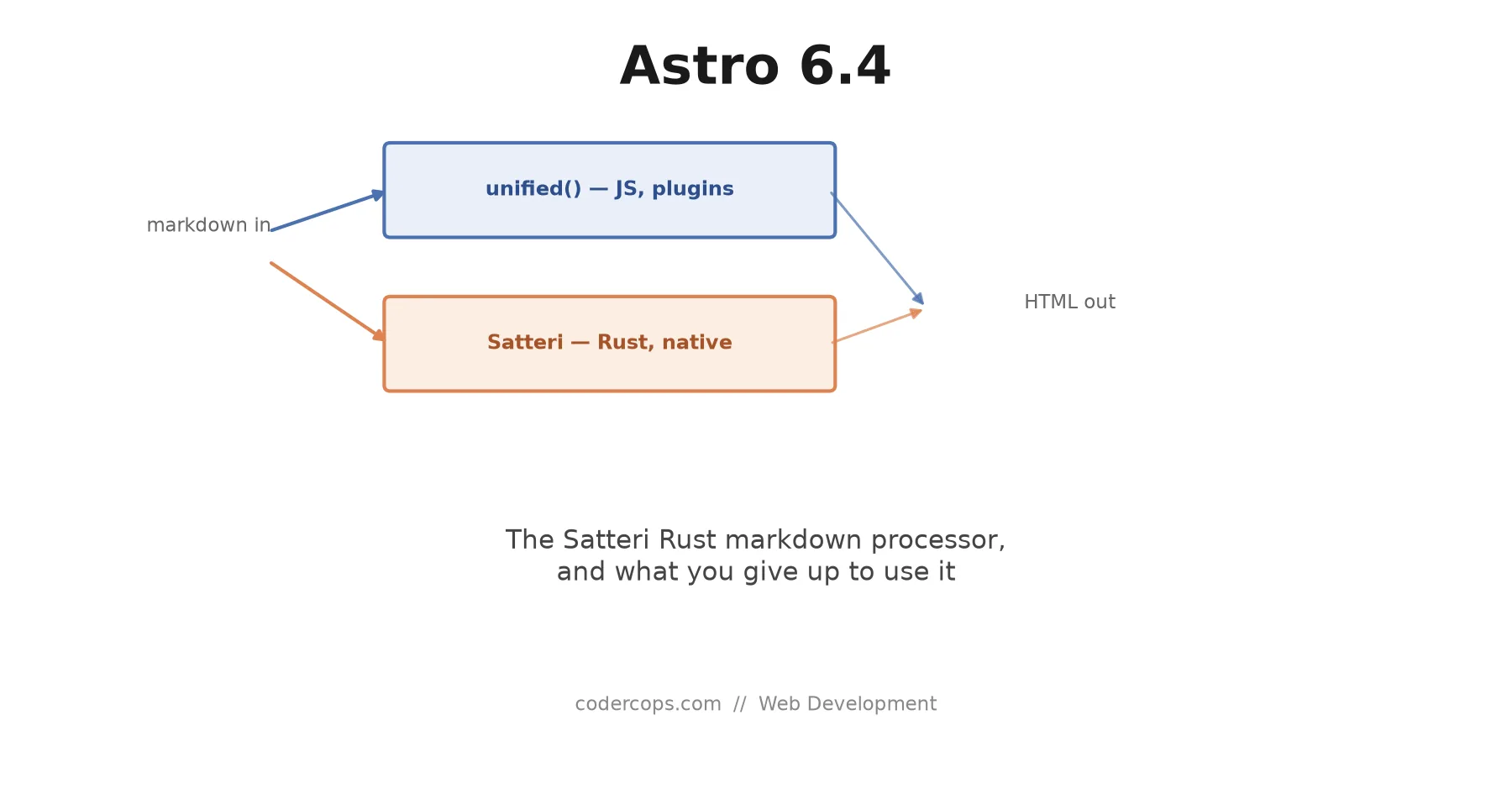
The processor being offered alongside the default is Sätteri, shipped as a new @astrojs/markdown-satteri package. It’s a Rust-native markdown and MDX pipeline, and its whole reason for existing is speed: it implements GFM tables, footnotes, smart punctuation, and syntax highlighting hooks natively, rather than assembling them from a chain of separate remark plugins.
Why that matters for performance: every plugin in a unified() pipeline walks the full abstract syntax tree of your document. Five plugins means five traversals of the same content, even if each individual plugin does very little work. Sätteri collapses that into a single native pass. The more plugins your unified config chains together, the more this compounds, which is exactly why the biggest wins show up on the biggest sites.
The numbers Astro published
Astro’s team benchmarked the switch on their own infrastructure rather than a synthetic test case, and reported the results in the 6.4 release post: switching both the Astro documentation site and the Cloudflare documentation site to Sätteri shaved over a minute off each site’s respective build time.
That’s a meaningful number for two reasons. First, it’s a real production workload, not a contrived benchmark. Second, both are large, markdown-heavy docs sites, which is the profile where a faster processor pays off most. If you’re running a five-page marketing site, don’t expect the same absolute savings. If you’re running a documentation site with hundreds of pages and a plugin chain doing GFM parsing, syntax highlighting, table of contents generation, and heading-anchor injection, the maths favor Sätteri clearly.
What you give up
Sätteri’s speed comes from not running the unified plugin ecosystem. If your astro.config.mjs currently lists remarkPlugins or rehypePlugins, none of them execute under Sätteri. Common cases that will need a decision:
| If your project uses… | Sätteri support |
|---|---|
| Standard GFM tables, footnotes, smart quotes | Native, works out of the box |
| Syntax highlighting via Shiki | Supported via built-in hooks |
| Custom remark/rehype plugins (TOC generators, link rewriters, etc.) | Not executed, so stay on unified() or port the plugin |
| MDX components | Unaffected, MDX component handling is separate from markdown text processing |
For teams with a plugin-free or lightly customized pipeline, switching costs one config line and a test build. For teams with several custom plugins doing real work (link validation, custom callouts, cross-reference generation), staying on unified() for now is the reasonable call. Astro isn’t forcing a migration: the legacy config keys (markdown.remarkPlugins, rehypePlugins, remarkRehype, gfm, smartypants) still work, they’re just marked deprecated with removal planned for Astro 8.0, which gives teams real runway.
Trying it on this kind of site
This blog itself is served from a set of markdown files staged into an Astro site, which is exactly the workload Sätteri targets: hundreds of posts, syntax-highlighted code blocks, and standard GFM tables, with no exotic remark plugins in the pipeline. That combination is close to the best case for switching, and it’s worth testing in a branch before committing to it project-wide.
npm install @astrojs/markdown-satteri// astro.config.mjs
export default defineConfig({
markdown: {
processor: 'satteri',
},
});Run a full build before and after, and compare wall-clock time. If your CI logs build duration (most do), this is a five-minute experiment with a clear answer either way.
Context: Astro under Cloudflare
Worth noting for anyone who hasn’t been tracking it: Astro is no longer an independent company. Cloudflare acquired The Astro Technology Company earlier this year, and the team continues shipping Astro full-time as part of Cloudflare’s web platform push. Sätteri being tested against Cloudflare’s own docs site in this release isn’t a coincidence: it’s the acquisition paying off in the form of a shared testbed and, presumably, shared incentive to make markdown-heavy sites build faster on Cloudflare’s infrastructure. It’s also a natural follow-on from the edge computing and CSP work Astro previewed during the 6.0 beta, where Cloudflare integration was already the headline story.
The practical takeaway
If your Astro project has a plugin-light markdown pipeline and you care about build time, especially in CI where every minute is billed compute, switching to Sätteri today is close to a free win: one config line, no content changes, and a documented double-digit-second-to-minute-plus improvement on comparable sites. If you’ve built a markdown pipeline with several custom plugins doing real transformation work, stay on unified() for now and revisit once Sätteri’s plugin story matures. Nothing forces the decision before you’re ready.
Frequently asked questions
- What is Sätteri and how is it different from Astro's default markdown processor?
- Sätteri is a new markdown and MDX processing pipeline written in Rust, shipped as the @astrojs/markdown-satteri package in Astro 6.4. Astro's default processor is unified(), a mature JavaScript-based pipeline built on remark and rehype plugins. Sätteri implements many common markdown features (GFM tables, smart punctuation, syntax highlighting hooks) natively in Rust rather than through a plugin chain, which is where its speed advantage comes from.
- How much faster is Sätteri, really?
- Astro's own benchmarking, published with the 6.4 release, reports that switching the Astro documentation site and the Cloudflare documentation site to Sätteri shaved more than a minute off each site's respective build time. Both are large, markdown-heavy documentation sites, which is exactly the workload where Sätteri's advantage compounds: every remark or rehype plugin in the unified pipeline does a full AST traversal, so more plugins means more passes over the same content. A small blog with a handful of posts won't see the same absolute gain.
- Can I use my existing remark and rehype plugins with Sätteri?
- No, not directly. Sätteri does not execute the unified ecosystem's remark or rehype plugins. If your project depends on plugins like remark-toc, rehype-external-links, or a custom transform, you have two options: stay on the default unified() processor, or port the plugin's logic to work against Sätteri's own MDAST or HAST-compatible plugin interfaces. For most teams with heavily customized pipelines, staying on unified() for now is the pragmatic choice.
- Do I need to change my markdown files to switch to Sätteri?
- No. Sätteri processes standard Markdown and MDX syntax and Astro's content collections work unchanged. The switch is a configuration change in astro.config.mjs, not a content migration, unless you rely on plugin-specific syntax extensions that Sätteri doesn't implement natively.
- Should I switch now, or wait?
- If you run a plugin-free or lightly-customized markdown pipeline and build times matter to you (large docs sites, content-heavy blogs, frequent CI builds), switching now is low-risk and the config change takes minutes. If your build depends on specific remark or rehype plugins, test in a branch first. The deprecated legacy config keys still work through at least Astro 7, so there's no urgency to migrate away from unified() before you're ready.
Sources
Sponsored
More from this category
More from Web Development
Sponsored
Discussion
Join the conversation.
Comments are powered by GitHub Discussions. Sign in with your GitHub account to leave a comment.
Sponsored