Web Development · React
React 19: Everything You Need to Know
React 19 shipped Server Components, Actions, a built-in compiler, and new hooks like useOptimistic and use(). Here's what changed and how to migrate.

Anurag Verma
11 min read

Sponsored
React 19 represents the biggest evolution of React since hooks were introduced. With Server Components now stable, a built-in compiler, and powerful new APIs, React development in 2026 looks fundamentally different. Here’s your complete guide.

Release Timeline
- April 2024: React 19 Beta released
- December 2024: React 19 stable released
- June 2025: React 19.1 with refinements
- October 2025: React 19.2 with Activity, Partial Pre-rendering
The React Compiler: Automatic Optimization
One of the most impactful features in React 19 is the built-in compiler that automatically optimizes your components.
What It Does
The React Compiler transforms your components into highly optimized JavaScript, handling:
- Automatic memoization - No more manual
useMemoanduseCallback - Smart re-rendering - Only updates what actually changed
- Bundle optimization - Smaller, faster code
Before React 19
// Manual optimization required
import { useMemo, useCallback, memo } from 'react';

const ExpensiveList = memo(({ items, onItemClick }) => {
  const sortedItems = useMemo(() => {
    return [...items].sort((a, b) => a.name.localeCompare(b.name));
  }, [items]);

  const handleClick = useCallback((id) => {
    onItemClick(id);
  }, [onItemClick]);

  return (
    <ul>
      {sortedItems.map(item => (
        <li key={item.id} onClick={() => handleClick(item.id)}>
          {item.name}
        </li>
      ))}
    </ul>
  );
});
With React 19 Compiler
// Compiler handles optimization automatically
const ExpensiveList = ({ items, onItemClick }) => {
  const sortedItems = [...items].sort((a, b) =>
    a.name.localeCompare(b.name)
  );

  return (
    <ul>
      {items.map(item => (
        <li key={item.id} onClick={() => onItemClick(item.id)}>
          {item.name}
        </li>
      ))}
    </ul>
  );
};

// The compiler automatically:
// - Memoizes sortedItems computation
// - Optimizes the onClick handler
// - Prevents unnecessary re-renders
Server Components: Production Ready
React Server Components are now fully stable and production-ready. They represent a fundamental shift in how we think about React components, and the pattern has spread well beyond React itself; see why server components are everywhere now for the broader ecosystem picture.
Stability doesn’t mean risk-free. Server Components changed the trust boundary between server and client code, and that boundary has already produced real vulnerabilities: CVE-2025-55182, a remote code execution bug in React Server Components, is worth reading before you ship anything that deserializes untrusted input through the RSC payload.
Server vs Client Components
Component Types in React 19
├── Server Components (default)
│   ├── Run only on the server
│   ├── Zero JavaScript sent to client
│   ├── Direct database access
│   └── Async by default
│
└── Client Components ('use client')
    ├── Run on client (and server for SSR)
    ├── Interactive and stateful
    ├── Event handlers
    └── Browser APIs
Server Component Example
// app/products/page.jsx (Server Component by default)
import { db } from '@/lib/database';
import { ProductCard } from './ProductCard';

// This component runs on the server
// No JavaScript shipped to the client
async function ProductsPage() {
  // Direct database query - no API needed!
  const products = await db.products.findMany({
    where: { isActive: true },
    orderBy: { createdAt: 'desc' },
  });

  return (
    <div className="grid grid-cols-3 gap-4">
      {products.map(product => (
        <ProductCard key={product.id} product={product} />
      ))}
    </div>
  );
}

export default ProductsPage;
Client Component Example
// components/AddToCart.jsx
'use client'; // This directive makes it a Client Component

import { useState } from 'react';
import { addToCart } from '@/actions/cart';

export function AddToCart({ productId }) {
  const [isLoading, setIsLoading] = useState(false);

  async function handleClick() {
    setIsLoading(true);
    await addToCart(productId);
    setIsLoading(false);
  }

  return (
    <button onClick={handleClick} disabled={isLoading}>
      {isLoading ? 'Adding...' : 'Add to Cart'}
    </button>
  );
}
Actions API: Simplified Data Mutations
React 19 introduces Server Actions that replace traditional REST/GraphQL APIs for many use cases.
Form Actions
// Traditional approach
function ContactForm() {
  const [isSubmitting, setIsSubmitting] = useState(false);
  const [error, setError] = useState(null);

  async function handleSubmit(e) {
    e.preventDefault();
    setIsSubmitting(true);
    try {
      const formData = new FormData(e.target);
      await fetch('/api/contact', {
        method: 'POST',
        body: formData,
      });
    } catch (err) {
      setError(err.message);
    } finally {
      setIsSubmitting(false);
    }
  }

  return <form onSubmit={handleSubmit}>...</form>;
}
// React 19 with Server Actions
// actions/contact.js
'use server';
export async function submitContact(formData) {
const email = formData.get('email');
const message = formData.get('message');
await db.contacts.create({
data: { email, message }
});
return { success: true };
}
// components/ContactForm.jsx
import { submitContact } from '@/actions/contact';
function ContactForm() {
return (
<form action={submitContact}>
<input name="email" type="email" required />
<textarea name="message" required />
<button type="submit">Send</button>
</form>
);
}
New Hooks in React 19
useActionState
Manages the state of form actions:
import { useActionState } from 'react';
import { updateProfile } from '@/actions/profile';

function ProfileForm() {
  const [state, formAction, isPending] = useActionState(
    updateProfile,
    { message: '' }
  );

  return (
    <form action={formAction}>
      <input name="name" disabled={isPending} />
      <button disabled={isPending}>
        {isPending ? 'Saving...' : 'Save'}
      </button>
      {state.message && <p>{state.message}</p>}
    </form>
  );
}
useFormStatus
Access form state from child components:
import { useFormStatus } from 'react-dom';

function SubmitButton() {
  const { pending, data, method } = useFormStatus();

  return (
    <button disabled={pending}>
      {pending ? 'Submitting...' : 'Submit'}
    </button>
  );
}

// Use in any form
<form action={submitAction}>
  <input name="email" />
  <SubmitButton /> {/* Knows if form is submitting */}
</form>
useOptimistic
Optimistic updates made simple:
import { useOptimistic } from 'react';

function MessageList({ messages }) {
  const [optimisticMessages, addOptimistic] = useOptimistic(
    messages,
    (state, newMessage) => [...state, newMessage]
  );

  async function sendMessage(formData) {
    const message = formData.get('message');

    // Immediately show the message
    addOptimistic({ text: message, sending: true });

    // Then actually send it
    await submitMessage(message);
  }

  return (
    <>
      {optimisticMessages.map((msg, i) => (
        <div key={i} style={{ opacity: msg.sending ? 0.5 : 1 }}>
          {msg.text}
        </div>
      ))}
      <form action={sendMessage}>
        <input name="message" />
        <button>Send</button>
      </form>
    </>
  );
}
use() Hook
Await promises directly in components:
import { use, Suspense } from 'react';

// Create a promise
const dataPromise = fetch('/api/data').then(r => r.json());

function DataDisplay() {
  // use() unwraps the promise
  const data = use(dataPromise);

  return <div>{data.title}</div>;
}

// Wrap with Suspense for loading state
<Suspense fallback={<Loading />}>
  <DataDisplay />
</Suspense>
Ref as a Prop: No More forwardRef
React 19 stopped treating ref as special. Function components can now accept it as a regular prop, which means most of the components that only existed to satisfy forwardRef can be deleted entirely.
// Before React 19: forwardRef required
const Input = forwardRef((props, ref) => {
  return <input ref={ref} {...props} />;
});

// React 19: ref is just a prop
function Input({ ref, ...props }) {
  return <input ref={ref} {...props} />;
}
forwardRef still works for backward compatibility, and React has said it will eventually be deprecated, but there’s no reason to reach for it in new code. This mostly matters for component libraries and shared UI primitives, where wrapping every element in forwardRef was pure ceremony.
Document Metadata: Title, Meta, and Link Tags
React 19 lets components render <title>, <meta>, and <link> tags directly, anywhere in the component tree, and React hoists them into the document <head> automatically.
function BlogPost({ post }) {
  return (
    <article>
      <title>{post.title} | My Blog</title>
      <meta name="description" content={post.excerpt} />
      <link rel="canonical" href={post.url} />
      <h1>{post.title}</h1>
      <p>{post.body}</p>
    </article>
  );
}
This removes the need for a separate <Head> component or a metadata-management library for the common case: a deeply nested component (a product page, a blog post, a dashboard tab) can now set its own title and meta tags without threading that state up to a layout component. It works the same way whether the component renders on the server or the client, and duplicate tags from nested components are deduplicated automatically.
React 19.2 Features (October 2025)
Activity Component
Control rendering priorities with activities:
import { Activity } from 'react';

function App() {
  return (
    <Activity mode={isVisible ? 'visible' : 'hidden'}>
      <ExpensiveComponent />
    </Activity>
  );
}

// Hidden activities:
// - Keep state preserved
// - Don't render to DOM
// - Resume instantly when visible
Partial Pre-rendering
Pre-render static parts, stream dynamic content:
// Static shell is pre-rendered at build time
// Dynamic content streams in at request time

export default function ProductPage({ params }) {
  return (
    <div>
      {/* Static - pre-rendered */}
      <Header />
      <ProductDetails id={params.id} />

      {/* Dynamic - streamed */}
      <Suspense fallback={<ReviewsSkeleton />}>
        <Reviews id={params.id} />
      </Suspense>

      {/* Static - pre-rendered */}
      <Footer />
    </div>
  );
}
Concurrent Rendering by Default
React 19 enables concurrent rendering by default, allowing React to:
- Interrupt long renders - Keeps UI responsive
- Prioritize updates - User input > background work
- Batch updates intelligently - Fewer re-renders
// React 19 automatically handles this
function SearchResults({ query }) {
  const results = use(searchAPI(query));

  // React can pause this render if user types again
  // Preventing UI from freezing during searches

  return (
    <ul>
      {results.map(result => (
        <SearchResult key={result.id} result={result} />
      ))}
    </ul>
  );
}
Migration Guide
Step 1: Update Dependencies
npm install react@19 react-dom@19Step 2: Enable the Compiler (Optional)
// babel.config.js
module.exports = {
  plugins: [
    ['babel-plugin-react-compiler', {
      // Compiler options
    }],
  ],
};
Step 3: Migrate to Server Components
// Before: API route + client fetch
// pages/api/products.js
export default async function handler(req, res) {
  const products = await db.products.findMany();
  res.json(products);
}

// pages/products.jsx
function Products() {
  const [products, setProducts] = useState([]);

  useEffect(() => {
    fetch('/api/products')
      .then(r => r.json())
      .then(setProducts);
  }, []);

  return <ProductList products={products} />;
}
// After: Server Component
// app/products/page.jsx
async function Products() {
const products = await db.products.findMany();
return <ProductList products={products} />;
}Common Migration Pitfalls
A few gotchas trip up teams moving to React 19 in practice:
useFormStatus returns nothing useful inside the form itself. It has to be called from a component that is a child of the <form>, not from the component that renders the <form> tag. Calling it in the same component that owns the form will always return the default, non-pending state, which is why the pattern above puts SubmitButton as a separate component nested inside the form.
The compiler skips components it can’t safely optimize instead of erroring. If a component breaks the Rules of React (mutating props, conditional hook calls, unstable identity tricks), the compiler silently opts that component out of memoization rather than failing the build. This means a component can appear to work while getting none of the compiler’s benefit, so it’s worth running the compiler’s ESLint plugin to catch violations explicitly.
use() can’t be called inside try/catch or after an early return, the same restriction that applies to every other hook. It reads more like a normal function call, but React still tracks it by call order, so treat it with the same rules-of-hooks discipline as useState or useEffect.
Best Practices for React 19
1. Default to Server Components
Decision Tree:
├── Does it need interactivity? → Client Component
├── Does it need browser APIs? → Client Component
├── Does it need state? → Client Component
└── Otherwise → Server Component (default)
2. Keep Client Components Small
// Good: Small client boundary
function ProductPage({ product }) {
  return (
    <div>
      <h1>{product.name}</h1>
      <p>{product.description}</p>
      {/* Only AddToCart is a Client Component */}
      <AddToCart productId={product.id} />
    </div>
  );
}
3. Use Actions for Mutations
// Prefer Actions over API routes for forms
<form action={serverAction}>
  {/* Form fields */}
</form>
Summary
React 19 brings:
| Feature | Benefit |
|---|---|
| React Compiler | Automatic optimization |
| Server Components | Zero-JS server rendering |
| Actions API | Simplified data mutations |
| New Hooks | Better form & async handling |
| Concurrent Rendering | Responsive UIs by default |
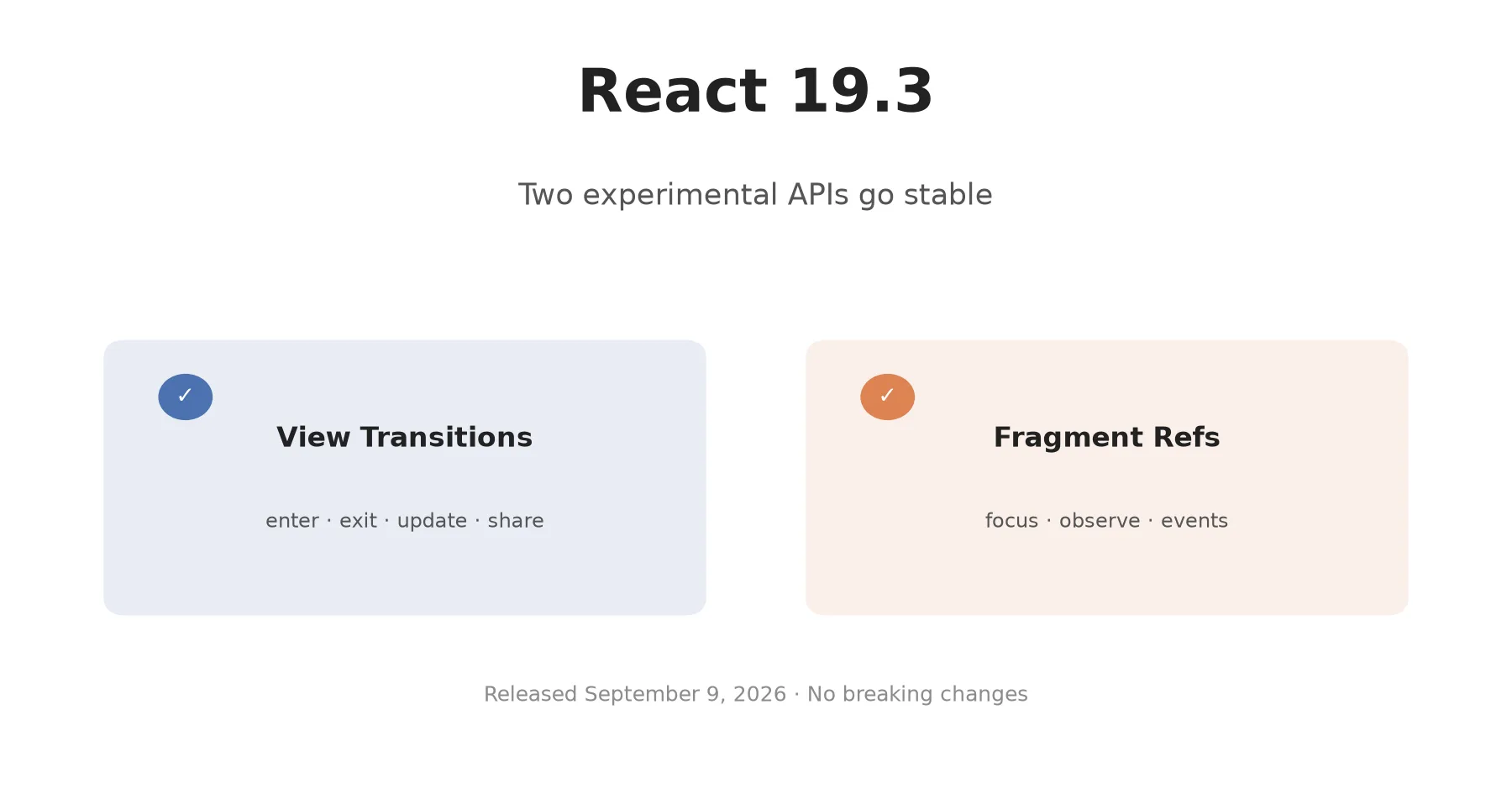
The ecosystem is still evolving, but React 19 sets the foundation for faster, simpler, and more efficient React applications. If you’re already on 19.2, React 19.3’s View Transitions and Fragment Refs are the next features worth evaluating, and pairing the compiler with Next.js 16’s Turbopack and cache components is where most teams see the biggest build and runtime wins in practice.
Resources
- React 19 Official Blog
- React 19.2 Release Notes
- Netguru: Future of React Trends
- GeeksforGeeks: React 19 Features
Need help migrating to React 19? Contact CODERCOPS for expert React development services.
Frequently asked questions
- Do I still need useMemo and useCallback with React 19?
- Not for most components. The React Compiler analyzes your code at build time and inserts the equivalent memoization automatically, so components that used to need manual useMemo, useCallback, and memo calls can usually drop them. You still control the compiler's opt-in scope, and manual memoization still works if you write it.
- What's the difference between a Server Component and a Client Component in React 19?
- Server Components are the default: they run only on the server, send zero JavaScript to the browser, and can query a database directly. Client Components, marked with the 'use client' directive, run in the browser (and during SSR) and are needed for anything interactive: state, event handlers, or browser APIs.
- Do I still need forwardRef in React 19?
- Usually not. React 19 made ref a regular prop that function components can accept directly, so most components that previously needed forwardRef just to forward a ref down to a DOM node can drop it and read props.ref instead.
- Can I still use API routes instead of Server Actions in React 19?
- Yes, Server Actions don't replace REST or GraphQL APIs, they replace the boilerplate of wiring a form to a fetch call for simple mutations. For public APIs consumed by other clients, or complex query patterns, a traditional API layer is still the right tool.
- What's the easiest first step to adopt React 19?
- Update react and react-dom to version 19, then enable the compiler as a build step; both work with your existing components without a rewrite. Converting data-fetching components to Server Components and adopting Actions for forms are separate steps you can do incrementally afterward.
Sponsored
More from this category
More from Web Development
Sponsored
Discussion
Join the conversation.
Comments are powered by GitHub Discussions. Sign in with your GitHub account to leave a comment.
Sponsored