Cloud & Infrastructure · Industry News
AMD Buys Taalas: What Etching AI Weights Into Silicon Actually Changes
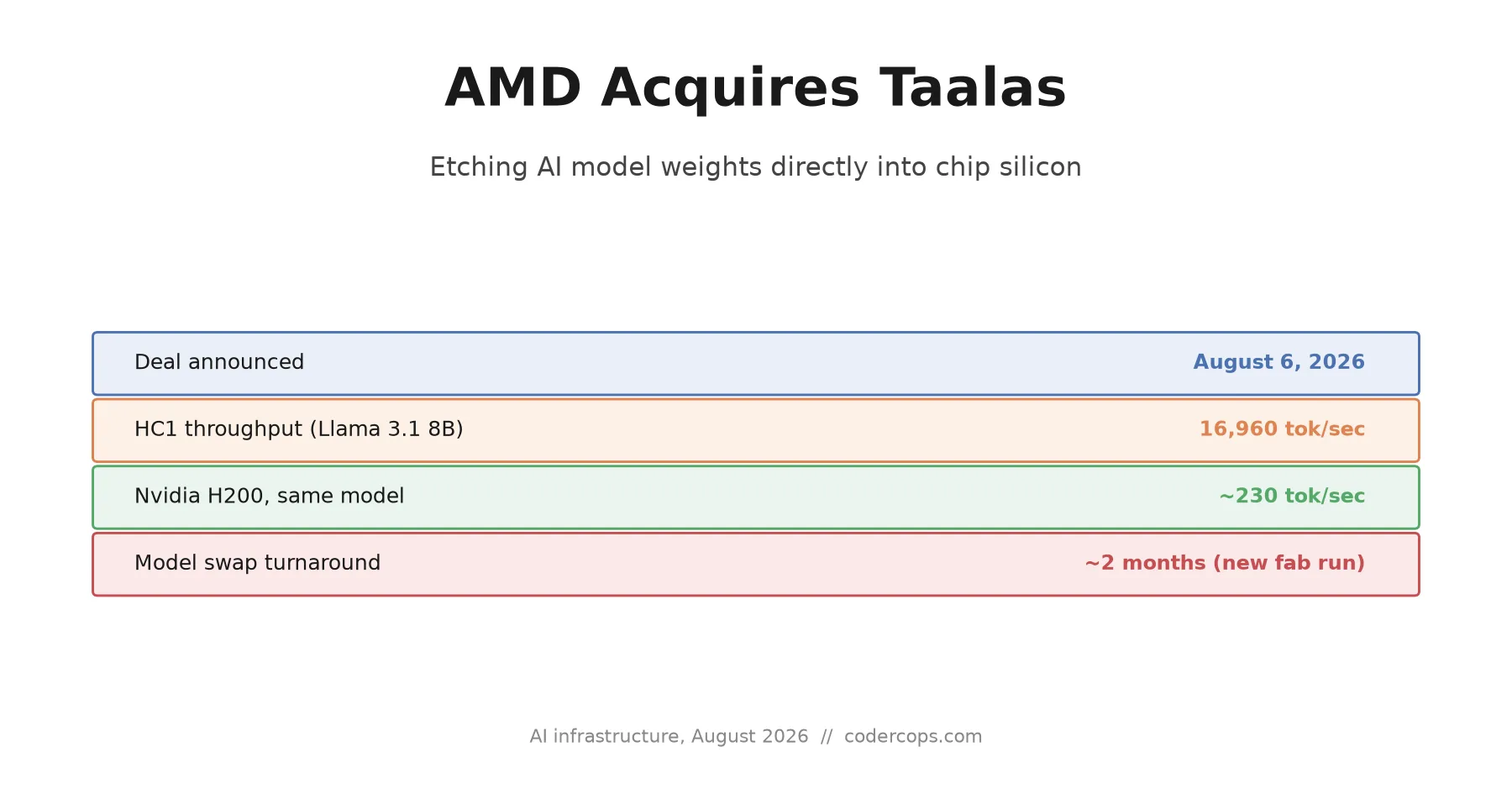
AMD acquired Taalas on August 6, a startup that hardwires model weights directly into chip silicon instead of loading them from memory. Here's what that trade-off means for inference cost, and why it can't replace your GPU fleet.

Prathviraj Singh
6 min read
Sponsored
AMD’s biggest AI announcement this month wasn’t a new GPU. On August 6, it bought Taalas, a Toronto startup with a strange pitch: stop loading model weights into a chip and start manufacturing the weights as the chip. The numbers behind that pitch are large enough to be worth understanding, and narrow enough that they won’t change what you build this year.
What Taalas actually does
Every GPU or TPU running an LLM today separates the chip from the model. The silicon is general-purpose; the weights live in high-bandwidth memory and get streamed in during inference. That separation is why one GPU can run Llama, then Qwen, then your own fine-tune, with nothing but a config change.
Taalas throws that separation away. Its chips, which it calls model-specific integrated circuits, hardwire a model’s weights into roughly the top two layers of a roughly 100-layer fabrication stack. The rest of the chip, the transistor logic that does the actual computation, stays the same across models. Only the layers encoding the weights change. Taalas says that lets it go from a customer’s model weights to a shippable inference chip in about two months, fast for a custom ASIC, glacial next to swapping a model file on a GPU server.
The payoff for giving up that flexibility is that the chip never has to move weights across a memory bus at inference time. Memory bandwidth, not raw compute, is the bottleneck that limits how fast a GPU can generate tokens for a single user. Remove the round trip to HBM and the ceiling moves.
The number that’s driving the coverage
Taalas’s first test chip, the HC1, fabbed on TSMC’s 6-nanometer process, ran Meta’s Llama 3.1 8B at 16,960 tokens per second for a single user. Taalas’s own comparison puts an Nvidia H200 running the same model at roughly 230 tokens per second under the same conditions, a wide gap on this one published benchmark.
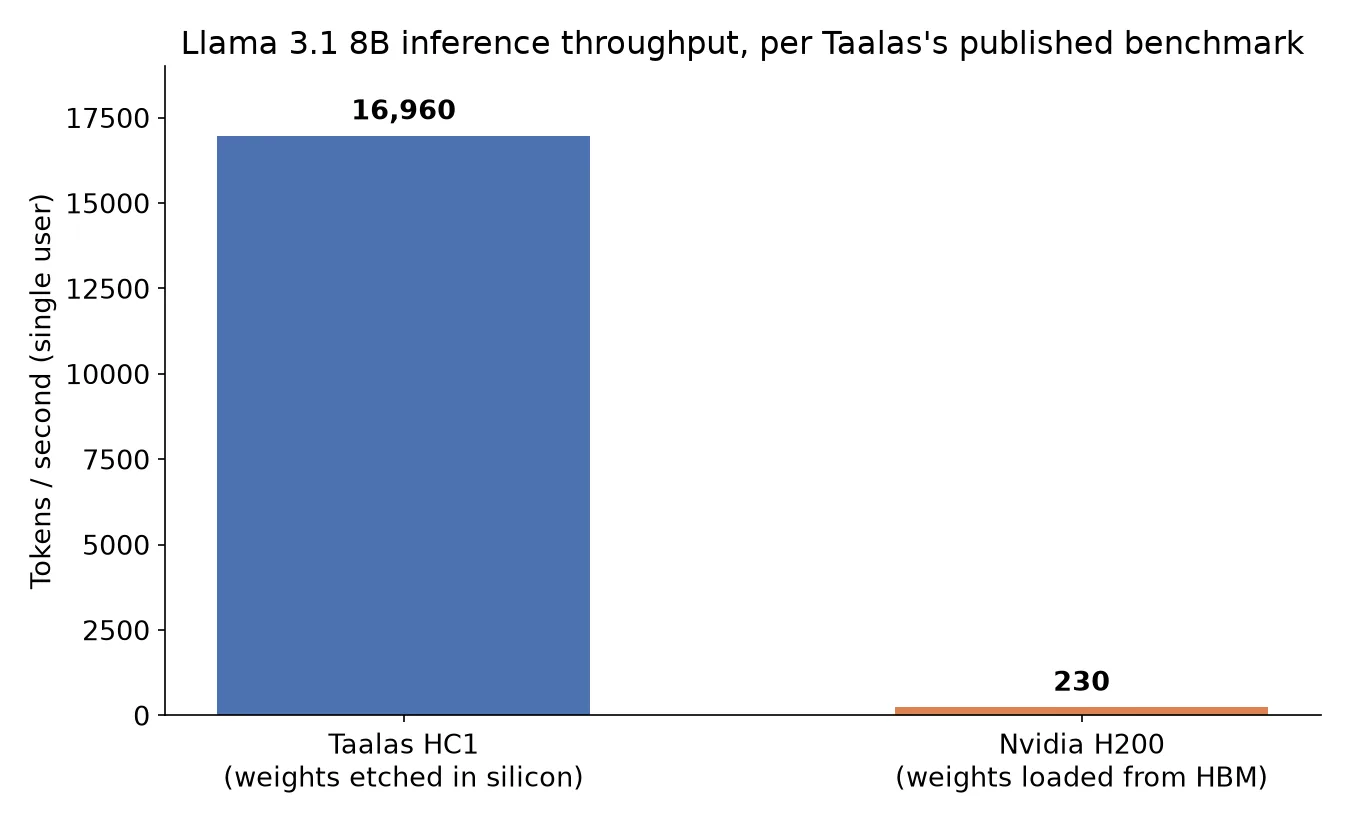
That’s a vendor’s own number on a benchmark it chose, not a third-party evaluation, and it’s worth treating as directional rather than a settled fact about every model or workload. But even discounted for that, the shape of the result lines up with the underlying architecture: eliminating a memory bottleneck for a fixed, known model is exactly the kind of specialization that produces this order of gain. The die itself is substantial: about 815 square millimeters holding roughly 53 billion transistors, using a custom 3-bit and 6-bit mixed-precision data format rather than the 16-bit or 8-bit formats most GPU inference stacks use.
The trade that makes this a niche play, not a GPU replacement
Here’s the part that gets lost in a 74x headline number: the same design choice that removes the memory bottleneck also removes the thing that makes a GPU a GPU. You cannot fine-tune a Taalas chip’s model, load a different model onto it, or patch a bug in the weights without a new mask set and another trip through the fab. For a startup iterating on prompts and model versions weekly, that’s disqualifying. For the handful of companies running one model at enormous, stable volume, it might not matter at all.
That’s the actual market Taalas is chasing, and it’s a real one, just a smaller one than the headline suggests. A large consumer product serving the same fine-tuned model to hundreds of millions of requests a day cares more about cost per token and latency than about swapping models on a Tuesday. A company still iterating on which model to use, or fine-tuning weekly, gets nothing from a chip that takes two months to update.
Why AMD wanted it
AMD’s existing roadmap competes with Nvidia on general-purpose AI silicon: bigger GPUs, more memory bandwidth, better software stack. Taalas is a different bet layered on top of that, not a replacement for it. It’s a hedge on a specific, high-value slice of the inference market: hyperscalers and large AI product companies running a small number of models at volumes where a two-month fab cycle and the loss of flexibility are acceptable costs against a meaningful drop in cost per token. The framing several outlets have used, comparing this to Nvidia’s licensing arrangement with Groq, is apt: both moves are about locking in a piece of high-volume, low-flexibility inference before a competitor does.
What this actually means for a team shipping AI features today
Nothing changes about how you should architect an inference stack this quarter. This is early-stage acquisition news about a chip built for one open-weight 8B model as a proof of concept, not a production option you can buy or rent yet. The useful takeaway isn’t “prepare to deploy on model-specific silicon.” It’s narrower and more actionable:
- Watch which models get this treatment first. If Taalas-under-AMD ships hardware for a widely used open-weight model at real availability and price, that’s the signal a broader shift is starting, not the acquisition announcement itself.
- This validates memory bandwidth as the real cost driver, not compute. Even without touching Taalas hardware, that’s worth internalizing when you’re choosing between GPU instance types for your own inference workload: the bottleneck you’re paying for is usually bandwidth, not FLOPs.
- If you run one model at genuinely massive, stable volume, this is worth tracking closely over the next year. Everyone else can treat this as infrastructure news, not a roadmap item.
The interesting question isn’t whether silicon-etched inference beats a GPU on one vendor benchmark. It’s whether enough workloads are stable and high-volume enough to justify the two-month iteration cost across an entire industry that has spent the last three years optimizing for the opposite: shipping a new model version every few weeks. Right now, that’s a bet on a narrow slice of the market, and AMD just paid to find out if it’s right. If your team is weighing inference architecture decisions for a production AI product, our infrastructure team can help you work through the actual cost tradeoffs for your workload rather than the vendor benchmark.
Frequently asked questions
- What did AMD actually acquire when it bought Taalas?
- A Toronto-based AI chip startup that manufactures application-specific integrated circuits, or ASICs, with a model's weights etched directly into the silicon's transistor layout rather than stored in external memory and loaded at inference time. AMD gets the design team, the fabrication approach, and the intellectual property behind chips like Taalas's HC1 test part.
- How is this different from a GPU or a TPU?
- A GPU or TPU is general-purpose hardware: it loads whatever model weights you give it from memory (HBM) and runs the same silicon for any model. Taalas's chips are the opposite: the weights are part of the physical chip, changed only by altering the top two of roughly 100 fabrication layers and running a new batch through the fab. That trade removes memory-bandwidth bottlenecks entirely, at the cost of losing the ability to swap models without new hardware.
- Is this actually faster than a GPU?
- On the one benchmark Taalas has published, yes, by a wide margin. Its HC1 chip served Meta's Llama 3.1 8B at 16,960 tokens per second, compared to roughly 230 tokens per second Taalas reports for an Nvidia H200 running the same model. That's a vendor-published number on a specific model and workload, not an independent, apples-to-apples benchmark across the industry, so treat the multiple as directional rather than a guaranteed result for any model you'd run.
- Should we plan to run our models on this kind of hardware?
- Not yet, and for most teams, not ever. This only makes sense for a stable model run at very high volume, where a roughly two-month turnaround to bake in a new version is an acceptable cost. If your model changes every few weeks, or your volume doesn't justify a dedicated fab run, GPU or cloud API inference remains the right answer, and will for the foreseeable future.
- Why would AMD want this instead of just building faster GPUs?
- AMD's GPU roadmap competes with Nvidia head-on for general-purpose inference and training. Taalas is a different bet: a small number of very large customers running one model at massive, sustained volume, where a purpose-built chip can beat any general-purpose GPU on cost per token. It's a hedge on a specific slice of the inference market, not a replacement for AMD's existing GPU line.
Sources
Sponsored
More from this category
More from Cloud & Infrastructure
 R.01
R.01 Leader Election Explained: How a Cluster Picks Who's in Charge
 R.02
R.02 Structured Logging Done Right: JSON, Correlation IDs, and What to Skip
 R.03
R.03 How Database Indexes Actually Work (And When They Make Queries Slower)
Sponsored
Discussion
Join the conversation.
Comments are powered by GitHub Discussions. Sign in with your GitHub account to leave a comment.
Sponsored