Web Development · JavaScript Frameworks
Is Qwik Production-Ready? Resumability Explained, Honestly
Qwik skips hydration entirely instead of optimizing it, and Qwik 2.0 makes that model cheaper to use. Here's how resumability actually works, what changed in 2.0, and the real tradeoffs before you pick it for a production app.

Anurag Verma
5 min read
Sponsored
Every mainstream JavaScript framework in 2026 ships less JavaScript than it used to. Astro shipped islands. React shipped Server Components. Next.js keeps trimming its client bundle with every release. Qwik took a different position from the start: instead of optimizing hydration, it tries to skip it entirely. That’s the whole pitch, and it’s worth understanding precisely before deciding whether it belongs in a production stack, because “skip hydration” sounds like marketing until you see what it actually changes about how the app runs.
Hydration, and why Qwik doesn’t do it
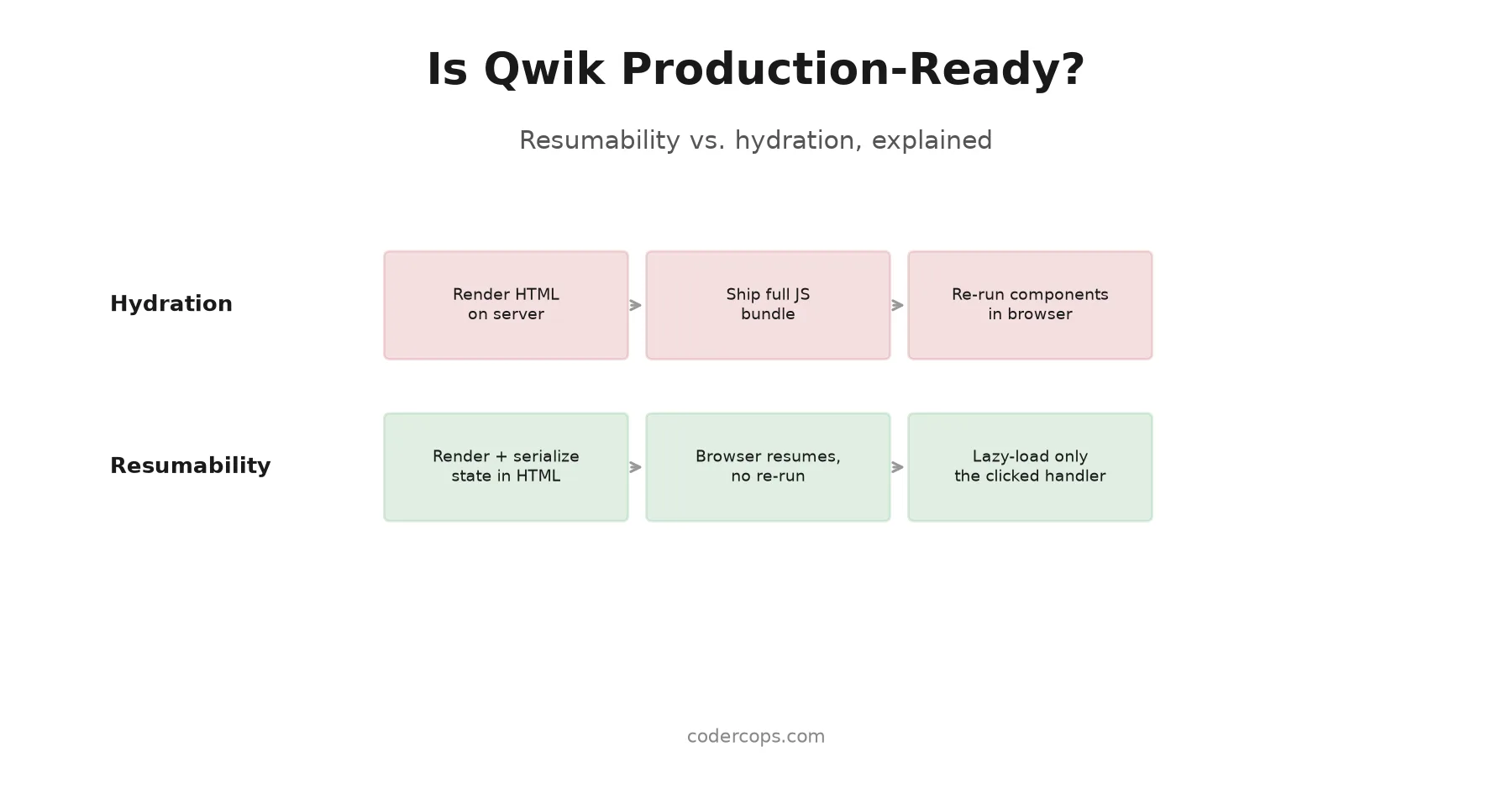
Server-side rendering sends a browser a fully formed HTML page, which is why it looks instant. The catch is that the page is inert. Buttons don’t work, forms don’t submit, nothing responds to a click until the framework’s JavaScript downloads, parses, and re-executes the same component logic that already ran once on the server, this time in the browser, to rebuild state and wire up event listeners. That re-execution is hydration, and it’s expensive in proportion to how much of the page is interactive, which is why frameworks spend so much effort trying to shrink or defer it.
Qwik’s answer is to not do that step. When Qwik renders on the server, it serializes what it already knows, component state, and critically, exactly where each event listener needs to attach, directly into the HTML as data attributes. The browser doesn’t need to re-run any component code to figure out “what happens when this button is clicked,” because that information already shipped in the markup. When a user actually clicks something, the browser looks up the tiny, specific chunk of JavaScript responsible for that one handler, fetches it, and runs it. Nothing else on the page gets touched.
<!-- Simplified: a Qwik button with its handler location serialized into the HTML -->
<button on:click="./chunk-a1b2c3.js#handleClick">
  Add to cart
</button>
The browser never downloads or executes the component that rendered this button until, and unless, someone clicks it. If a user never touches that button, that code never ships. This is the concrete meaning of “resumable”: the app resumes from where the server left off, instead of restarting.
What Qwik 2.0 actually changes
Qwik 1’s resumability model worked, but it wasn’t free. Encoding listener locations and component boundaries into HTML adds markup, and in Qwik 1 that overhead per component boundary was noticeable enough to matter on pages with a lot of small interactive pieces. Qwik 2.0’s stated focus is specifically lowering that cost: encoding the same listener and boundary information more compactly, so a page with many small components doesn’t pay a large HTML tax for it. It’s a targeted optimization of the existing model, not a rewrite, and the team has committed to no breaking changes for code written against Qwik 1.
That matters for the adoption decision. A framework’s second major version rewriting its core model is a signal to wait. A second major version making the existing model cheaper, with a stated backward-compatibility guarantee, is a much lower-risk upgrade for anyone already invested.
The honest tradeoffs
None of this makes Qwik a default choice, and the framework’s own FAQ is fairly direct about where it fits.
Ecosystem and hiring. Qwik’s community and package ecosystem are meaningfully smaller than React’s, Vue’s, or even Svelte’s. If you’re choosing a framework partly on “can we hire for this,” that’s a real cost, not a hypothetical one, and it’s worth reading against a broader framework comparison before committing a team to it.
Debugging model. Resumability means execution doesn’t follow the component tree the way React or Vue developers are used to reasoning about. Figuring out why a specific chunk didn’t load, or why serialized state doesn’t match what you expected, requires understanding the serialization boundary, not just the component code. Tooling here is improving but still behind what React and Vue developers take for granted.
Deployment. Hosting platforms have fewer purpose-built adapters for QwikCity than they do for Next.js or Astro, so deployment sometimes needs more manual configuration than teams expect from a modern meta-framework.
When it’s actually worth it
Qwik earns its complexity on pages where interactivity is spread thin across many components and initial load time is the metric you’re optimizing hardest, content-heavy sites, e-commerce catalogs, marketing pages with scattered widgets, where a conventional framework would hydrate a large tree to activate a handful of small interactions. On an internal dashboard that’s mostly interactive from the first pixel, the resumability advantage shrinks and the ecosystem gap starts to dominate the decision.
The direct answer to “is Qwik production-ready” is yes, for the specific case it was built for, with the specific costs listed above. It’s not a faster React. It’s a different bet on where JavaScript cost should live, and Qwik 2.0 makes that bet cheaper to place without changing what you’re actually betting on.
Frequently asked questions
- What does resumability actually mean?
- It means the browser can pick up exactly where the server left off without redoing any of the server's work. A traditional SSR framework renders HTML on the server, then ships JavaScript that re-runs on the client to rebuild component state and attach event listeners, which is hydration. Qwik instead serializes the application's state and listener locations directly into the HTML, so when a user interacts with the page, the browser fetches and runs only the small piece of JavaScript needed to handle that specific interaction. Nothing gets rebuilt from scratch.
- Is Qwik actually production-ready in 2026?
- Yes, for teams whose use case matches its strengths. Qwik and QwikCity have been stable since 1.0, several companies run it in production, and Qwik 2.0 is a compatibility-focused release rather than a rewrite. The caveats are ecosystem size and team familiarity, not runtime stability.
- What changed in Qwik 2.0?
- The primary focus is lowering the HTML and runtime cost of resumability at component boundaries. Earlier versions encoded listener locations and state in a way that added meaningful markup overhead per component; 2.0 encodes the same information more efficiently, with no breaking changes for existing Qwik 1 code.
- How is Qwik different from React Server Components or Astro's islands?
- Astro's islands architecture ships zero JavaScript by default and hydrates only the specific interactive components you mark, but those marked islands still hydrate the normal way once their JavaScript loads. React Server Components move rendering work to the server but the client tree that does ship still hydrates conventionally. Qwik is the only one of the three that avoids hydration as a concept entirely, for the whole app, not just the parts you opt into.
- What's the biggest practical downside of choosing Qwik right now?
- Hiring and tooling. The talent pool of developers who already know Qwik's serialization model is small compared to React or even Svelte, which lengthens onboarding. Debugging lazy-loaded chunks and reasoning about serialization boundaries also has a steeper learning curve than debugging a conventional component tree, and IDE support lags what React and Vue developers are used to.
Sources
Sponsored
More from this category
More from Web Development
 R.01
R.01 Webhook Design: Signatures, Retries, and Idempotency Done Right
 R.02
R.02 Node.js Is Moving to One Major Release a Year. What That Means for Your Upgrade Plan
 R.03
R.03 WebMCP: How Chrome Lets a Website Expose Its Own Tools to AI Agents
Sponsored
Discussion
Join the conversation.
Comments are powered by GitHub Discussions. Sign in with your GitHub account to leave a comment.
Sponsored