Business · Compliance
The EU AI Act's Article 50 Deadline: What to Fix
Chatbot disclosure, deepfake labeling, and AI content transparency became enforceable on August 2, 2026, with fines to €15M or 3% of turnover. A checklist.

Anurag Verma
5 min read
Sponsored
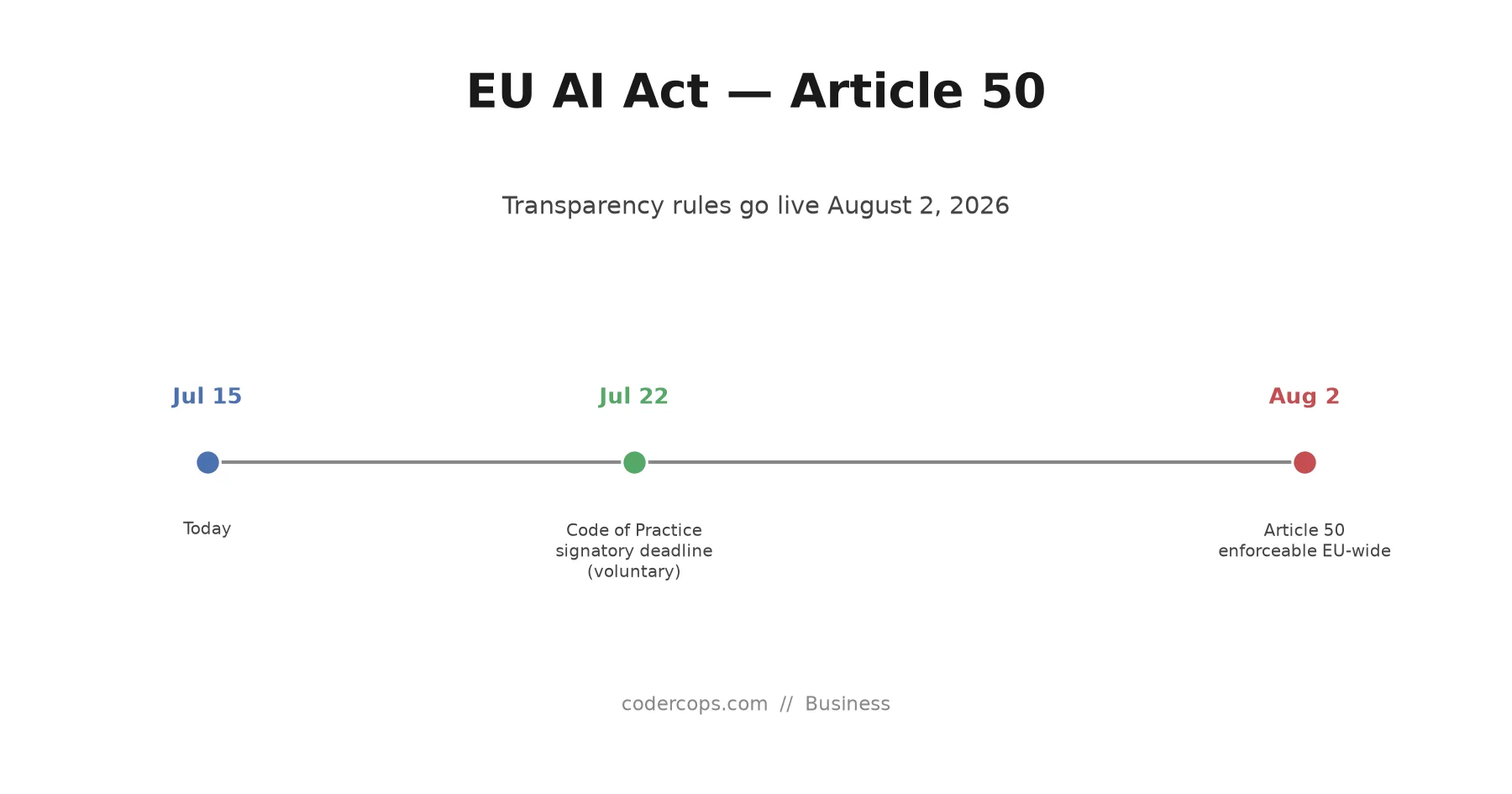
If your product has a chatbot, generates images or video, or produces AI-written text that reaches users in the European Union, you have about two and a half weeks before Article 50 of the EU AI Act stops being a compliance roadmap item and starts being an enforceable law. The obligations go live August 2, 2026, across all 27 member states, and the penalties (up to €15 million or 3% of global annual turnover) apply regardless of where your company is headquartered.
This isn’t the AI Act’s high-risk-system regime, which has its own separate and much heavier compliance burden, and which got real breathing room this year when the Digital Omnibus pushed standalone high-risk obligations from August 2026 to December 2027. Article 50 is a different, narrower track that the omnibus delay did not touch. It’s about disclosure, telling people when they’re talking to a machine or looking at synthetic content, and it’s still on its original schedule. If you read the high-risk delay news and assumed the whole Act got pushed back, that’s the mistake to fix before August 2. Article 50 is narrower and more mechanical than the high-risk regime. That narrowness is exactly why it’s easy to underestimate. It reads like a UX tweak. Missing it is a fine.
The four things Article 50 actually covers
Chatbots and conversational AI. Any system designed to interact directly with a person in a way that could plausibly be mistaken for a human must disclose that fact at the first point of contact. Not in a footer link. Not in terms of service. The disclosure needs to be visible or audible before or as the interaction begins.
Emotion recognition and biometric categorisation. Systems that infer emotional state or biometric categories (whether someone appears distressed, their inferred age range, and similar signals) must tell the people being analyzed that this is happening.
Deepfakes and synthetic media. AI-generated or manipulated audio, image, or video content that resembles real people, places, or events needs a disclosure that a reasonable person would actually notice, whether that’s a persistent visual label, an opening disclaimer for video, or an audible cue for audio.
AI-generated text on matters of public interest. Text generated or manipulated by AI that informs the public on matters of public interest needs disclosure that it’s AI-generated, unless a human has reviewed and taken editorial responsibility for the content.
Why “we have a privacy policy” isn’t compliance
The most common mistake product teams are likely to make here is treating this like a documentation requirement instead of a UX requirement. A chatbot disclosure buried in an FAQ page technically exists, but it doesn’t meet “clearly informed… at the first point of contact.” The guidance from the European Commission points toward layered disclosure: a plain-language notice, plus a persistent visual indicator for ongoing interactions, plus audio cues where relevant.
For a support chatbot, that likely means a visible “You’re chatting with an AI assistant” banner at the start of the session, not just a one-time modal a user can dismiss and never see again. For AI-generated marketing images that resemble real people, it means a label that survives being screenshotted and shared, not metadata that only shows up if someone inspects the file.
The July 22 signatory deadline is separate and voluntary
There’s a second date worth knowing about that’s easy to confuse with the enforcement date: July 22, 2026, a deadline to sign the EU’s voluntary Code of Practice for AI content transparency. Signing gives companies a safe-harbor compliance pathway with clearer, pre-approved implementation guidance. It’s not mandatory, and not signing doesn’t exempt anyone from the underlying legal obligation that starts August 2. But for teams still deciding how to implement disclosure, the Code of Practice is worth reading before you build your own approach from scratch, since it’s the closest thing to an official implementation checklist that exists right now.
A practical checklist before August 2
| Area | Question to ask | Action if the answer is “yes, and we haven’t handled it” |
|---|---|---|
| Chatbot / assistant | Does it interact with EU users in a way that could be mistaken for a human? | Add a clear, persistent AI disclosure at session start |
| Generated images/video | Could outputs be mistaken for real people, places, or events? | Add a visible label that survives sharing/screenshotting |
| Generated audio | Could outputs be mistaken for a real person’s voice? | Add an audible disclosure at the start of playback |
| Generated text/content | Does it inform the public on matters of public interest without human editorial review? | Disclose AI generation, or add a human review step that takes editorial responsibility |
| Emotion/biometric inference | Does your system infer emotional state or biometric categories from users? | Disclose this to the people being analyzed |
Most teams building on top of the major LLM APIs already have the underlying capability to add this disclosure; the gap is almost always product decision-making, not engineering effort. If you’re scoping this work and want to make sure the disclosure implementation actually satisfies “clearly informed at first point of contact” rather than just checking a box, that’s a conversation worth having with legal counsel alongside your product team, not engineering alone.
What this means if you’re shipping AI features fast
Teams that have been moving quickly on AI features, which is most teams right now, are the ones most likely to have shipped a chatbot or content-generation feature without thinking through EU-specific disclosure requirements, because the requirement didn’t exist when the feature launched. If you’re auditing your product surface against this deadline and need engineering capacity to implement disclosure UX correctly across every affected touchpoint before August 2, that’s exactly the kind of focused, time-boxed work our team takes on. Waiting until after the enforcement date to find out you missed a surface is the expensive way to learn about Article 50.
Frequently asked questions
- Does Article 50 apply to my product if my company isn't based in the EU?
- Yes. Like most EU AI Act provisions, Article 50 applies based on where the AI system's output reaches users, not where the provider is headquartered. If EU users interact with your chatbot, see AI-generated content from your product, or could be shown synthetic media you generated, the obligation applies to you.
- What counts as a chatbot for this rule?
- Any AI system designed to interact directly with a natural person in a way that could reasonably be mistaken for human interaction, including customer service bots, virtual assistants, and autonomous AI agents that converse with users. The disclosure needs to happen at the first point of contact, not somewhere the user has to go looking for it.
- What's the actual penalty if I miss the deadline?
- Up to €15 million or 3% of global annual turnover, whichever is greater. That's a lower tier than the AI Act's penalties for prohibited-practice violations, but it's still a meaningful enforcement risk for any company with EU revenue, and it scales with company size rather than being a flat fee.
- Is there a grace period after August 2?
- The obligations become legally binding on that date. There is a separate, voluntary Code of Practice with a July 22, 2026 signatory deadline that offers a safe-harbor compliance pathway for companies that commit to it, but signing isn't mandatory and missing it doesn't exempt you from the underlying legal requirement.
Sources
Sponsored
Sponsored
Discussion
Join the conversation.
Comments are powered by GitHub Discussions. Sign in with your GitHub account to leave a comment.
Sponsored