Technology · Mobile
Google Play Now Hosts Rival App Stores
Since July 22, 2026, third-party stores can list your Android app inside Google Play unless you opt out. How enrollment works and what to check now.

Aman Chaudhary
4 min read
Sponsored
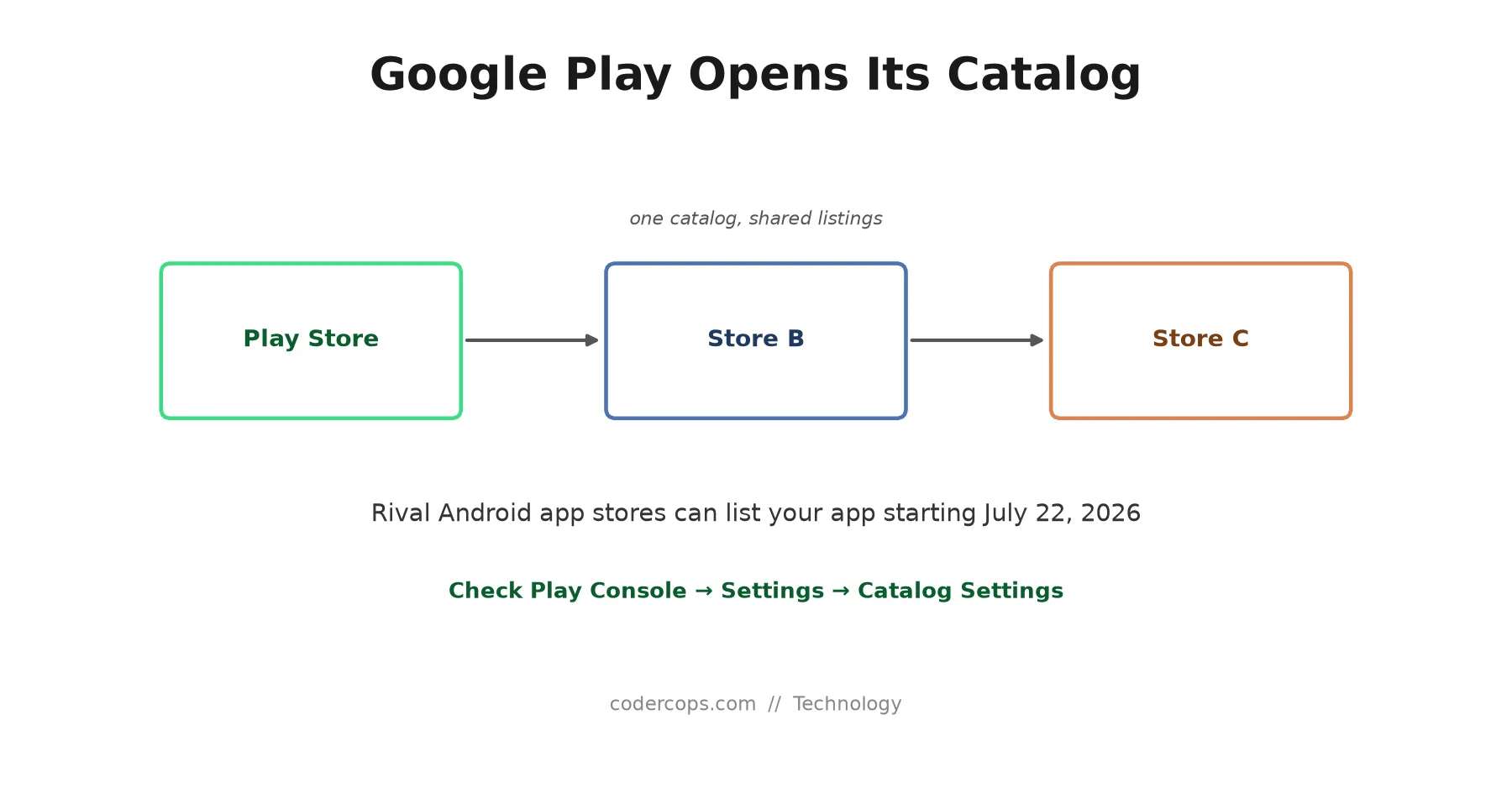
If you publish an Android app in the US and haven’t touched Play Console this month, your listing is probably already sitting inside a rival app store. Starting July 22, 2026, Google began carrying third-party storefronts inside the Play Store catalog itself, and the default for developers is opt-in, not opt-out. Silence means you’re enrolled.
What actually launched
This is the court-ordered remedy from Google’s antitrust loss to Epic Games. A December 2023 jury found Google’s control over Android app distribution broke federal and California antitrust law. After Epic and Google jointly withdrew an earlier settlement attempt in mid-July, this enrollment program is what replaced it, and it went live for US users on July 22.
The mechanism is narrower than “Android now has open app stores,” which is the headline version most people will hear. What actually happens: third-party storefronts can enroll with Google, and once enrolled, they get access to the names, icons, descriptions, screenshots, and other listing metadata of apps published on Google Play. They can then offer those apps to their own users. Google still handles the download and install itself, even when the discovery happens through a rival store’s interface. It’s catalog sharing bolted onto Google’s existing install pipeline, not a rival store hosting and serving your APK independently the way F-Droid or the Samsung Galaxy Store do today.
The setting you need to check this week
Every US-listed app and game becomes available to enrolled third-party stores automatically. Developers who want a different outcome have to go find the control:
Play Console → Settings → Catalog Settings
Three options live there:
| Option | What it does |
|---|---|
| Publish to all enrolled stores | Default behavior if you do nothing |
| Manage access per store | Approve or block individual third-party stores |
| Opt out entirely | Your listing metadata is not shared with any enrolled store |
If your team hasn’t reviewed this setting, the honest assumption is that your current listing is already syndicated to whichever stores have enrolled so far. That’s worth five minutes today, not next sprint.
What it costs a rival store to plug in
This isn’t free for the storefronts either, which tells you something about how Google structured the remedy to still control who gets in. Operators pay a $5,000 onboarding fee plus $5,000 annually, which Google frames as funding security and policy review. Enrolled stores also have to keep malware below 1% of install attempts to stay in the program. That bar filters out fly-by-night storefronts, but it also means the “opening” is closer to a licensed integration than an open door.
Why this matters beyond the headline
For most individual developers, the practical effect on day-to-day work is small right now. Your build pipeline doesn’t change, your signing keys don’t change, and your revenue split with Google on purchases made through Google’s own checkout doesn’t change either. What does change is discoverability: your app can now show up in a storefront you never submitted it to, with a description and screenshots you wrote for a different context.
That’s the detail worth flagging to clients if you run an agency handling Android apps. A few things worth doing in the next release cycle:
- Confirm the Catalog Settings choice matches what the client actually wants, rather than defaulting to whatever Google set.
- Re-check your app’s screenshots and description with the assumption they’ll be shown in an unfamiliar storefront’s UI, not just Google Play’s.
- If the app handles anything regulated (health data, payments, minors), the opt-out is probably the safer default until the client’s legal team has looked at what “1% malware tolerance” means for stores carrying their brand.
This sits next to the broader distribution questions agencies already field from clients when scoping a new Android build: where an app lives isn’t just a technical decision anymore, it’s a policy one that changes under you without a deploy.
The bigger story is that Android’s walled garden just got a door cut into it by a court, not by Google’s own roadmap. Expect more enrollment activity, more storefronts testing the malware threshold, and more of these settings mattering over the next year than they do this week. Check Catalog Settings before your next release, and don’t assume “we didn’t change anything” means nothing changed.
Frequently asked questions
- Do I have to do anything for my app to end up on a third-party store?
- No, and that is the point to notice. As of July 22, 2026, eligible US app and game listings are automatically made available to enrolled third-party stores unless you explicitly opt out. If you have not touched this setting, assume your listing is already shared.
- Where do I control this as a developer?
- In Play Console under Settings > Catalog Settings. You can publish all listings to every enrolled store, manage access on a per-store basis, or opt out of the program entirely.
- What can a rival store actually do with my app?
- It can surface your app's name, icon, description, screenshots, and other listing metadata to its own users and offer the app for install. Google still handles the underlying install mechanics, so this is closer to catalog syndication than a rival store hosting your APK independently.
- Why is Google doing this now?
- It is a court-ordered remedy. A December 2023 jury found Google's control over Android app distribution violated federal and California antitrust law in Epic Games' suit. Epic and Google jointly withdrew an earlier settlement attempt, and this enrollment program is what took its place, live in the US as of July 22, 2026.
- What does it cost a rival store to plug into Google Play's catalog?
- Store operators pay Google a $5,000 onboarding fee and $5,000 annually, described by Google as covering security and policy reviews. Operators also have to keep malware below 1% of install attempts across their store to remain enrolled.
Sources
Sponsored
Sponsored
Discussion
Join the conversation.
Comments are powered by GitHub Discussions. Sign in with your GitHub account to leave a comment.
Sponsored