Career · Skills
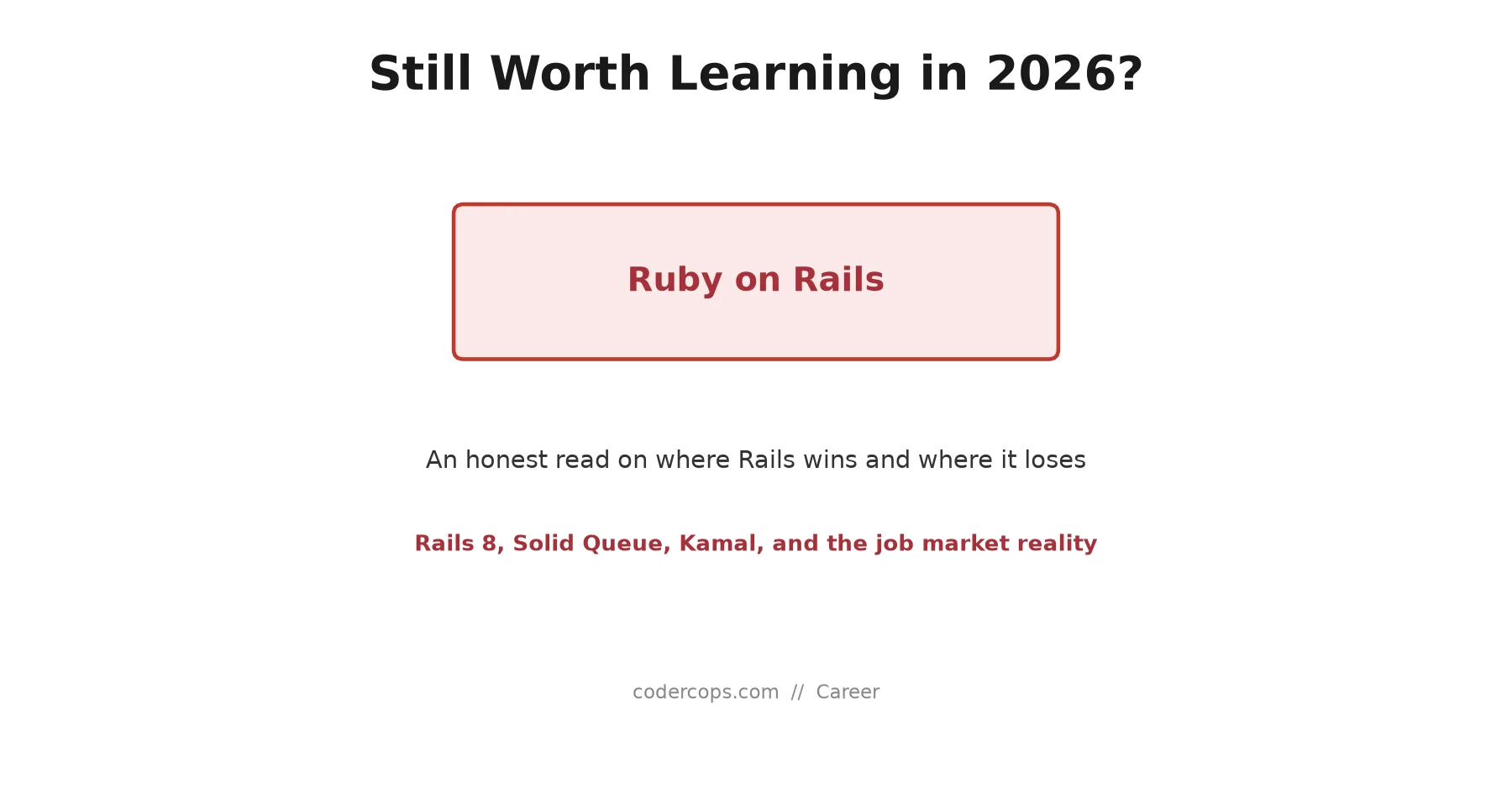
Is Ruby on Rails Still Worth Learning in 2026?
Rails isn't the default startup choice anymore, but it didn't disappear. Where it still wins, where Next.js and Django beat it, and who should learn it.

Abhishek Gupta
5 min read
Sponsored
Rails is worth learning in 2026 if you’re joining a team that already runs it, want to ship a solo project fast without assembling a stack piece by piece, or you value a framework that optimizes for getting something running over giving you granular control. It’s a weaker bet if your only goal is maximizing the number of jobs you can apply to, because that market is simply bigger on the JavaScript side now. Both of those things are true at once, and the honest answer depends on which one applies to you.
The case that Rails lost its moment
Ten years ago “what should I learn first” had an obvious answer for a lot of people: Rails, because it got you from zero to a working app faster than almost anything else, and the job market rewarded that. That specific advantage eroded. Next.js, and more recently full-stack React frameworks generally, offer a similar “batteries included, ship fast” experience, but land you in the language most new developers are already learning for the frontend anyway. Django offers something close to Rails’ philosophy inside the Python ecosystem, which has its own gravity from data and AI work pulling developers toward it.
The job market numbers reflect this. Rails postings are a fraction of what JavaScript full-stack roles post, and that gap widened rather than closed over the past several years. If someone’s entire calculation is “which skill maximizes the number of open roles I qualify for,” Rails is not the answer in 2026, and pretending otherwise doesn’t help anyone make a real decision.
The case that Rails is having a quiet second act
Where Rails picked up ground is less visible than a job board count, but it’s real. A “Returning to Rails in 2026” discussion made the rounds on Hacker News this year, and the argument underneath it wasn’t nostalgia, it was fatigue. Teams that spent several years chasing whatever framework had the most momentum started noticing that Rails, Elixir/Phoenix, and other “boring” stacks kept shipping without anyone rewriting the app every eighteen months. Boring, in this context, is a compliment: it means the framework isn’t the thing eating your sprint.
Rails also got materially better at removing its own dependency sprawl. Rails 8 shipped Solid Queue, Solid Cache, and Solid Cable, database-backed replacements for what used to require standing up Redis and Sidekiq separately for background jobs and caching. For a lot of apps, that’s one less piece of infrastructure to run and pay for. Rails 8 also made Kamal the default deployment path, a tool built by the Rails team specifically to get a containerized app onto a plain server without assembling a PaaS or a Kubernetes setup from scratch. Combined, these changes address the two complaints that used to follow Rails around: too many bolted-on dependencies, and no clear story for deploying outside Heroku once Heroku’s free tier disappeared.
What Rails is still genuinely good at
If you’re building a data-modeling-heavy application, the kind with a lot of interrelated database records and business logic sitting close to that data, Rails’ conventions still save real time. Active Record’s approach to associations, validations, and migrations remains one of the fastest ways to go from schema idea to working CRUD app of any framework in wide use. That’s not a nostalgic claim, it’s the same reason it worked in 2010: the framework makes a lot of decisions for you, and most of those decisions are still reasonable defaults in 2026.
Rails is also a genuinely strong choice for a solo developer or small team shipping a product where velocity matters more than architectural purity. You get authentication, background jobs, caching, and a deployment path without gluing together five separate libraries and reading five separate sets of docs to get there.
| Scenario | Rails fit |
|---|---|
| Joining an existing Rails codebase | Learn it, no real alternative |
| Solo project, want to ship fast | Strong fit |
| Data-modeling-heavy CRUD app | Strong fit |
| Maximizing job application volume | Weak fit, JS-stack roles are more numerous |
| Real-time collaborative frontend-heavy app | Weaker fit than a JS-native stack |
| Team already fluent in Python/Django | Learn Django instead, similar philosophy |
The honest recommendation
If you already work at a company running Rails, or you’re evaluating a job offer at one, learning Rails properly is not optional and it’s not wasted effort. It’s a mature, well-documented framework and the investment pays off inside that job.
If you’re picking your first backend framework with zero external constraints, Rails is a reasonable choice specifically because it teaches you a coherent set of conventions (MVC, migrations, RESTful routing) that transfer conceptually even if your next job uses Django or a Node framework instead. What it won’t do is maximize your options on the job board the way learning the current JavaScript full-stack path will. Decide which of those two things you’re actually optimizing for before you commit the time, because they point in slightly different directions, and both are legitimate answers depending on what you’re trying to get out of the next year.
For agencies advising clients on which stack to greenlight for a new build, the same logic applies at a company level: Rails is a defensible choice for a data-heavy internal tool or a founder-led SaaS that needs to ship fast, and a harder sell when the client’s plan is to hire a large team quickly in a market where Rails talent is a narrower pool than JavaScript talent.
Frequently asked questions
- Is Ruby on Rails dead in 2026?
- No. It's a smaller share of new greenfield projects than a decade ago, but it still powers large, profitable products (Shopify, GitHub, Basecamp) and a substantial number of mid-size SaaS companies that never had a reason to migrate off it. Dead would mean no jobs and no new development. Neither is true.
- Will learning Rails get me a job as easily as learning Next.js or Node?
- Not as easily in raw volume. Rails job postings are fewer than JavaScript-stack postings, but they also have less applicant competition per posting in many markets, and Rails roles skew toward backend-heavy, higher-context positions rather than junior frontend work.
- What changed in Rails that makes it more competitive again?
- Rails 8 shipped with Solid Queue, Solid Cache, and Solid Cable as database-backed defaults, removing the usual requirement to bolt on Redis and Sidekiq separately for a lot of apps. It also shipped Kamal as a default deployment path, which simplifies going from code to a running production app without assembling a separate DevOps stack.
- Who should actually spend time learning Rails right now?
- Developers joining a team that already runs Rails, developers who want to build and ship a solo project fast without assembling a stack from scratch, and backend-focused engineers who want a framework that optimizes for developer productivity over granular architectural control. It's a weaker choice if your primary goal is maximizing job applications in the current market, where JavaScript-stack roles are simply more numerous.
Sources
Sponsored
Sponsored
Discussion
Join the conversation.
Comments are powered by GitHub Discussions. Sign in with your GitHub account to leave a comment.
Sponsored