Business · Hiring
How to Hire a Data Analyst in 2026: SQL, Dashboards, and the Skills That Actually Move Decisions
A data analyst is not a junior data scientist and not a dashboard builder with no opinions. Here's what the role actually requires, how it differs from data scientist and data engineer, and the screen that finds someone whose analysis changes decisions.

Shashikant Gupta
6 min read
Sponsored
A data analyst who can write flawless SQL and still hands back the wrong answer is a common, expensive failure mode, because the SQL was never the hard part. The hard part is figuring out what question actually needs answering, since the business question that gets asked (“why did signups drop?”) and the question that actually matters for the decision on the table (“did the signups we lost matter, or were they low-intent traffic we don’t want anyway?”) are often not the same question at all.
What the role actually is
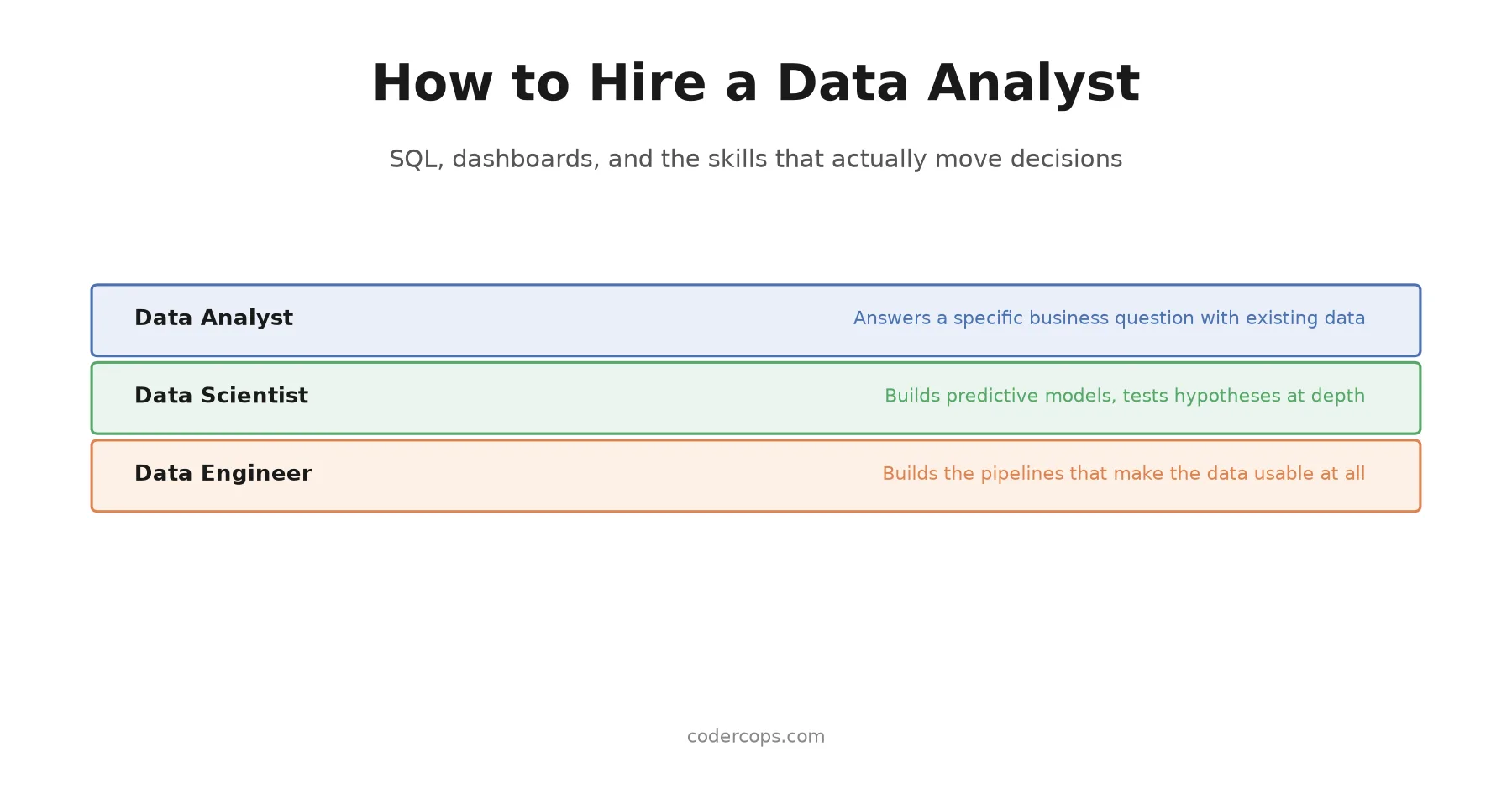
A data analyst turns an existing dataset into an answer to a specific business question, usually on a timeline measured in hours or days, not weeks. That’s meaningfully different from a data scientist, who builds predictive models and runs experiments that may not have a clean existing dataset to draw from and often carries a much longer time horizon. It’s also different from a data engineer, whose job is building and maintaining the pipelines and warehouse structure that make the data analyzable at all, work that happens upstream of anything an analyst touches.
| Role | Core question | Typical timeline | Primary skill |
|---|---|---|---|
| Data analyst | What does the existing data say about this specific decision? | Hours to days | SQL, business context, communication |
| Data scientist | What can we predict, or what does a rigorous test show? | Weeks to months | Statistics, modeling, experiment design |
| Data engineer | How do we make this data reliably available and correct? | Ongoing infrastructure | Pipelines, warehousing, data modeling |
Role confusion between these three is the single most common source of a bad hire in this cluster. Hiring an analyst and expecting data-scientist-level modeling stalls on work they weren’t trained for. Hiring a data scientist and handing them an analyst’s recurring dashboard requests burns out someone whose actual skill set goes mostly unused.
The floor skill is SQL, not a BI tool
A candidate who’s fluent in a drag-and-drop BI tool but can’t write a join from scratch will hit a wall the moment a question doesn’t fit that tool’s built-in assumptions, and in real analyst work, that happens constantly. The floor skill worth screening for directly is SQL: a correctly-scoped JOIN, a window function used appropriately, a CTE that doesn’t silently double-count rows because of an unfiltered join.
-- A reasonable screening question: find each customer's most recent order
-- and flag anyone who hasn't ordered in 90+ days.
WITH ranked_orders AS (
  SELECT
    customer_id,
    order_date,
    ROW_NUMBER() OVER (PARTITION BY customer_id ORDER BY order_date DESC) AS rn
  FROM orders
)
SELECT
  customer_id,
  order_date AS last_order_date,
  CASE WHEN order_date < CURRENT_DATE - INTERVAL '90 days' THEN true ELSE false END AS is_lapsed
FROM ranked_orders
WHERE rn = 1;
A candidate who writes something close to this without much hesitation, and who can explain why ROW_NUMBER() with a partition is the right tool instead of a naive GROUP BY with MAX(order_date), which would lose the rest of that row’s columns, has cleared the actual bar. BI tool proficiency (Looker, Tableau, Power BI, Metabase, whatever the team already uses) is real but genuinely teachable in a few weeks on the job. SQL fluency at this level is a much better predictor of whether that’s true.
The interview signal that actually separates candidates
Give a candidate a deliberately underspecified business question, “why did conversion rate drop last month,” along with a rough sketch of the available tables, and watch what happens before any query gets written.
A weak candidate starts pulling data immediately and returns a number: “conversion dropped 12%.” A strong candidate asks what decision this is actually feeding before touching anything: is this about a specific campaign, a platform-wide trend, one segment? What counts as “conversion” here, and did that definition change recently? What else happened around that time that could be a confound, a pricing change, a site outage, a shift in traffic mix? That sequence of questions, asked before the SQL, is the actual signal. It’s the difference between someone who produces a technically correct number and someone whose analysis is trustworthy enough to change a decision.
This is the same judgment gap that shows up when screening a data engineer for pipeline thinking rather than just SQL syntax, or a data scientist for business judgment rather than just modeling technique: the technical skill is necessary and checkable in twenty minutes, but the judgment about what actually matters is what the interview needs to be built around, not an afterthought bolted onto a coding test.
What a dashboard-building test does and doesn’t tell you
Asking a candidate to build a dashboard from a sample dataset is common, and it’s not a bad exercise, but it’s testing a narrower thing than teams often assume. It tells you whether they know a tool. It doesn’t tell you whether they’d notice a number is wrong before it ships to a VP, whether they’d push back on a dashboard request that’s tracking the wrong metric for the stated goal, or whether they can explain in one sentence why a chart matters to someone who has thirty seconds to look at it.
If a dashboard exercise is part of the process, pair it with a five-minute follow-up: “walk me through why you chose these five metrics over the fifteen other things you could have shown.” The answer to that question is where the actual hiring signal lives, not in whether the chart rendered correctly.
The hire that actually works
The strongest data analyst hires share a pattern that has nothing to do with years of experience or which tool they list first on a resume: they treat a request for a number as a request for context, they ask what decision is riding on the answer before pulling any data, and they’re comfortable saying “that’s not quite the right question” to a stakeholder without turning it into a confrontation. SQL fluency and tool familiarity are the part of the job that’s straightforward to verify and, if the person has decent instincts otherwise, straightforward to build up on the job. The judgment about what actually matters in a pile of numbers is the part worth spending most of the interview on.
Frequently asked questions
- What does a data analyst actually do, day to day?
- Most of the job is turning a business question, why did signups drop last week, which campaign actually drove the revenue lift, into a specific query or set of queries against existing data, then presenting the answer in a form someone can act on. That's usually SQL against a warehouse, sometimes a spreadsheet model, and a chart or short writeup at the end. It is rarely, on its own, building predictive models or designing A/B tests from scratch, that's closer to a data scientist's remit.
- What's the real difference between a data analyst and a data scientist?
- A data analyst answers a specific, usually near-term business question with data that already exists. A data scientist builds models, runs experiments, and answers open-ended questions that may not have a clean existing dataset to draw from, often with a longer time horizon and more statistical depth. The two roles share tools (SQL, Python, sometimes the same BI layer) but the actual work and the kind of judgment required are different enough that hiring for one when you need the other is a common and expensive mistake.
- How much SQL does a data analyst actually need to know?
- Enough to write a correctly-scoped join, a window function, and a CTE without looking them up, and enough to reason about why a query might be double-counting rows before running it, not just after. A candidate who's fluent in a BI tool's drag-and-drop interface but can't write a query from scratch will hit a wall the first time a question doesn't fit the tool's assumptions, which happens constantly in real analyst work.
- What's a good interview question for a data analyst candidate?
- Give them a genuinely ambiguous business question, 'why did conversion rate drop last month', and a rough description of the available tables, and watch what they ask before touching any data. A strong candidate asks what decision this is for, what changed around that time that could be a confound, and what 'conversion' actually means in this context, before writing a single query. A weak candidate starts writing SQL immediately and hands back a number with no framing.
- Is 'can build a dashboard' a good hiring bar for a data analyst?
- It's a necessary skill, not a sufficient bar. Dashboard-building tests tool familiarity, which is real but teachable in weeks. It doesn't test whether someone can figure out which five metrics on that dashboard actually matter for the decision it's meant to support, or whether they'll notice when a number looks wrong before shipping it to a VP. Screen for the judgment first; the tool proficiency is the easier gap to close after hiring.
Sponsored
More from this category
More from Business
 R.01
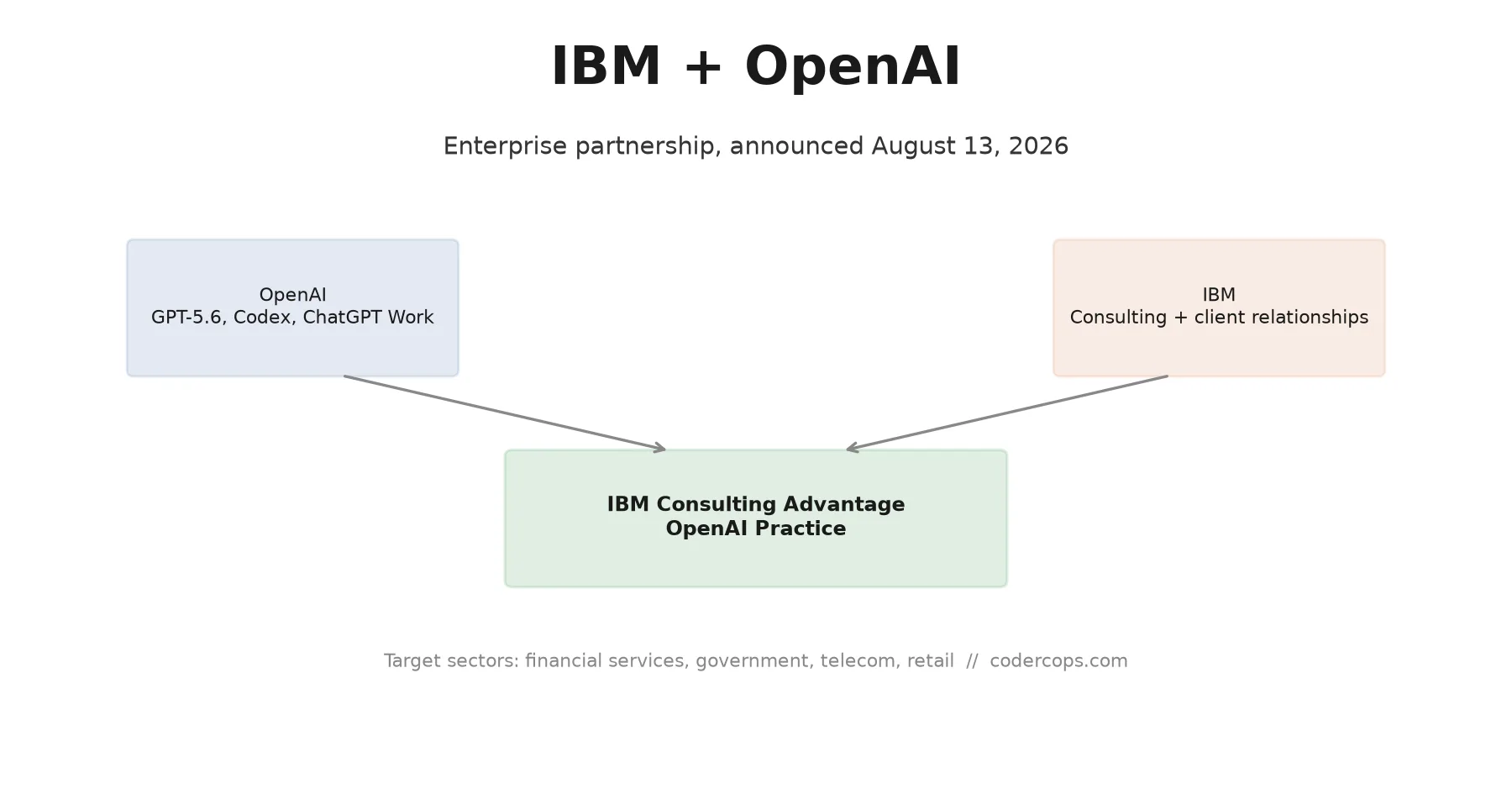
R.01 IBM and OpenAI's Enterprise Deal: What It Means Beyond the Press Release
 R.02
R.02 Arc.dev Alternatives in 2026: When a Curated Marketplace Is and Isn't the Answer
 R.03
R.03 Braintrust Alternatives in 2026: What the No-Fee Model Actually Costs You
Sponsored
Discussion
Join the conversation.
Comments are powered by GitHub Discussions. Sign in with your GitHub account to leave a comment.
Sponsored