Cloud & Infrastructure · AI Infrastructure
Nvidia's $96B Quarter: What GPU Buyers Should Know
Nvidia posted $96.2B in Q2 FY27 revenue, Data Center up 117% to $89B. What the number means if you're the one budgeting GPU capacity this quarter.

Shashikant Gupta
4 min read
Sponsored
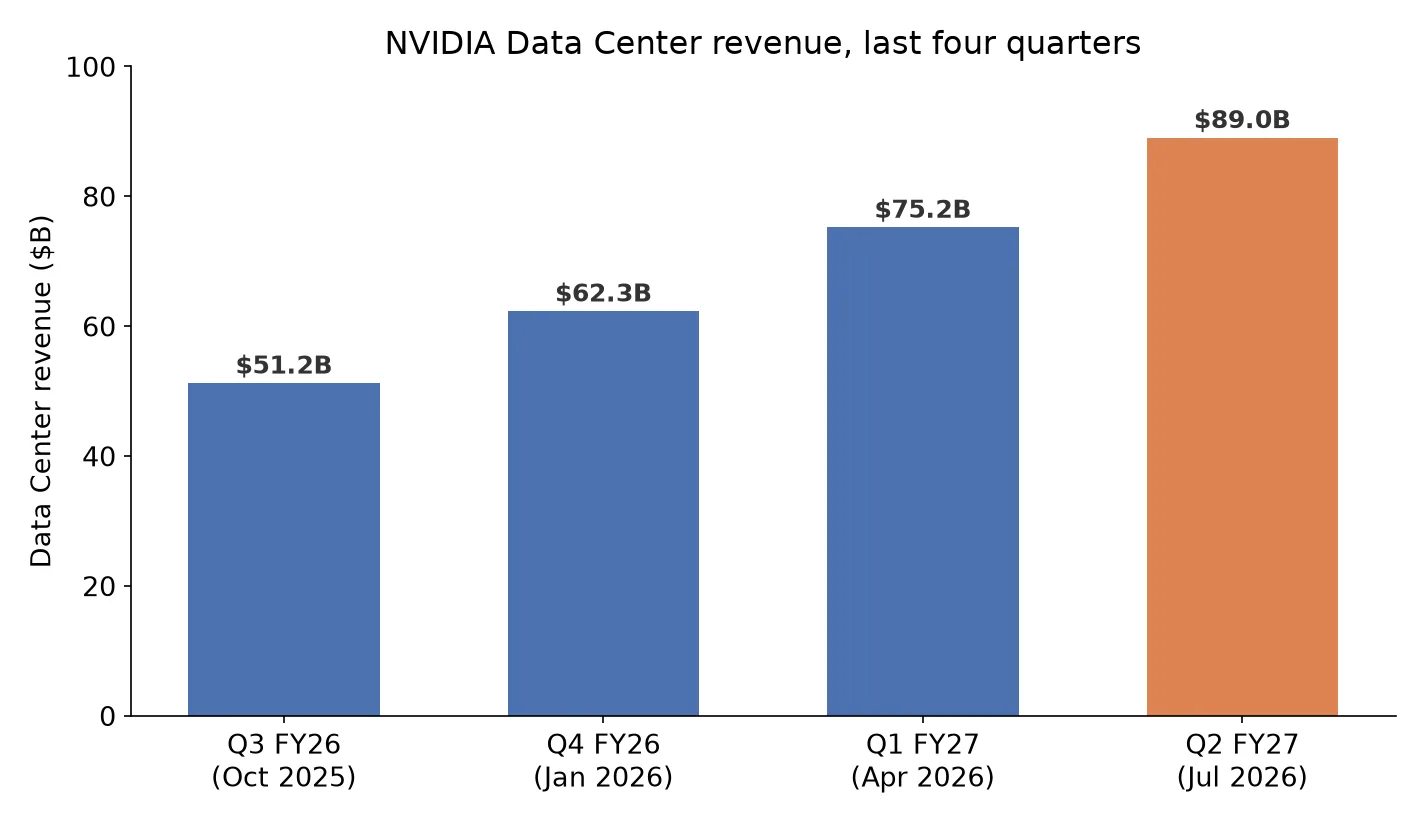
Nvidia reported $96.2 billion in revenue for the quarter ended July 26, 2026, up 106% from a year earlier. Data Center alone was $89.0 billion, 92% of the total, up 117% year over year and 18% from the prior quarter. If you’re the one who has to explain a GPU cloud bill to a finance team this quarter, the headline number matters less than what’s underneath it: the shortage didn’t end, it moved up a generation, and that split is the actual number to plan around.
The number, and what’s driving it
Four straight quarters of acceleration, not a one-time spike:
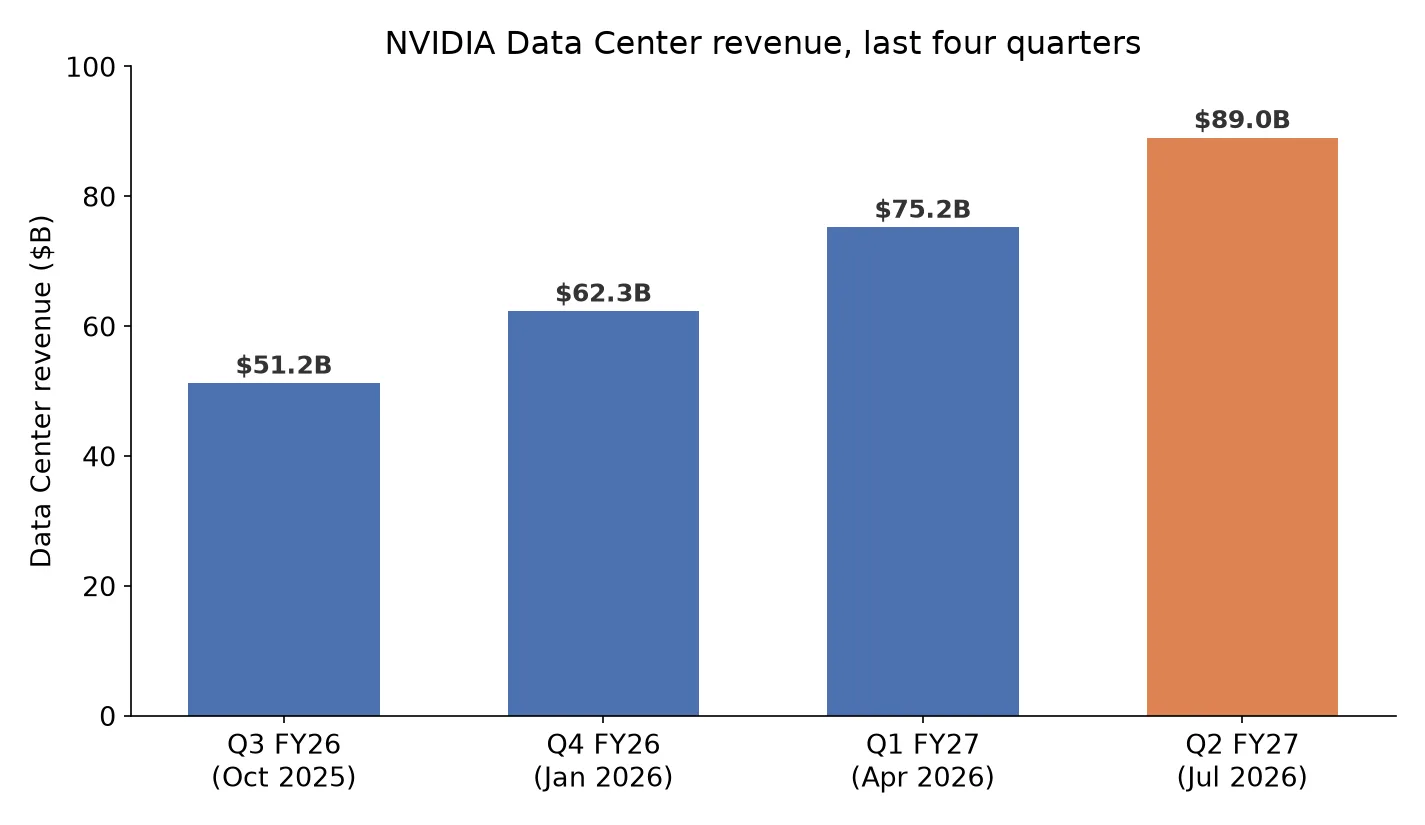
Nvidia’s own guidance says this isn’t slowing down. Q3 FY27 is guided to $108.0 billion, another double-digit sequential jump, and CEO Jensen Huang has raised the company’s long-term data center revenue outlook to $1 trillion through 2027, up from a prior $500 billion forecast. That’s a company telling investors it expects demand to keep outrunning supply for at least another year, and the reason is specific: Vera Rubin, Nvidia’s next platform after Blackwell, is ramping into full production right now, with racks already live at CoreWeave, Google Cloud, Azure, Oracle Cloud Infrastructure, and Nebius, and Nvidia expects it to contribute roughly 20% of this quarter’s Data Center revenue already.
Why this splits the market in two
Here’s the part that actually changes a procurement decision: the “GPU shortage” story from the last few years wasn’t really about GPUs in general, it was about the newest generation specifically, and that pattern is repeating exactly on schedule.
H100-class capacity has genuinely loosened. Lead times for new H100 deployments have fallen from the 50+ weeks reported in 2023 down to roughly 6-12 weeks industry-wide, and cloud spot pricing for H100 instances has dropped sharply, into the $1.20-1.80/hour range in parts of this year on some providers, well below where it sat twelve months ago. Providers are sitting on inventory of last-generation silicon and want to move it.
Blackwell and Vera Rubin-class capacity tells the opposite story. Lead times for new Blackwell deployments still stretch out months, and reports of providers fighting to secure B200 spot instances at premium rates are common. Every rack a provider allocates to standing up Vera Rubin is a rack not available for anything else, and Nvidia’s own commentary makes clear that migration is happening as fast as the supply chain allows, not faster.
| If your workload needs… | Current market | What to do |
|---|---|---|
| H100/H200-class training or inference | Loosening, prices down, lead times ~6-12 weeks | Negotiate reserved capacity now, you have leverage |
| Blackwell/B200-class capacity | Tight, premium spot pricing, longer lead times | Book ahead, budget for scarcity pricing |
| Vera Rubin-class (newest) | Ramping, allocated to hyperscaler and neocloud partners first | Plan for a queue measured in months, not weeks |
What this means for a procurement decision this quarter
The instinct to default to “the newest available GPU” is expensive and usually unnecessary. Most training and inference workloads that aren’t pushing the frontier of model scale run perfectly well on H100 or H200-class hardware, and that’s exactly the tier where the market has turned in the buyer’s favor. If your team has been putting off a reserved-capacity conversation because the last two years of headlines were all shortage and premium pricing, this quarter’s numbers say that conversation is worth having again, specifically at the previous-generation tier.
If your workload genuinely requires the newest silicon, this earnings report is a reason to start procurement earlier, not later. A $1 trillion long-term revenue outlook from the vendor itself is Nvidia telling you, in the clearest way a public company can, that it expects demand for the leading edge to keep exceeding what it can ship. Waiting for prices to soften at that tier the way they did for H100 assumes the same multi-year supply catch-up will repeat before your project needs the hardware, and the last two ramps didn’t move that fast.
The same logic that applies to comparing AI chip options across vendors applies here: match the tool to the actual requirement rather than the newest option, and you end up with both a better price and a shorter wait. Read the earnings number as a signal about where scarcity actually sits this quarter, then buy against your real workload, not against the headline.
Frequently asked questions
- Why did Nvidia's revenue jump so much this quarter?
- Data Center revenue rose 18% sequentially and 117% year over year to $89.0B, driven mostly by the ramp of Blackwell Ultra infrastructure at hyperscalers and neocloud providers. It's not one customer or one deal, it's broad-based buildout across AWS, Google Cloud, Microsoft Azure, Oracle Cloud, CoreWeave, and others racing to add inference and training capacity.
- Does this mean GPU prices are going up?
- It depends which GPU. Cloud rental prices for H100-class chips have actually fallen, spot pricing dropped as low as $1.20-1.80/hour in parts of Q2 2026 as lead times shortened and supply caught up. Blackwell-generation chips (B200 and newer) are a different story: lead times for new deployments still stretch into several months, and providers report spot rates well above on-demand pricing when capacity gets tight. The 'shortage' moved up a generation rather than disappearing.
- What is Vera Rubin and why does it matter for pricing?
- Vera Rubin is Nvidia's next data center platform after Blackwell, now ramping into full production with racks live at CoreWeave, Google Cloud, Azure, OCI, and Nebius. Nvidia expects it to contribute about 20% of Data Center revenue in the current quarter already. Every dollar of capacity providers put toward Vera Rubin deployments is capacity they're not putting toward keeping older-generation inventory cheap and available, so the migration is part of why H100-class pricing has softened while the newest silicon stays tight.
- Should a small team lock in GPU capacity now or wait?
- If the workload is fine on H100 or H200-class hardware, now is a reasonable time to negotiate a reserved contract, providers have inventory and softening demand at that tier gives you leverage. If the workload genuinely needs the newest architecture, waiting doesn't fix the scarcity, it just moves you further back in a queue that's growing. The practical move is matching your actual compute requirement to a generation, not defaulting to 'newest available.'
Sources
Sponsored
More from this category
More from Cloud & Infrastructure
Sponsored
Discussion
Join the conversation.
Comments are powered by GitHub Discussions. Sign in with your GitHub account to leave a comment.
Sponsored