Business · Engineering Process
Developers Code Faster With AI. Delivery Hasn't.
GitLab's 2026 report found 78% of developers write code faster with AI, yet 79% say delivery hasn't accelerated. Where the time actually goes instead.

Anurag Verma
5 min read
Sponsored
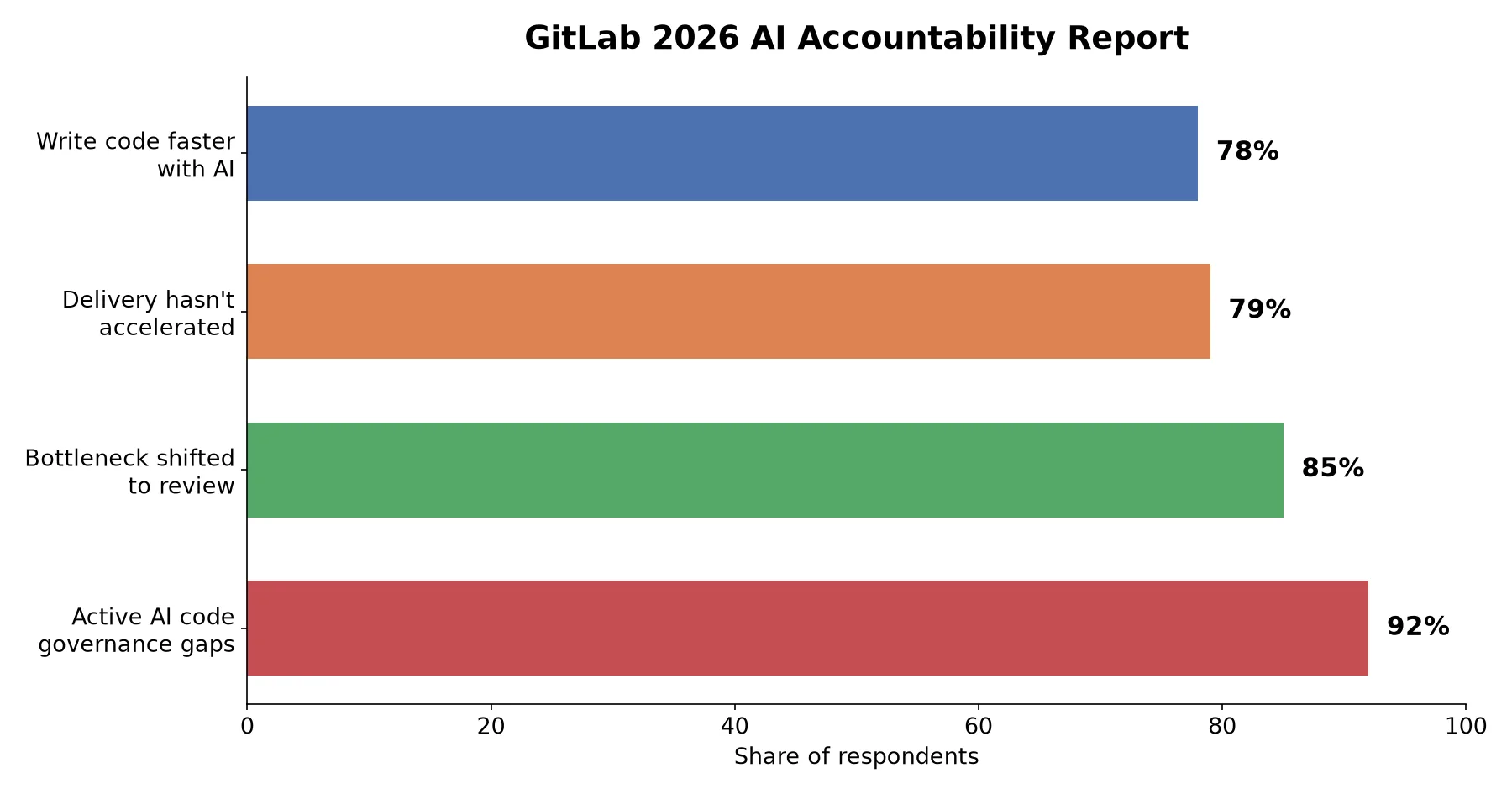
Ask a developer if AI tools made them faster and most say yes without hesitating. Ask an engineering leader if releases are shipping faster because of it, and the answer gets a lot more complicated. GitLab’s 2026 AI Accountability Report put numbers on that gap, and they’re stark: 78% of developers report writing and committing code faster since adopting AI tools, but 79% agree overall software delivery hasn’t accelerated at anywhere near the same pace. GitLab calls this the AI paradox. It’s a useful name for something a lot of teams are already living through without quite being able to explain it.
Where the speedup actually goes
The report’s most concrete finding is about where the bottleneck moved, not whether one exists. 85% of respondents say AI has shifted the constraint from writing code to reviewing and validating it. That tracks with what anyone running a team with heavy AI adoption has probably noticed: pull requests pile up faster than reviewers can get through them, not because reviewers got slower, but because there’s simply more to review, more often, from more contributors who are now shipping more per day.
Code review was never designed around the assumption that individual output could scale several times over. It’s a human-paced activity built on judgment, and judgment doesn’t get faster just because more work is arriving for it to judge. The same logic hits QA, security review, and release sign-off. Every downstream gate that used to run at the pace of a human-typing-code world now has to absorb a firehose from a human-prompting-a-model world, using the same headcount and the same process.
| Stage | Sped up by AI adoption? |
|---|---|
| Writing / committing code | Yes: 78% report faster |
| Code review | No: cited as the new bottleneck by 85% |
| Testing / QA | No: largely unchanged process, higher volume |
| Overall delivery to production | No: 79% say it hasn’t kept pace |
The governance number that should worry you more
The productivity gap is the headline, but the number that has more teeth is this one: 92% of organizations report active gaps in how they govern AI-generated code. GitLab frames accountability as the ability to answer three questions about any line of code running in production: where did it come from, what was it supposed to do, and who owns it now that it’s live.
Most teams can answer that for code a human wrote and reviewed under a normal process, there’s a commit, an author, a PR discussion, a reviewer’s approval. It gets murkier fast for AI-assisted code, especially when a developer accepts a large suggestion with light review, or when an agentic tool makes several small edits across a session that never gets summarized into a clean diff story. The code works, it ships, and six months later nobody can reconstruct why a particular block exists or who actually understood it well enough to be accountable for it.
That’s not a hypothetical risk. It’s the same failure mode that shows up in incident postmortems after something breaks in a part of the codebase nobody remembers writing, except now it’s happening at a higher volume because more of the codebase was written in a single sitting by a model with a developer skimming the output.
What this actually means for teams and agencies
None of this is an argument against AI coding tools. The productivity gains in the raw numbers are real, and no team we’ve worked with wants to give them back. The argument is narrower: if you only invest in the writing side of the pipeline, faster code generation just relocates the bottleneck instead of removing it, and it can make the bottleneck worse by adding volume without adding review capacity.
A few things actually move the needle instead of just producing an impressive commit count:
- Review tooling has to scale with input, not stay flat. If AI tools tripled how much code shows up for review, the review process needs its own investment, whether that’s better diff summarization, AI-assisted first-pass review, or simply more reviewer time budgeted per sprint.
- Provenance has to be captured at commit time, not reconstructed later. Tag which changes were AI-generated, AI-assisted, or hand-written, and keep that metadata attached to the commit. It’s far cheaper than trying to figure it out during an incident.
- Testing has to be treated as the actual throughput constraint it now is. If code volume went up and test coverage discipline didn’t, the gap between “looks right” and “is right” widens exactly where nobody’s watching.
- Ownership has to survive the AI-assisted commit. A developer who accepts an AI suggestion is still the accountable owner of that code. Teams that treat “the AI wrote it” as diffusing responsibility are the ones that show up in the 92% with no clear answer to who owns what.
We see this pattern most clearly in client engagements where a team scaled AI adoption fast and then hit a wall in QA or in production stability, not because the AI-generated code was inherently worse, but because nothing downstream of “write the code” scaled with it. If your delivery pipeline hasn’t been rebuilt around the assumption that code arrives faster now, the paradox GitLab measured is probably already showing up in your own release cadence, whether or not you’ve put a number on it yet.
The honest takeaway from this report isn’t “AI tools don’t work.” It’s that the part of software delivery everyone optimized first, writing the code, was never the actual constraint. It just used to be slow enough to hide the constraints behind it.
Frequently asked questions
- What is the AI paradox GitLab describes?
- It's the gap between individual output and team throughput. Developers using AI tools write and commit code noticeably faster, but the overall pace at which software actually ships to production hasn't improved by a comparable margin, because the extra code has to be reviewed, tested, and governed by processes that didn't get any faster.
- Why hasn't faster coding led to faster delivery?
- GitLab's survey found 85% of respondents say AI shifted the bottleneck from writing code to reviewing and validating it. Code review, QA, and security sign-off are still largely human-paced steps, and a larger volume of AI-generated code arriving at that stage doesn't move any faster just because it was written quickly.
- What does 'AI code governance' actually mean in practice?
- It means being able to answer three questions for any line of AI-generated code in production: where did it come from (which model, which prompt, which developer accepted it), what was it meant to do, and who is responsible for it now. GitLab found 92% of organizations have active gaps in at least one of those three.
- Should a team slow down AI adoption because of this?
- No. The data doesn't say AI coding tools are a net negative, individual productivity gains are real and substantial. It says the gains get capped by whatever's next in the pipeline. The fix is investing in review tooling, testing automation, and code provenance tracking to match the new input rate, not writing less code.
Sources
Sponsored
Sponsored
Discussion
Join the conversation.
Comments are powered by GitHub Discussions. Sign in with your GitHub account to leave a comment.
Sponsored