Industry News · Product Strategy
Apple Delayed Its Smart Glasses to 2027 Over Privacy
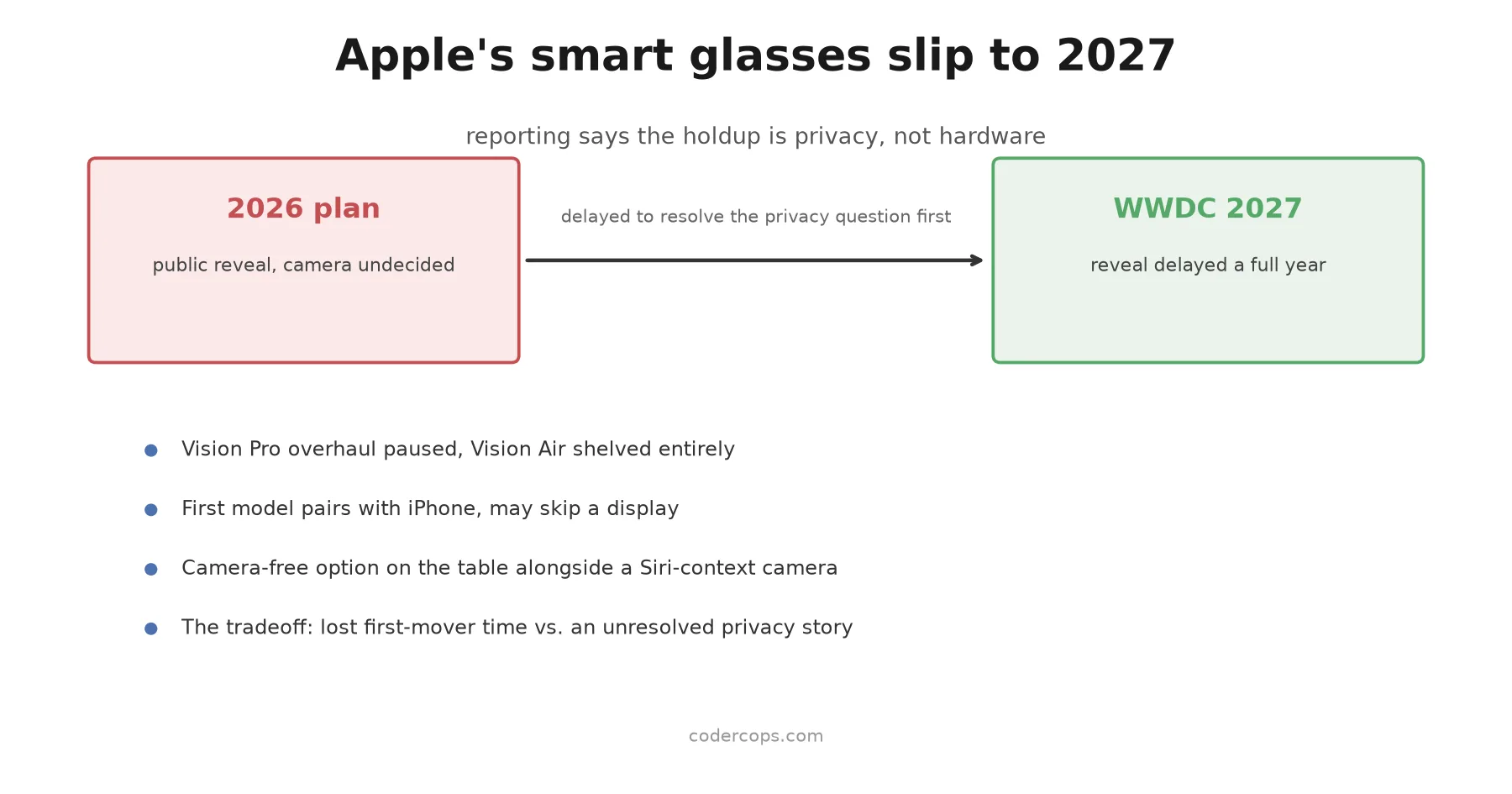
Apple shelved Vision Air and pushed the glasses reveal to WWDC 2027, and the holdup is privacy engineering, not hardware. What that signals for sensors.

Anurag Verma
4 min read
Sponsored
Apple was supposed to show its first real smart glasses sometime in 2026. That reveal has now slipped to WWDC 2027, and according to reporting from Bloomberg and other outlets, the holdup isn’t a supply chain problem or an unfinished chip. It’s that Apple’s engineering and marketing teams are still working out how to put a camera on someone’s face without it becoming a privacy story they can’t control.
That’s a more interesting piece of news than another hardware roadmap slip, because it’s a company with more resources than almost anyone choosing to lose a year rather than ship an answer to “does this record people around me” that it isn’t confident defending.
What actually happened
Bloomberg’s reporting describes Apple pausing a planned Vision Pro overhaul and shelving Vision Air, a lighter headset that had been in development, and redirecting both teams’ effort into smart glasses designed to pass as ordinary eyewear rather than read as a headset. The first model is expected to pair with an iPhone rather than run standalone, and multiple reports say it may skip a display entirely for the initial version, leaning on audio and a Siri-driven interface instead.
The camera question is the one still unresolved. Reporting lists a camera-free version as one option on the table, alongside a design where a camera feeds visual context to Siri, letting the assistant respond to what you’re looking at, without giving the device a way to capture and store photos or video the way Meta’s Ray-Ban glasses do. Apple hasn’t committed publicly to either path, which is part of why the reveal moved from 2026 to WWDC 2027.
Why privacy is the bottleneck, not engineering
Camera-equipped smart glasses already exist and sell reasonably well. Meta’s Ray-Ban line has been on the market for a while, and the category isn’t new or unproven from a hardware standpoint. What’s slowing Apple down is specifically the trust question: a camera worn on someone’s face, pointed outward at other people who never consented to being recorded, is a fundamentally different privacy surface than a camera in your pocket that you pull out and point deliberately.
Apple has spent a decade building its brand around being the company that doesn’t sell your data and locks down what apps can access on your phone. Shipping a product that immediately generates headlines about being recorded without consent would directly undercut that positioning in a way a delayed launch date doesn’t. The tradeoff Apple is making, explicitly, is a year of lost first-mover advantage in a category Meta already occupies, in exchange for not shipping a privacy answer it can’t stand behind.
The lesson for teams building anything with a sensor
Most software teams aren’t building smart glasses, but plenty are building features that touch a camera, a microphone, a location stream, or increasingly, an AI agent with access to a user’s screen or files. The Apple situation is worth studying because it’s a real-world case of a company treating “can we explain this data flow in one sentence a user will trust” as a launch blocker, not a nice-to-have documented in a privacy policy nobody reads.
If you’re scoping a product with always-on sensing, whether that’s a wearable, a browser extension with screen access, or an AI feature that reads a user’s inbox, the questions worth asking upfront look a lot like Apple’s: What does the device or feature actually capture? Who else is affected by that capture, not just the primary user? And can you describe the answer in a sentence that survives being read out loud in a product review? Teams that treat this as a late-stage compliance checkbox tend to ship the version that generates the bad headline. Teams that treat it as a design constraint from day one, the way Apple apparently is here, ship slower but avoid the retroactive trust repair. If your team is working through that kind of tradeoff on an AI-enabled feature, it’s worth reading through how AI integration decisions get scoped before a single line of the sensing pipeline gets written, because the privacy design choices are cheapest to make before the architecture is set, not after.
The actual takeaway
A delayed product launch isn’t usually interesting news. This one is, because the delay is a deliberate trade: Apple picked spending another year over shipping a camera-on-your-face product it can’t yet explain simply and honestly. Whatever you’re building that touches a camera, a mic, or a user’s data in a new way, that’s the standard worth holding yourself to before launch, not after the first bad review cycle forces the conversation.
Frequently asked questions
- When are Apple's smart glasses actually launching?
- As of the latest reporting, the public reveal has slipped to WWDC 2027, with a consumer release expected later that year. Earlier plans had targeted a 2026 unveiling, but Apple pushed the timeline back specifically to resolve open privacy questions before showing the product.
- Why did Apple cancel Vision Air?
- Bloomberg's reporting says Apple paused work on a Vision Pro overhaul and shelved the lighter Vision Air headset entirely, redirecting the people and budget from both projects toward smart glasses that look and feel closer to normal eyewear rather than a headset.
- Will Apple's smart glasses have a camera?
- It's still undecided, which is part of why the launch slipped. Reporting describes multiple options under consideration, including a camera-free first version, or a variant where the camera feeds visual context to Siri directly without capturing storable photos or video.
- Why does a hardware delay matter to software teams that don't make wearables?
- Because the decision being delayed isn't engineering, it's a privacy design choice, and any product with a camera, microphone, or location sensor faces the same category of question: what data does the device capture, who can see it, and can you explain that clearly to a user in one sentence. Apple's willingness to lose a year over that question is the signal worth studying, not the glasses themselves.
Sources
Sponsored
More from this category
More from Industry News
Sponsored
Discussion
Join the conversation.
Comments are powered by GitHub Discussions. Sign in with your GitHub account to leave a comment.
Sponsored