Technology · Architecture Patterns
Why Teams Are Quietly Choosing Boring Tech Again in 2026
Teams are picking Rails, Elixir, and calmer backends over the framework of the month. Why boring is winning arguments it used to lose, and when it's wrong.

Anurag Verma
5 min read
Sponsored
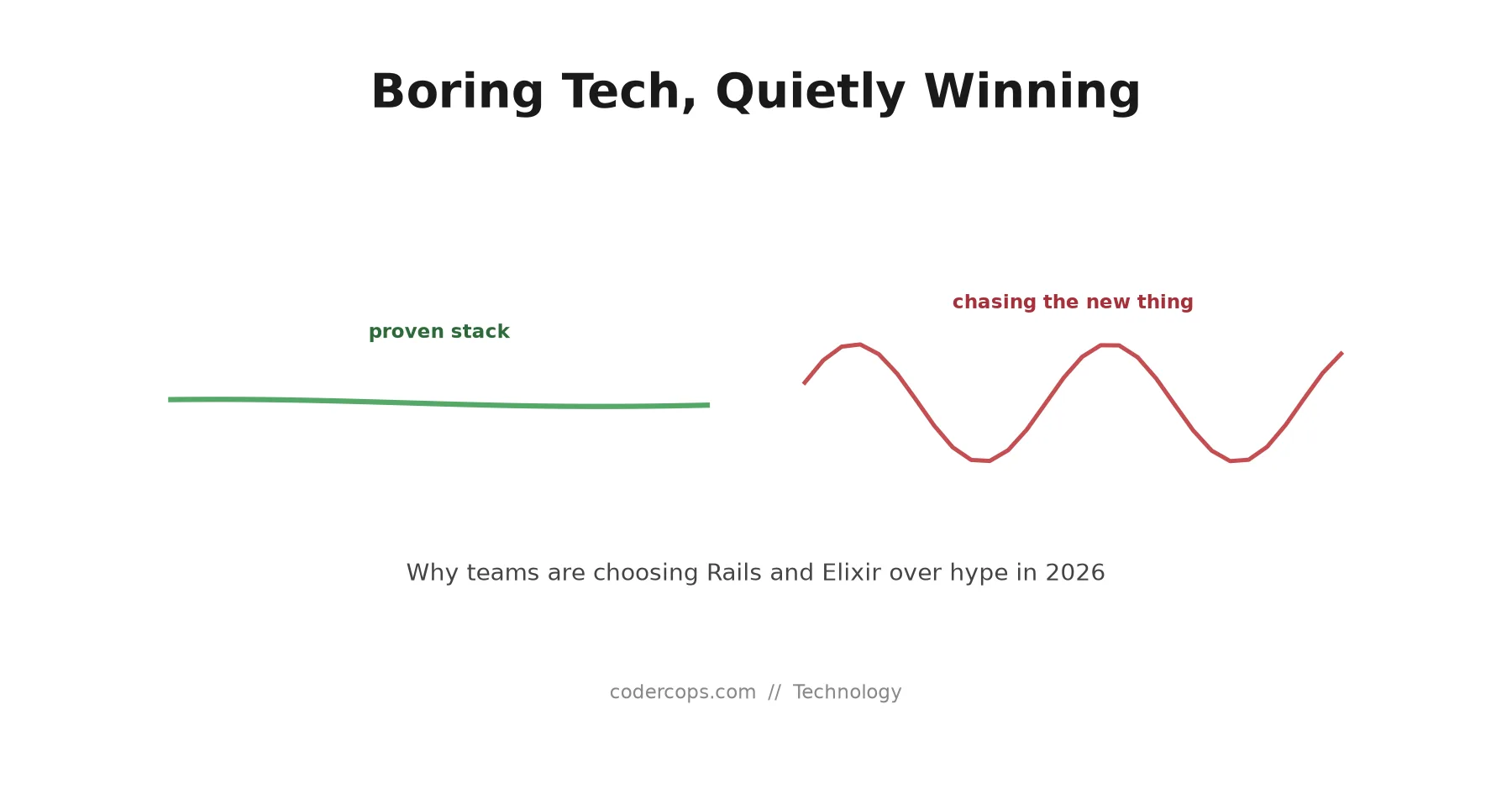
A recurring thread in developer discussion in 2026 pushes back on something that’s been treated as background noise for years: reflexive stack churn. The pattern shows up as teams publicly choosing Rails, Elixir, or similarly mature stacks over the framework of the month, and defending that choice not with nostalgia but with an operational argument that’s harder to dismiss than it used to be.
The argument, stated plainly
Every new framework adoption carries a cost that rarely appears in the blog post that convinced you to switch: rehiring or retraining for a different skill set, rewriting integrations that worked fine, relearning the idioms and footguns of a new ecosystem, and losing the institutional knowledge of exactly how your old stack breaks under load. That cost is real, it’s recurring, and it compounds every time a team switches again before the last switch has fully paid for itself.
The boring-tech case isn’t that new frameworks are bad. It’s that the decision to adopt one is usually made by comparing the new tool’s best day against the old tool’s worst day, a comparison that flatters the new option every time and rarely gets revisited once the migration is underway and the old tool’s actual failure modes, all now familiar and mostly solved, are forgotten.
Why this is landing differently in 2026
Two things changed the shape of this argument recently. AI-assisted coding tools have made it faster than ever to spin up a new stack, a proof of concept, a migration branch, a rewrite. That speed is genuinely useful, but it also means teams hit the maintenance phase of a new stack faster and more often, and maintenance is where boring tech’s advantages, predictable failure modes, a deep hiring pool, years of accumulated Stack Overflow answers and production war stories, actually pay off. Fast to start doesn’t mean cheap to run.
Second, a wave of framework and tooling churn over the preceding years left a lot of teams holding migration debt from switches that didn’t deliver what they promised. That’s not a universal experience, plenty of migrations do pay off, but it’s common enough that “we should have just stayed on the stack we knew” has become a recognizable, specific complaint rather than generic conservatism.
What “boring” doesn’t mean
It’s worth being precise here because the term invites a lazy read. Boring doesn’t mean unmaintained. Rails ships regular releases and has absorbed real architectural improvements over the years. Elixir and its BEAM runtime remain under active development with a stable, growing ecosystem. PostgreSQL, the other name that comes up constantly in these discussions, gets a major version yearly with genuine new capability, not just security patches.
The actual claim is narrower: these tools’ operational surface is already mapped. You know how Rails behaves under load because thousands of production deployments have already found the edges. You know how BEAM processes fail and recover because Elixir and Erlang teams have been debugging that exact runtime in production for years before you adopted it. That known-quantity property is the entire value proposition, and it’s orthogonal to whether the tool itself is old.
When the newer option is actually right
None of this is an argument for never adopting new technology. It’s an argument for being honest about why you’re adopting it. A genuine capability gap, your current queue can’t hit the throughput you need at p99, your current framework has no path to the real-time feature your product now requires, your hiring market for the old stack has genuinely dried up, is a legitimate reason to migrate, and the cost of staying put in that case is real too.
The test worth applying before greenlighting a migration: can you name the specific thing the new tool does that the old one structurally cannot, or are you naming things the old tool does less elegantly. The second category includes real preferences that are worth weighing, developer happiness and hiring appeal for a stack genuinely matter, but they should be argued as preferences, openly weighed against the migration cost, not smuggled in as technical necessity.
The practical version of this for an agency or product team
If you’re choosing a stack for a new project, the boring-tech argument suggests defaulting to the option your team already knows deeply unless a specific requirement rules it out, rather than defaulting to whatever’s generating the most conference talks this year. If you’re deciding whether to migrate an existing system, it suggests writing down the specific capability gap before you write a line of migration code, and being suspicious of a migration proposal that can’t produce one.
This connects to a broader theme in how teams pick their stack under real constraints rather than hype, something we’ve written about in our own tech stack decisions for 2026: the tools that stay in a production codebase for years are rarely the ones that were most exciting to adopt. They’re the ones whose tradeoffs the team actually understood going in.
Boring tech isn’t a nostalgia play. It’s a bet that predictability compounds, and in 2026, more teams are deciding that bet has been paying off quietly the whole time.
Frequently asked questions
- What does 'boring technology' actually mean in this context?
- It's a term (popularized well before 2026, but recirculating in current developer discussion) for choosing established, well-understood tools over the newest available option, specifically because the established tool's failure modes, hiring pool, and operational quirks are already known. It doesn't mean outdated or unmaintained. Rails, Elixir, PostgreSQL, and similar tools in this conversation are all actively developed with regular releases; boring here means mature and predictable, not old.
- Why is this argument resurfacing now instead of a few years ago?
- Two forces are converging. First, the AI coding tooling boom has made spinning up new stacks faster, which paradoxically increases the visible cost of stack churn once a team has to maintain what got spun up quickly. Second, a stretch of high-profile framework and tooling churn earlier in the decade left a lot of teams carrying migration debt from switches that didn't pay off, which makes the 'proven stack' argument land differently in retrospect than it did as a prediction.
- Is this just an anti-JavaScript-framework argument?
- No, and treating it that way misses the point. The critique applies to any unnecessary migration, including moving between two very similar new frameworks for marginal gains, adopting a new backend language because of hype rather than a specific capability gap, or replacing a working queue or database because a newer option benchmarks better in a blog post. Rails and Elixir get named because they're concrete examples of mature tools that keep getting passed over for newer options despite doing the job well, not because the argument is JavaScript-specific.
- When does adopting new technology over a proven stack actually make sense?
- When the new tool closes a capability gap the old one genuinely can't, not just does less elegantly. Real-time collaborative features at scale, a specific performance ceiling your current stack has hit in production, or a hiring market where you simply cannot find people for the old stack anymore are legitimate reasons. 'It's more fun to write' or 'it's what's trending on Hacker News' are not, even though they're often the real reason behind a migration proposal.
- How do I make this case to a team that wants to adopt something new?
- Ask them to name the specific capability gap, not the general vibe. 'Our current queue can't handle the throughput we need at p99' is a real gap. 'The new framework has better ergonomics' is a preference, and preferences are legitimate inputs but shouldn't be dressed up as necessity. Separating the two claims, and being honest about which one is actually driving the proposal, turns a values argument into a decision you can actually evaluate.
Sponsored
Sponsored
Discussion
Join the conversation.
Comments are powered by GitHub Discussions. Sign in with your GitHub account to leave a comment.
Sponsored