AI Integration · Model Releases
Gemini 3.1 Flash-Lite Image: What It Changes
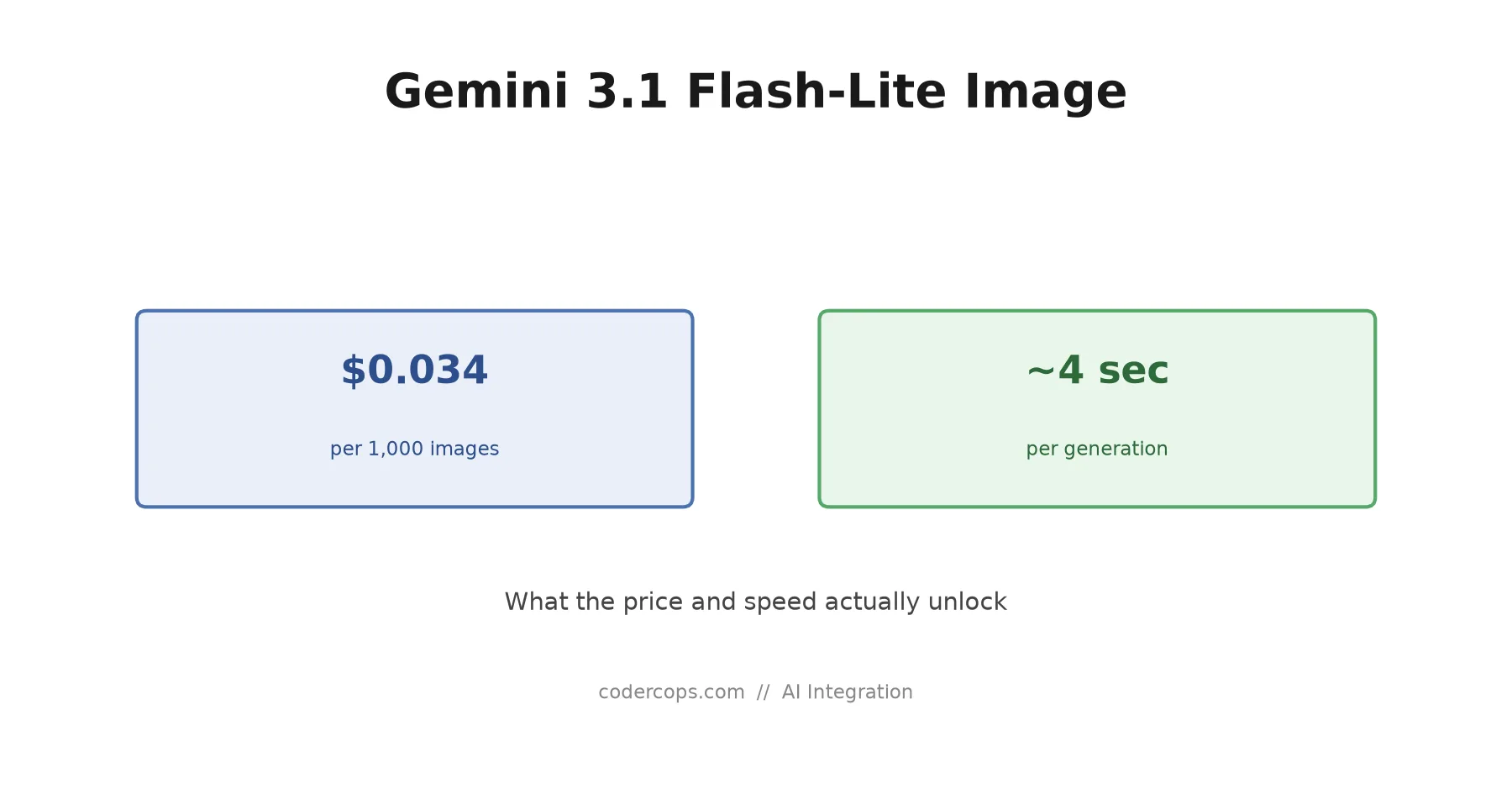
Gemini 3.1 Flash-Lite Image generates in about 4 seconds at $0.034 per 1,000 images. What that price and speed change for product teams, and the limits.

Abhishek Gupta
4 min read
Sponsored
Google shipped Gemini 3.1 Flash-Lite Image, internally tagged “Nano Banana 2 Lite,” to general availability with two numbers doing all the marketing work: roughly 4 seconds per generation and $0.034 per 1,000 images. Neither number is about quality. Both are about making image generation cheap and fast enough to use in places it previously wasn’t worth the cost or the wait.
What it actually is
Flash-Lite Image is the cost- and latency-optimized image model in Google’s Gemini 3.1 family, available through Google AI Studio, the Gemini API, and the Gemini Enterprise Agent Platform. It generates and edits images, and according to Google’s model documentation it comes with upgraded world knowledge for drafting data visualizations and layouts, character consistency across image sequences, and localized typographic rendering, meaning text rendered inside generated images in a way that respects the target locale’s script and conventions.
None of that positions it as the best image model Google makes. It’s positioned as the fast, cheap one. That’s a deliberate tier, not a limitation to apologize for, and it matters for how you should actually evaluate it.
The tier pattern, and why it’s not new
Google, OpenAI, and Anthropic have all converged on the same shape for their model families: a flagship tier for maximum capability, and a “lite” or “mini” tier optimized for cost and latency at some quality cost. Flash-Lite Image is that pattern applied to image generation specifically. If you’ve already made peace with using a lite-tier text model for high-volume, low-stakes text generation while reserving the flagship for anything that needs real reasoning, this is the same tradeoff, just for pixels.
The practical question isn’t “is Flash-Lite Image good.” It’s “which of my image generation needs actually require the flagship tier, and which ones were only using it because there wasn’t a cheaper option that worked.” That second bucket is what this release is aimed at.
Where the price and speed actually change what’s possible
Per-user or per-session generation. Generating a unique thumbnail, avatar variant, or illustration for every user session was rarely worth it at flagship image model pricing and latency. At $0.034 per 1,000 images and roughly 4-second generation, the math changes for products where personalized visuals add real value: dynamic content platforms, generative onboarding flows, or e-commerce product variation previews.
Bulk content variants. Teams that need many visual variations of the same underlying concept, for A/B testing ad creative, generating illustration sets for a content library, or producing localized versions of the same graphic, can now generate at a volume where testing many options is cheap rather than something you ration.
Draft-quality data visualization. Google specifically calls out upgraded world knowledge for “drafting rough data visualizations and contextual layouts.” That’s a narrower claim than “generates publication-ready charts,” and worth testing against your actual data before trusting it in a pipeline. If you’re building chart generation into a product, treat this as a fast first-pass step that a human or a rules-based renderer still checks, not a replacement for a chart built from real, verified numbers.
Where it falls short
Speed and cost come from somewhere. Flash-Lite tiers across every vendor trade some prompt-following precision and visual fidelity for their advantages. If you’re generating hero images, marketing key art, or anything where a single bad generation costs real money to catch and fix, this isn’t the model reaching for. The flagship tier in the same family exists specifically for that case.
Character consistency across a sequence is a capability worth testing rather than trusting from the spec sheet. Google claims it “preserves identity across continuous image streams,” which matters a lot if you’re generating, say, a consistent mascot or character across multiple images, and matters much less if every generation is independent. Run your own test before building a feature that depends on it.
The actual decision
Don’t migrate an existing image pipeline to Flash-Lite Image because it’s new and cheap. Instead, identify which of your image generation use cases are currently constrained by cost or latency rather than quality, and test this model against your real prompts for exactly those cases. If the quality bar holds at your volume and your budget, you’ve got features that weren’t economical before. If it doesn’t, keep using the flagship tier for the workloads that actually need it and treat this as a tool for a specific class of problem, not a universal replacement.
For teams evaluating whether any given AI model release is worth integrating versus noise, our guide to evaluating an AI integration partner covers the same discipline applied more broadly: test against your actual workload before you commit engineering time to a migration.
Frequently asked questions
- What is Gemini 3.1 Flash-Lite Image?
- It's Google's fastest and lowest-cost image generation and editing model, part of the Gemini 3.1 family, released to general availability in 2026. It's built for high-volume, latency-sensitive use cases rather than maximum visual quality, and it's accessible through Google AI Studio, the Gemini API, and the Gemini Enterprise Agent Platform.
- How much does it cost and how fast is it?
- Google prices it at a flat $0.034 per 1,000 images, with generation completing in about 4 seconds. That combination of low fixed cost and low latency is the entire point of the model; it's designed for workflows where you're generating images at volume or in response to a user action where wait time matters.
- How is this different from Google's flagship image model?
- Flash-Lite trades some visual fidelity and prompt-following precision for speed and cost. Google's naming convention (Flash-Lite versus a full Flash or Pro-tier image model) signals the same tradeoff pattern seen in its text models: the Lite tier is for volume and latency-sensitive workloads, not for the single best-quality output you can get from the family.
- What use cases actually make sense for a model like this?
- Anything where you're generating a large number of images and either quality bar or per-image budget rules out a premium model: per-user or per-session thumbnails, dynamic illustrations for generated content, A/B testing many visual variants of the same concept, or draft-quality data visualizations and layouts that a human or a downstream process refines. It's a poor fit for hero images, marketing key art, or anything where a single wrong generation is costly to catch.
- Should I switch my existing image generation pipeline to this model?
- Only after testing it against your actual prompts and quality bar. Model marketing benchmarks rarely match a specific product's requirements. Run a side-by-side comparison against whatever you currently use on a representative sample of your real prompts, check character consistency if your use case involves generating related images in sequence, and confirm the cost savings materialize at your actual volume before migrating a production pipeline.
Sources
Sponsored
More from this category
More from AI Integration
Sponsored
Discussion
Join the conversation.
Comments are powered by GitHub Discussions. Sign in with your GitHub account to leave a comment.
Sponsored