Cybersecurity · Vulnerability Management
CVE-2026-20262: Cisco Catalyst SD-WAN Manager Patch Guide
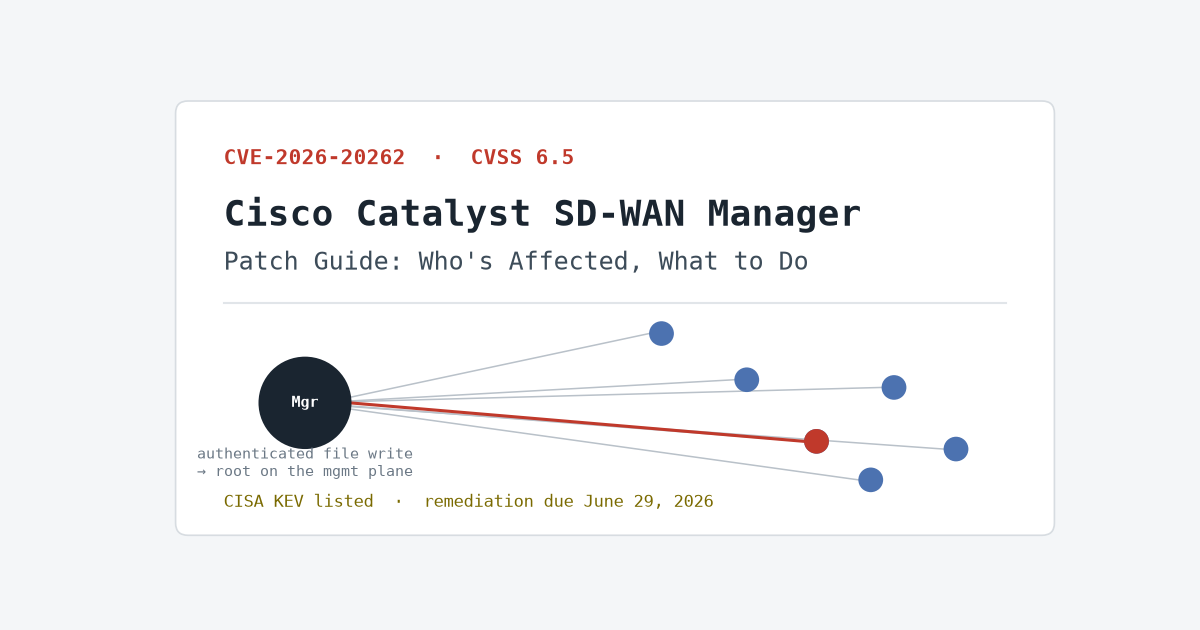
CVE-2026-20262 lets an authenticated attacker write files on Catalyst SD-WAN Manager and escalate to root. It's in CISA's KEV catalog with the deadline already passed. Here's who's affected and what to patch.

Prathviraj Singh
6 min read
Sponsored
If you run Cisco Catalyst SD-WAN Manager, on-prem or in the cloud, and someone on your network already has (or steals) a low-privileged account on it, that account is enough to write files to the underlying OS and climb to root. That’s CVE-2026-20262. It’s been fixed since mid-June 2026, it’s in CISA’s Known Exploited Vulnerabilities catalog, and the federal remediation deadline of June 29 has already come and gone. If you haven’t checked your version yet, do that today, not this quarter.
What the vulnerability actually is
CVE-2026-20262 is an arbitrary file write flaw. The root cause is insufficient validation of user-supplied input during a file upload process in SD-WAN Manager’s web-based management interface. An attacker who can reach an affected API endpoint sends a crafted request, and instead of the upload being confined to where it’s supposed to land, the attacker controls where the file goes and what it contains.
A file write on its own sounds contained. It isn’t. Once an attacker can place or overwrite a file anywhere they choose on the host filesystem, they have a well-worn path to escalate: overwrite a configuration file, a script that runs with elevated privileges, or a binary that the system trusts, and wait for it to execute. Cisco’s advisory describes exactly this chain, an authenticated file write that leads to root privilege escalation on the underlying operating system.
The part worth being precise about: this is not unauthenticated. An attacker needs valid credentials for a low-privileged user account before any of this works. That’s a real barrier, but it’s a lower one than it sounds. Low-privileged accounts get created for junior staff, contractors, automation, and integrations, and any of them can be phished, reused from a breached password list, or leaked in a misconfigured secret. Once an attacker has any working login, CVE-2026-20262 turns that into root.
Why the management plane matters here
SD-WAN Manager isn’t just another web app. It’s the control point that pushes configuration, policy, and software updates to every SD-WAN device in a deployment, sometimes thousands of edge routers and branch devices across an entire company. Compromise of a single edge device is bad. Root on the box that configures every edge device is a different category of bad: an attacker there can potentially reconfigure routing, intercept or redirect traffic, or push malicious changes fleet-wide from one foothold.
That’s the reason a CVSS 6.5, a score that on paper reads as medium, is getting this much attention. CVSS measures the mechanics of the individual bug. It doesn’t fully capture what sits behind the vulnerable component. A file-write bug on a kiosk app and a file-write bug on the thing that manages your entire WAN are not the same risk, even at the same score.
This is also the second notable Cisco management-plane CVE this blog has covered this year; we wrote up CVE-2026-20230, an unauthenticated SSRF-to-root chain in Unified Communications Manager, back in June. Different product, different entry point, same underlying pattern: a Cisco management or control-plane product gets a file-write primitive, and that primitive gets chained into root. If you’re responsible for Cisco infrastructure, both are worth tracking, and it’s a good moment to ask whether your patch cadence for management-plane products is actually keeping pace with how often these show up.
Who’s affected
| Item | Detail |
|---|---|
| CVE | CVE-2026-20262 |
| CVSS score | 6.5 |
| Component | Cisco Catalyst SD-WAN Manager (web-based management interface) |
| Vulnerability class | Arbitrary file write via insufficient input validation on file upload |
| Authentication required | Yes, a valid low-privileged user account |
| Resulting impact | File create/overwrite on the underlying OS, chaining to root privilege escalation |
| Deployment models affected | On-prem, Cloud-Pro, Cisco Managed Cloud, FedRAMP |
| Exploitation status | Limited, targeted exploitation observed by Cisco |
| CISA KEV status | Listed, remediation due date June 29, 2026 (already passed) |
| Workaround available | None published |
If you don’t operate Catalyst SD-WAN Manager at all, this doesn’t apply to you. If you do, the deployment model doesn’t get you out of it. All four listed models, including FedRAMP environments, are in scope.
What to do
Start by identifying every Catalyst SD-WAN Manager instance you run and its current version. Cisco’s advisory lists the specific fixed release for each software train, and per public reporting corroborating that advisory, fixes have shipped across the affected trains, including releases in the 20.9, 20.12, 20.15, 20.18, and 26.1 lines. Don’t take a version number from a secondhand blog as gospel, though. Match your running version against the fixed-release table in Cisco’s own advisory linked in the sources below, since that’s the authoritative source and the one that gets updated if anything changes.
Once you know your version, the sequence is straightforward:
- Confirm whether your running SD-WAN Manager version is below the fixed release for its train, using Cisco’s advisory.
- Schedule the upgrade. There’s no published workaround, so upgrading is the actual fix, not a stopgap.
- While you’re in there, review accounts with access to SD-WAN Manager. Since exploitation starts from a low-privileged account, tightening who holds those accounts and rotating credentials that might be stale or shared reduces the odds someone gets that starting foothold in the first place.
- If your instance is internet-reachable or reachable from a broad internal network, check whether it needs to be. Restricting management-plane access to a smaller, trusted set of networks doesn’t fix the CVE, but it shrinks who can even attempt to use a stolen credential against it.
- Treat this as already late. The KEV deadline was June 29, and today is July 27. If you’re still unpatched, this isn’t a “get to it next sprint” item.
The takeaway
CVE-2026-20262 needs a working low-privileged login to start, which is a real constraint, but not a strong one at scale, and the payoff for an attacker is root on the system that configures your entire SD-WAN fleet. Cisco shipped fixes for every affected train back in June, there’s no workaround to lean on instead, and the federal deadline is already a month behind us. Check your SD-WAN Manager version against Cisco’s advisory today, patch what’s behind, and tighten who holds accounts on that instance while you’re at it. This one doesn’t reward waiting.
Frequently asked questions
- What is CVE-2026-20262?
- An arbitrary file write vulnerability in Cisco Catalyst SD-WAN Manager. It's caused by insufficient validation of user-supplied input during a file upload process, and an attacker can trigger it with a crafted request to an affected API endpoint. Once a file is written or overwritten, the attacker uses that access to escalate to root on the underlying operating system.
- Do I need to be logged in to exploit this?
- Yes. This is not an unauthenticated bug. The attacker needs valid credentials for a low-privileged user account on the SD-WAN Manager instance before they can trigger the file write. Where those credentials come from (phishing, credential reuse, a leaked API token) is a separate problem, but this CVE alone doesn't hand an outsider a way in without an account.
- Is my deployment affected?
- If you run Cisco Catalyst SD-WAN Manager, check your version against the fixed releases in Cisco's advisory regardless of deployment model. On-prem, Cloud-Pro, Cisco Managed Cloud, and FedRAMP environments are all listed as affected.
- Has this actually been exploited, or is it theoretical?
- Cisco has confirmed limited, targeted exploitation in the wild, which is why CISA added it to the Known Exploited Vulnerabilities catalog. It's not a proof-of-concept-only bug at this point.
- What's the CISA deadline and does it still matter if I'm not a federal agency?
- CISA's KEV entry set a remediation due date of June 29, 2026 for federal civilian agencies. That date has already passed as of this post (July 27, 2026). If you're not a federal agency the deadline itself doesn't bind you, but the underlying fact does: this is a confirmed actively exploited bug on a management-plane product, and an unpatched instance sitting past a KEV deadline is a known, public target.
- Is there a workaround if I can't patch right now?
- Cisco has not published a workaround for this vulnerability. The remediation is to upgrade to a fixed release. If you truly cannot patch immediately, your best interim options are restricting management-plane access to trusted networks and auditing account credentials, but neither of those closes the vulnerability itself.
Sources
- Cisco Security Advisory: Catalyst SD-WAN Controller, Manager, and Validator Authenticated Privilege Escalation Vulnerability
- BleepingComputer: Cisco fixes SD-WAN vManage flaw exploited in zero-day attacks
- Security Affairs: CVE-2026-20262 Cisco Catalyst SD-WAN flaw under active targeted exploitation
- SOCRadar: CVE-2026-20262 Cisco Catalyst SD-WAN Manager
Sponsored
More from this category
More from Cybersecurity
 R.01
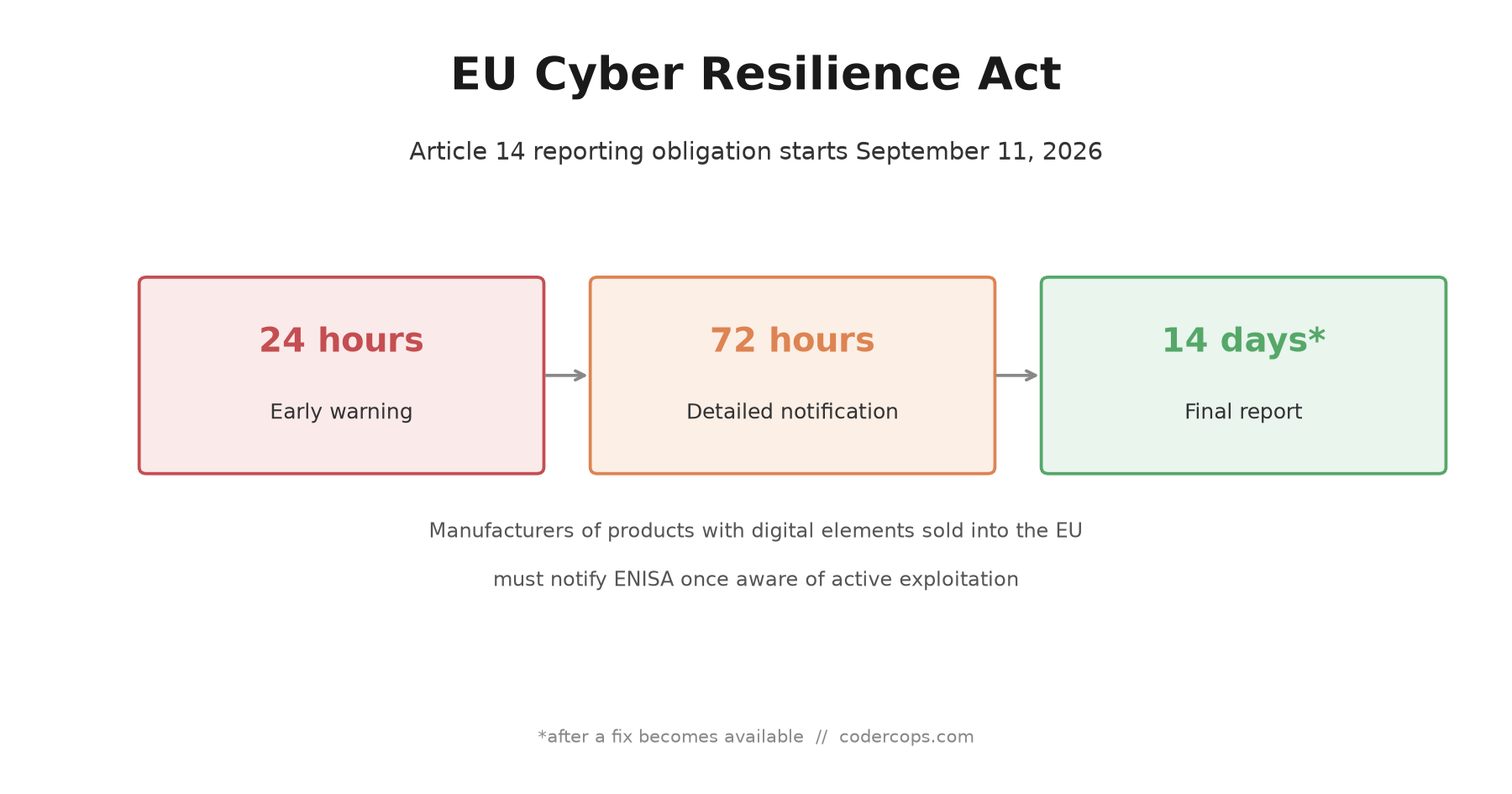
R.01 The EU Cyber Resilience Act's September 11 Deadline: What Software Teams Need Ready
 R.02
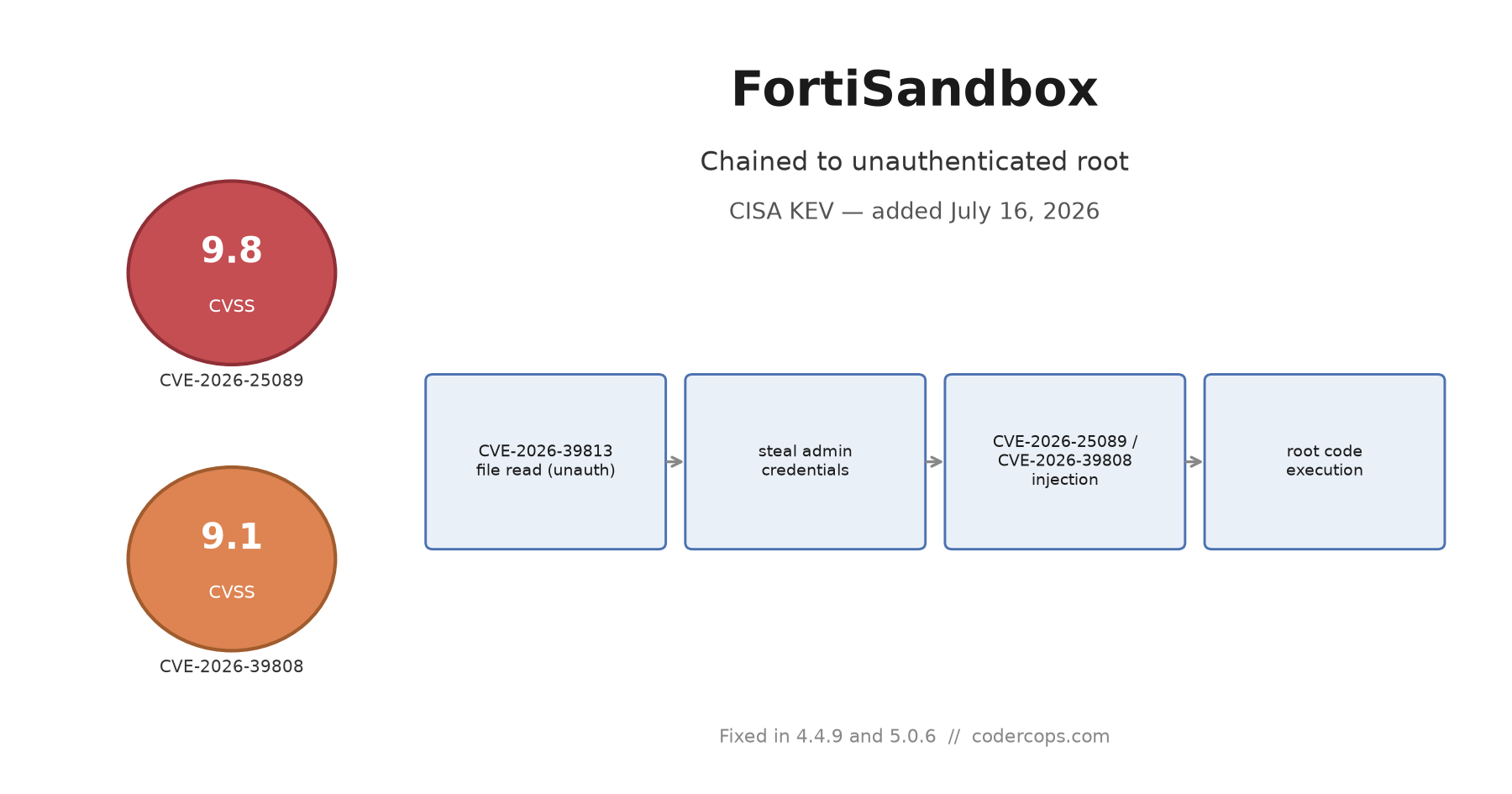
R.02 CVE-2026-25089 and CVE-2026-39808: The FortiSandbox Chain That Reaches Unauthenticated Root
 R.03
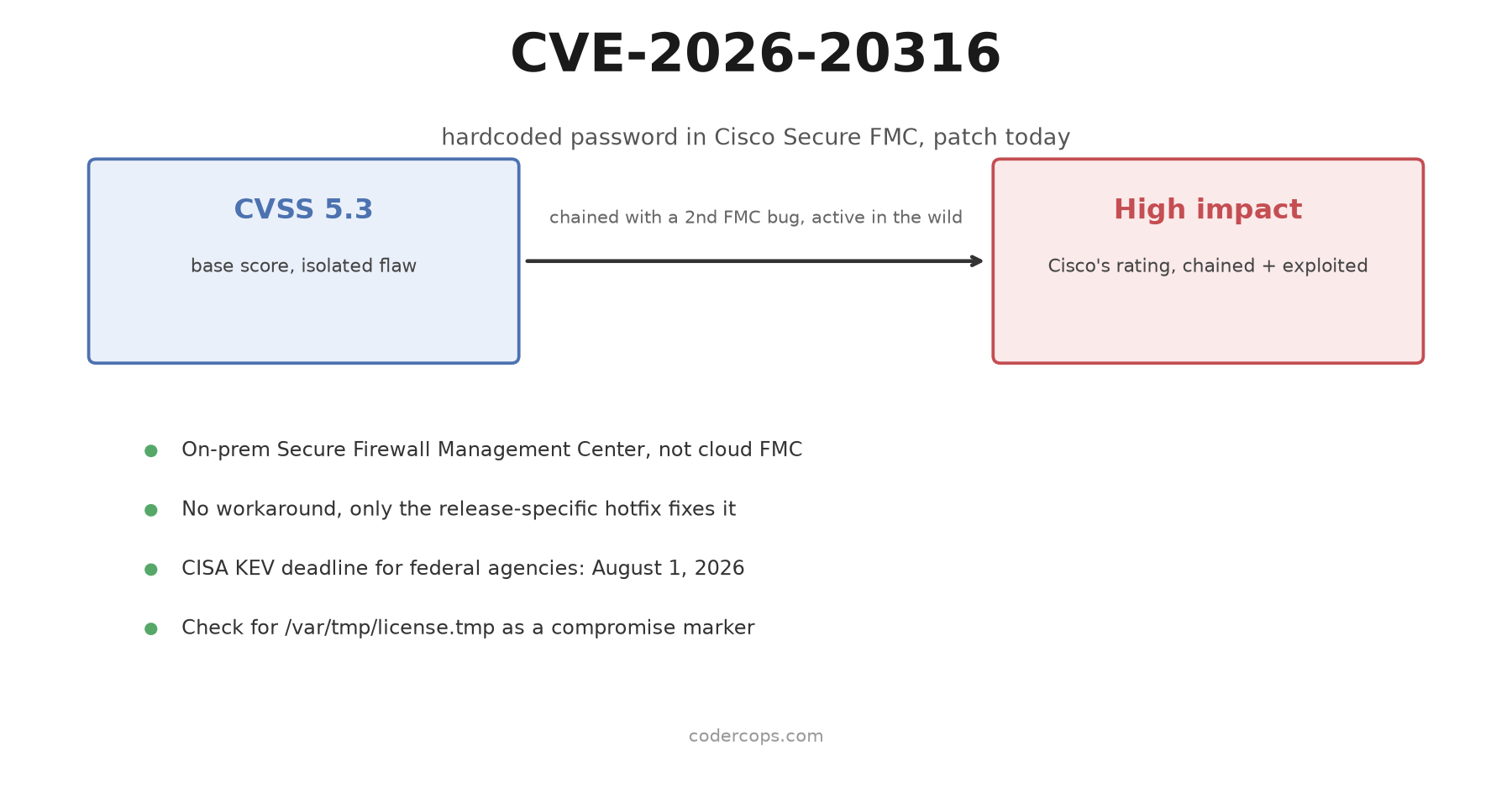
R.03 CVE-2026-20316: The Cisco Secure FMC Hardcoded Password CISA Wants Patched Today
Sponsored
Discussion
Join the conversation.
Comments are powered by GitHub Discussions. Sign in with your GitHub account to leave a comment.
Sponsored