Cybersecurity · Vulnerability Management
CVE-2026-16812: Arista VeloCloud's Perfect-10 Command Injection, and How to Patch It
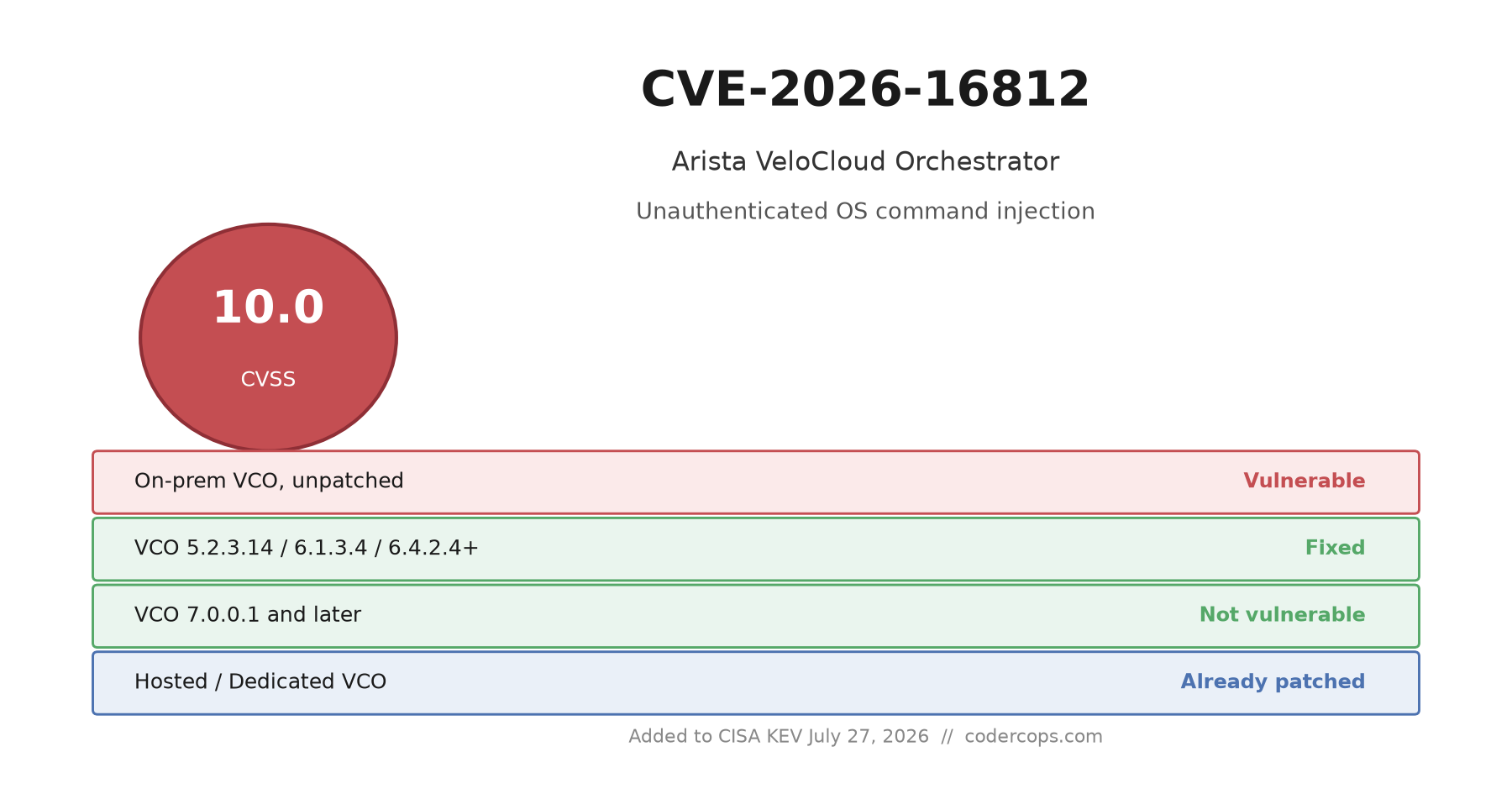
CISA added CVE-2026-16812, an unauthenticated OS command injection in Arista VeloCloud Orchestrator scored a maximum 10.0 CVSS, to its Known Exploited Vulnerabilities catalog on July 27. Here's who's affected, what's patched, and what to check first.

Prathviraj Singh
5 min read
Sponsored
If your organization runs an on-prem Arista VeloCloud Orchestrator to manage its SD-WAN, stop and check the version number before reading further. CISA added CVE-2026-16812 to its Known Exploited Vulnerabilities catalog on July 27. It’s an unauthenticated OS command injection scored a full 10.0 on CVSS, the ceiling of the scale, and it’s already being used in live attacks.
What the bug actually does
VeloCloud Orchestrator, VCO for short, is the management plane that sits above VeloCloud’s SD-WAN edge devices. It’s where an operator configures policy, pushes changes, and monitors every branch office the deployment covers. That central position is exactly why this bug is bad: VCO isn’t one branch’s router, it’s the console that controls all of them.
CVE-2026-16812 lets a remote, unauthenticated attacker execute operating system commands directly on the orchestrator host. No tenant login, no operator credentials, nothing. Arista’s own advisory notes that the vulnerable functionality was originally built for internal use only and was never supposed to be reachable from outside, but it stayed remotely accessible anyway. That’s a common failure shape in management software: a debug endpoint or internal API that assumes network position is the security boundary, and then the network position changes, or was never as isolated as the design assumed.
Successful exploitation compromises the confidentiality, integrity, and availability of the orchestrator itself and everything it manages. Practically, that means an attacker with a foothold on VCO can read and rewrite SD-WAN configuration, intercept or redirect traffic policy, and pivot toward whatever the orchestrator’s network position gives it access to.
Who’s affected and what’s already fixed
The exposure is specific to on-prem, self-managed VCO deployments:
| Deployment type | Status |
|---|---|
| On-prem VCO, unpatched | Vulnerable |
| On-prem VCO, patched | Fixed |
| VeloCloud Hosted / Dedicated | Already patched by Arista before the advisory; not exposed |
| VeloCloud Gateway | Not affected |
| VeloCloud Edge | Not affected |
If you manage your own VCO instance, the fix is versions 5.2.3.14, 6.1.3.4, or 6.4.2.4 depending on which branch you’re on, or any 7.0.0.1-or-later release, since the 7.x line was never vulnerable to this particular flaw. Arista discovered the issue through an external report rather than internal testing, and hasn’t published attribution or a detailed timeline of when exploitation began, which is itself worth noting: the absence of a clean “exploitation started on this date” line usually means the vendor is still reconstructing what happened, not that the risk window was short.
# Check your current VCO build against the fixed floors:
# 5.x branch -> needs 5.2.3.14+
# 6.1 branch -> needs 6.1.3.4+
# 6.4 branch -> needs 6.4.2.4+
# 7.x branch -> any 7.0.0.1+ release is unaffected
If your VCO is internet-facing at all, and a meaningful number of on-prem SD-WAN orchestrators are, treat patching as urgent rather than routine. An unauthenticated, full-compromise bug on a system with this much blast radius is close to the worst combination the KEV catalog sees.
The Fortinet bug that landed the same day
CISA’s July 27 update wasn’t only about Arista. It also added CVE-2025-68686, an information-disclosure flaw in Fortinet FortiOS that exposes sensitive data to an unauthorized actor. The two are unrelated products from different vendors, but the Fortinet one comes with a catch worth knowing: exploiting it requires the attacker to already have filesystem-level access to the device, meaning it’s a post-exploitation flaw, not an initial-access one. It’s a patch bypass for a symbolic-link persistence mechanism that Fortinet had previously tried to close. If you’re running FortiOS 7.6.0 through 7.6.1, 7.4.0 through 7.4.6, or any 7.2, 7.0, or 6.4 release, and you have any reason to suspect prior compromise on a FortiOS device, this is the flaw an attacker would use to keep sensitive data flowing even after the original entry point gets cleaned up.
Why the federal deadline math changed
Older KEV advisories, including the Langflow authorization bypass we covered earlier this month, operated under a flat deadline: every KEV addition got the same fixed remediation window for federal civilian agencies, regardless of how severe or exposed the specific bug was. That policy, BOD 22-01, has been replaced by BOD 26-04, which scores each KEV addition against four criteria, including whether the affected system is publicly exposed and whether successful exploitation grants full control of the asset, and sets a deadline accordingly. For a bug like CVE-2026-16812, unauthenticated, internet-reachable in many deployments, and a full command-injection compromise, that scoring can produce a remediation window as short as three days.
You don’t have to be a federal agency for that scoring model to be useful. It’s a reasonable way to triage your own patch queue: ask the same four questions BOD 26-04 asks, and the vulnerabilities that would score worst under it are the ones that deserve your team’s attention this week, not next sprint.
What to do this week
Check your VCO version against the fixed floors above and patch if you’re behind. If patching has to wait even a few days, pull the orchestrator off any network path that doesn’t strictly need to reach it, and review access logs for command execution or configuration changes you can’t account for. This is not a bug where “we’ll get to it next patch cycle” is a defensible position, and the KEV listing exists precisely to tell you that.
Frequently asked questions
- What is CVE-2026-16812?
- It's an unauthenticated OS command injection vulnerability in Arista VeloCloud Orchestrator (VCO), the centralized platform that configures, monitors, and manages VeloCloud SD-WAN deployments and their edge devices. A remote attacker can run operating system commands on the orchestrator host without providing any tenant or operator credentials.
- Which Arista products are affected?
- On-prem VeloCloud Orchestrator deployments are affected. Hosted and Dedicated VCO deployments, which Arista manages directly, were patched before the advisory went public and are not exposed. VeloCloud Gateway and VeloCloud Edge appliances are separate products and are not vulnerable to this specific flaw.
- Is CVE-2026-16812 being actively exploited?
- Yes. CISA added it to the Known Exploited Vulnerabilities catalog on July 27, 2026, which only happens with confirmed evidence of real-world exploitation, not a theoretical risk. Arista has said the flaw was discovered externally and hasn't disclosed who is behind the attacks or exactly how long they've been running.
- What versions fix the bug?
- VCO 5.2.3.14, 6.1.3.4, and 6.4.2.4 fix it on their respective branches, and every 7.0.0.1-or-later release is unaffected by design. If you're running an on-prem VCO below those version floors, treat it as exposed until you upgrade.
- Do I need to worry about this if I'm not a federal agency?
- The KEV deadline is a legal requirement for federal civilian agencies under BOD 26-04, not private companies. But the listing itself is the real signal: it means this bug is being used in active attacks right now, against a system that, if compromised, gives an attacker control of your SD-WAN configuration across every branch office it manages.
Sources
Sponsored
More from this category
More from Cybersecurity
 R.01
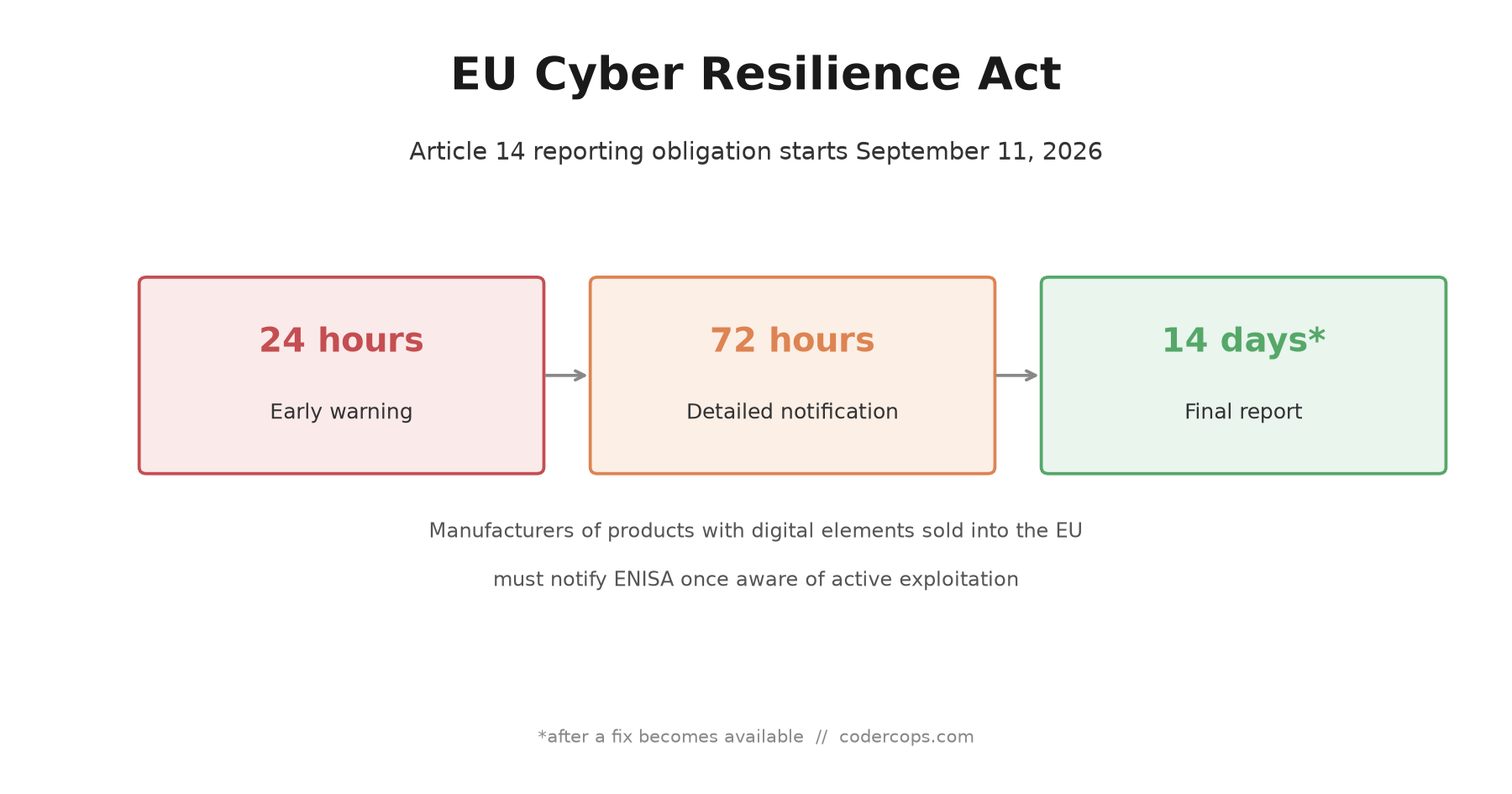
R.01 The EU Cyber Resilience Act's September 11 Deadline: What Software Teams Need Ready
 R.02
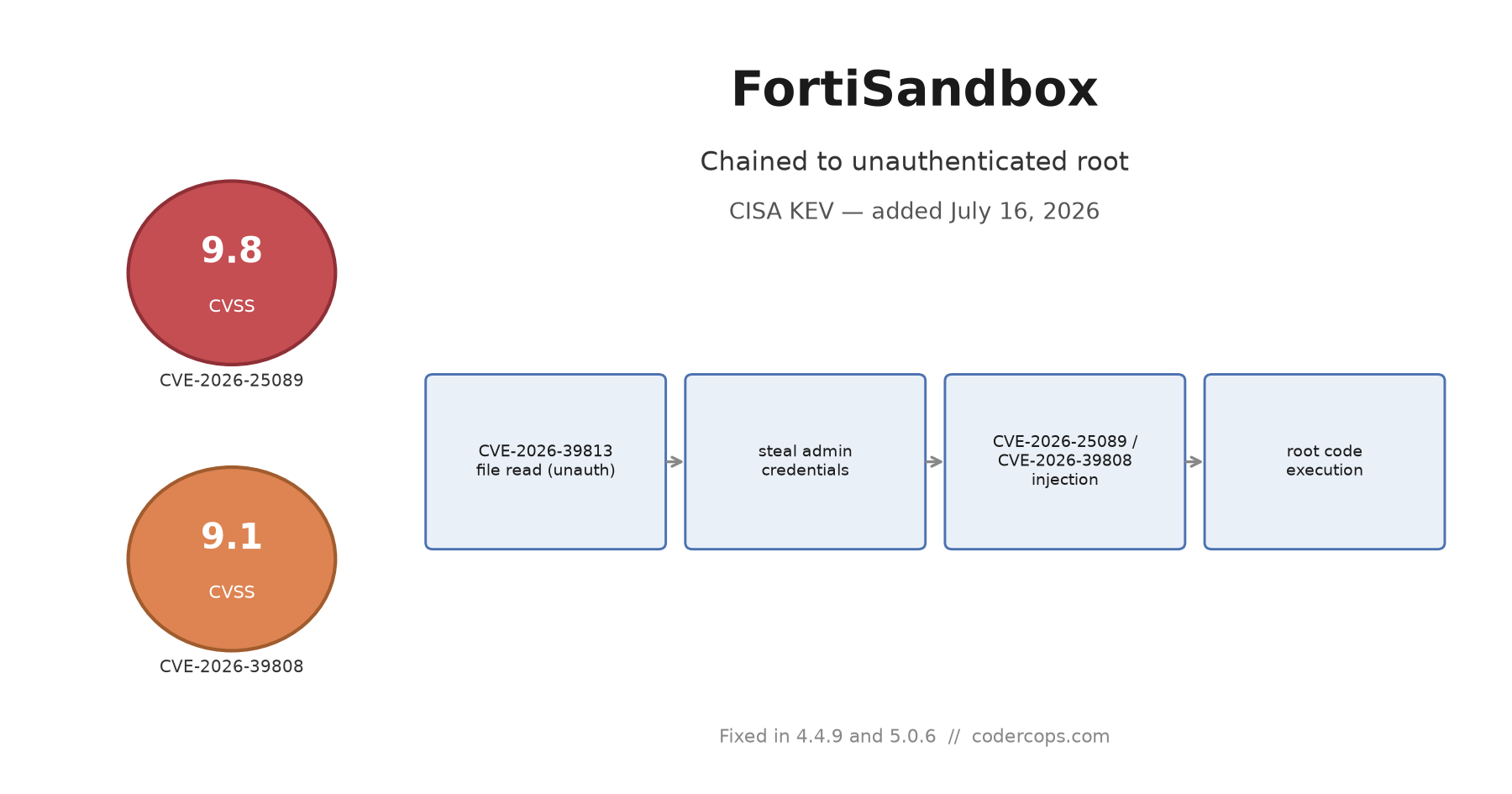
R.02 CVE-2026-25089 and CVE-2026-39808: The FortiSandbox Chain That Reaches Unauthenticated Root
 R.03
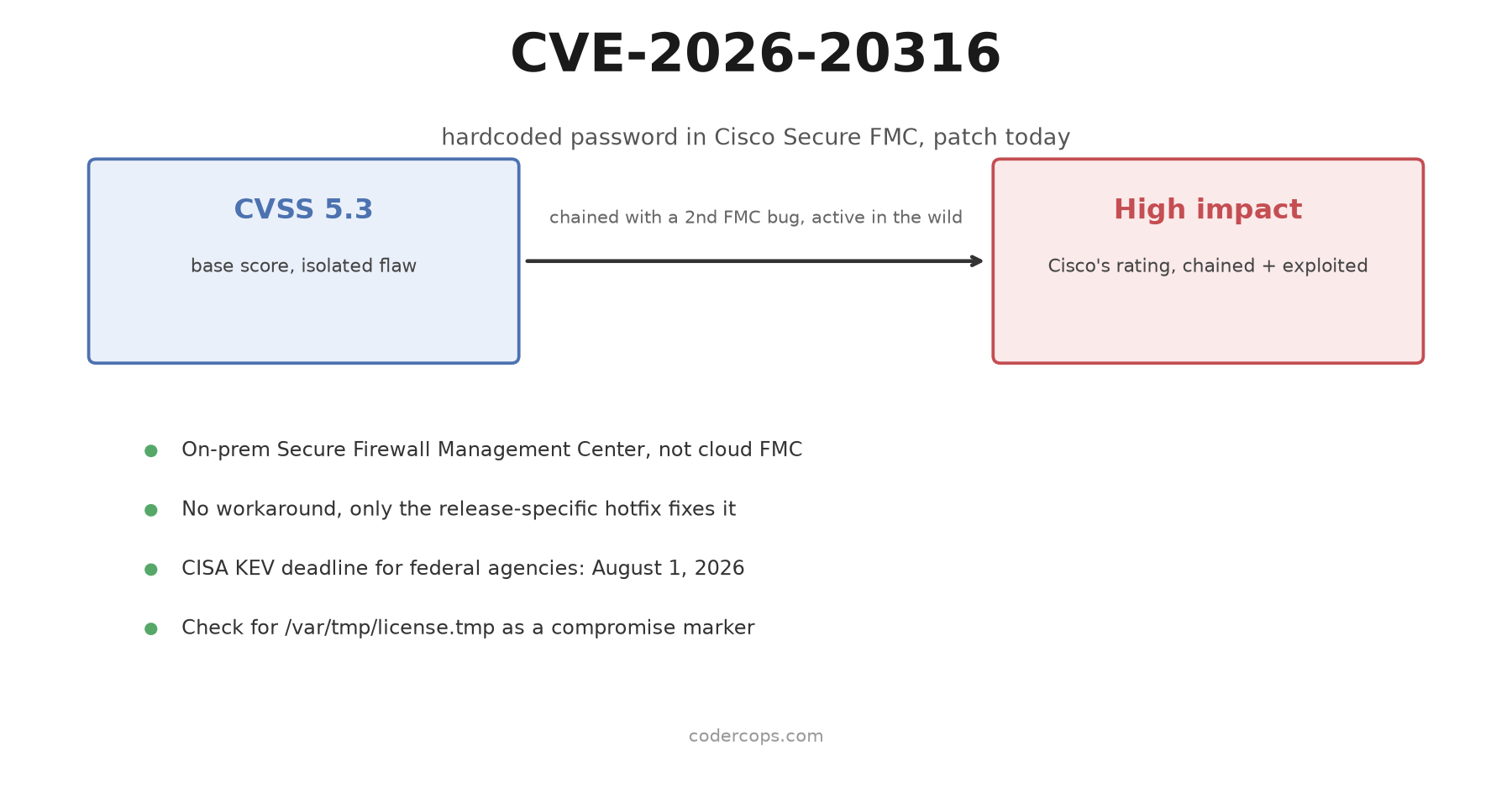
R.03 CVE-2026-20316: The Cisco Secure FMC Hardcoded Password CISA Wants Patched Today
Sponsored
Discussion
Join the conversation.
Comments are powered by GitHub Discussions. Sign in with your GitHub account to leave a comment.
Sponsored