
Sponsored
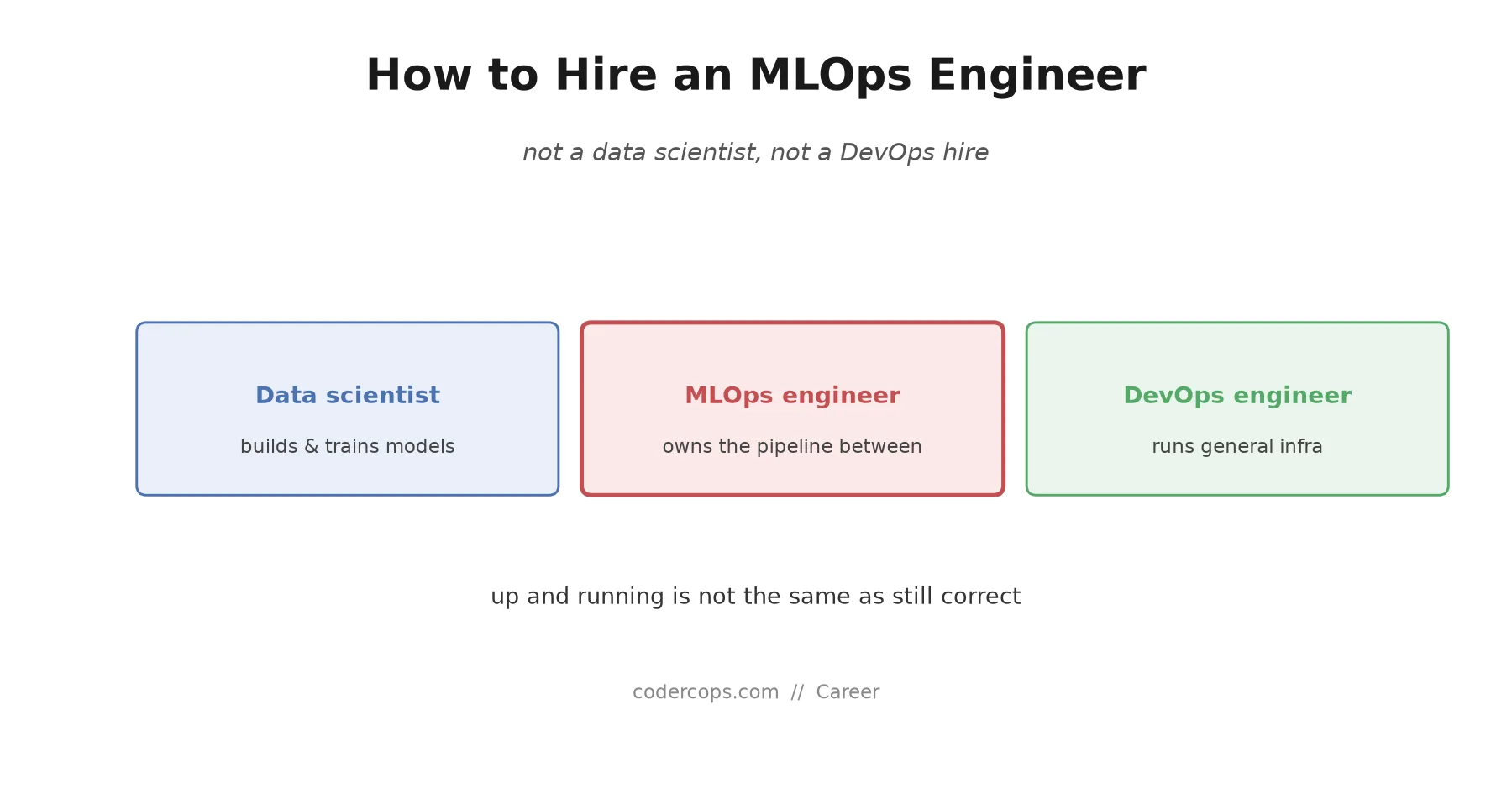
A model can be perfectly healthy by every metric a general DevOps dashboard tracks (200 status codes, low latency, no errors) and still be quietly wrong. That’s the sentence that explains why MLOps is a real, separate hire and not just DevOps with a machine learning label on it. A data scientist builds and trains the model. A DevOps or platform engineer runs the infrastructure and CI/CD for typical software. An MLOps engineer owns the part in between: the pipeline that takes a trained model and keeps it correct, not just running, in production.
Teams that skip this distinction tend to make one of two mistakes. They hire a data scientist and ask them to also own production deployment, and get someone who’s uncomfortable in Terraform and Kubernetes and treats the serving layer as an afterthought. Or they hire a DevOps engineer and expect them to intuit why a model that’s technically up can still be failing, and get someone who monitors uptime religiously while the model silently drifts for three weeks before anyone notices.
What an MLOps engineer actually owns
The job starts where the data scientist’s work ends: a trained model artifact. From there, the MLOps engineer is responsible for a chain of concerns that don’t map cleanly onto either data science or general infrastructure work.
Model versioning and registries come first. Every trained model needs a version, a lineage back to the training data and code that produced it, and a clear promotion path from staging to production. This is close to how software artifacts get versioned, but with the added complexity that “what changed” includes the training data and hyperparameters, not just code.
Feature stores are next, and they solve a problem that’s specific to ML: making sure the features a model sees in production match, exactly, the features it was trained on. A subtle mismatch between training-time and serving-time feature computation (a classic source of production bugs) is the kind of failure a feature store like Feast is built to prevent.
Training pipeline orchestration is the automation layer that takes raw or feature-store data, runs training jobs (often on GPU clusters that need to be scheduled and scaled), and produces a new candidate model. Tools here include Kubeflow, Airflow, Vertex AI Pipelines, and SageMaker Pipelines, and most teams pick one based on which cloud they’re already committed to rather than any dramatic difference in capability.
CI/CD for models is a real, distinct discipline from CI/CD for code. A code pipeline runs tests and checks for regressions in behavior that’s deterministic. A model pipeline needs to check for regressions in behavior that’s statistical: does the new model perform at least as well as the current one on a held-out evaluation set, does it pass fairness or bias checks if those apply, does it meet latency requirements at the serving layer. None of that is caught by a unit test suite.
Model serving and deployment infrastructure is where the model actually meets traffic. BentoML, Triton Inference Server, and Seldon are common open-source choices; most clouds also offer a managed serving layer. The MLOps engineer picks the serving pattern (batch, real-time, or somewhere in between) and owns the infrastructure that keeps it fast and available.
Production monitoring for drift and degradation is the piece that has no real equivalent in general DevOps. A model can serve requests at 40ms with zero errors while its predictions get steadily worse because the real-world data distribution moved away from what it was trained on. Catching that requires tools purpose-built for it, like Evidently AI, Arize, or WhyLabs, tracking statistical properties of inputs and outputs over time, not just service health.
What to actually screen for
The single best interview exercise is asking a candidate to walk through a real pipeline they’ve owned end to end: a model lands in a registry, and from there, describe every step until it’s serving production traffic. Listen for whether they can talk concretely about each handoff (registry to orchestration, orchestration to serving, serving to monitoring) or whether they gloss over the parts they haven’t actually done.
Then push on the monitoring half specifically. Ask how they detect drift, not just downtime. A weak answer describes uptime checks, error rates, and latency alerts, the same toolkit a general DevOps engineer would reach for. A strong answer talks about tracking input distribution shifts, output distribution shifts, and a proxy for prediction quality (sometimes ground truth arrives late, so they’re watching a leading indicator instead), and describes a specific threshold or process for when that triggers a response.
The most revealing single question is the rollback scenario: a newly deployed model starts producing worse predictions in production. Nothing has crashed. There’s no stack trace. How do they handle it? This is worth spending real interview time on because it’s the question that most clearly separates DevOps-adjacent experience from the real thing. A candidate coming from a pure infrastructure background will often reach for the code-rollback playbook: check the logs, look for an exception, revert the last deploy. That instinct isn’t wrong, it’s just insufficient, because the “bug” here is statistical, not something that throws an error. A candidate with real MLOps experience will talk about how they’d have caught the degradation in the first place through a monitored quality metric, how they’d confirm the model is actually the cause rather than an upstream data issue, and how the rollback itself goes through the model registry to a known-good version, the same discipline as a code rollback, just applied to an artifact that doesn’t fail loudly when it’s wrong.
MLOps engineer vs data scientist/ML engineer vs DevOps/platform engineer
| Owns | Typical background | Weak interview signal | Strong interview signal | |
|---|---|---|---|---|
| MLOps engineer | Model registry, training pipeline orchestration, CI/CD for models, serving infra, drift monitoring | DevOps who moved into ML, or ML engineer who leaned into infra | Talks about deployment only in terms of uptime and latency | Describes drift detection and a registry-based rollback process specifically |
| Data scientist / ML engineer | Model design, training, feature engineering, accuracy and evaluation | Statistics, applied ML, research | Can’t explain how their model gets from a notebook to production | Understands what the pipeline needs from them (clean artifacts, reproducible training) even if they don’t own it |
| DevOps / platform engineer | General infrastructure, CI/CD for code, uptime, scaling | Software infrastructure, SRE | Assumes model monitoring is the same as service monitoring | Recognizes the ML-specific gap and can name what they’d need to learn |
Where the candidates come from
Three pools are producing real MLOps hires right now. DevOps and platform engineers who moved into ML infrastructure bring strong instincts for automation, reliability, and infrastructure as code, but need to be tested on whether they actually understand drift and model quality monitoring, or whether they’re applying general service-health thinking to a problem it doesn’t fit. Data scientists and ML engineers who leaned into the ops and infrastructure side of their work bring a real understanding of what can go wrong with a model in production, but need to be tested on whether they can actually operate infrastructure like Terraform, Kubernetes, and CI/CD pipelines, not just talk about it conceptually.
The third pool is newer and growing: people with an actual MLOps title, from having done exactly this job at a company that already ran ML in production at meaningful scale. This group is the closest to a direct hire, but the title alone isn’t proof of depth, since companies use “MLOps” inconsistently. Ask the same pipeline-walkthrough question regardless of which pool a candidate comes from. The title on their resume tells you less than the specificity of their answer.
If you’re also evaluating the security side of running models and agents in production, the concerns overlap more than most teams expect; our guide to hiring an AI security engineer covers the adjacent skill set around securing systems that make autonomous decisions, which is a different but related problem from keeping those systems statistically correct.
Do you actually need this as a dedicated hire
Not every team does, and it’s worth being honest about that before opening a role. If you’re running one or two models in production, retraining infrequently, and the cost of a bad prediction is low, a senior ML engineer or a DevOps engineer with genuine exposure to ML pipelines can usually own this part time. The infrastructure overhead of a full MLOps discipline (registries, orchestration, dedicated drift monitoring) can be more process than the situation warrants.
The signal that you need a dedicated hire is retraining frequency combined with blast radius. If you’re retraining models regularly, running several models in production at once, or a model’s silent degradation would cost real revenue, trust, or safety, then part-time ownership starts to fail exactly where it matters most: nobody is watching the pipeline full time, and drift by definition doesn’t announce itself the way an outage does. At that point, the cost of a dedicated hire is smaller than the cost of the incident you won’t catch until a customer or a postmortem finds it for you.
Frequently asked questions
- What's the difference between an MLOps engineer and a machine learning engineer?
- The line is blurry in practice and companies use the titles inconsistently, but the useful distinction is where the person's attention lives. An ML engineer spends more time on model architecture, feature engineering, and improving accuracy. An MLOps engineer spends more time on the pipeline that takes a trained model and keeps it running correctly in production: versioning, deployment automation, serving infrastructure, and monitoring for drift. Many people do both jobs at smaller companies, but at any scale where ML is a real product dependency, the two skill sets start to require different people.
- Do I need an MLOps engineer if I only have one model in production?
- Probably not as a dedicated hire. One model with infrequent retraining and low-stakes predictions can usually be owned part-time by a senior ML engineer or a DevOps engineer who's willing to learn the ML-specific pieces (model registries, drift monitoring). The signal that you need a dedicated hire is retraining cadence and blast radius: multiple models, frequent retraining, or a model whose degradation directly costs revenue or trust. At that point, the part-time ownership model starts breaking down because nobody is watching the pipeline full time.
- What tools should a strong MLOps candidate be familiar with?
- Look for hands-on experience with at least one tool in each category rather than a checklist of every tool. Experiment tracking: MLflow or Weights & Biases. Pipeline orchestration: Kubeflow, Airflow, Vertex AI Pipelines, or SageMaker Pipelines. Feature stores: Feast or a cloud-managed equivalent. Model serving: BentoML, Triton Inference Server, Seldon, or a managed endpoint service. Drift and quality monitoring: Evidently AI, Arize, or WhyLabs. Infrastructure as code for training jobs: Terraform plus whatever GPU scheduling system their training runs on. A candidate who's used one real stack deeply is a better hire than one who can name all of them but hasn't operated any.
- How is this different from hiring a data scientist?
- A data scientist builds and trains models to answer a question or improve an outcome; their output is often a notebook, an experiment result, or a model artifact. An MLOps engineer takes that artifact and is responsible for what happens to it after: getting it into a registry, deploying it safely, serving it at the latency and scale the product needs, and knowing the moment it starts behaving worse in the real world. If you're hiring for the model-building side of this instead, see our guide to [hiring a data scientist](/blog/how-to-hire-data-scientist-2026/), which covers a genuinely different skill set.
- What's a good interview question to separate real MLOps experience from adjacent DevOps experience?
- Ask them to walk through how they'd handle a rollback when a newly deployed model starts producing worse predictions in production, not a crash, just quietly worse output. A DevOps background will often default to the code-rollback playbook: revert the deploy, check the logs, look for an exception. A real MLOps answer talks about how they'd have caught it in the first place (a monitored quality metric or drift score, not just an error rate), how they'd confirm it's the model and not a data pipeline issue upstream, and how they'd roll back to a known-good model version the same way you'd roll back a bad code deploy, through the registry, not through a hotfix.
Sponsored

Sponsored
Discussion
Join the conversation.
Comments are powered by GitHub Discussions. Sign in with your GitHub account to leave a comment.
Sponsored