Cybersecurity · Vulnerability Management
CVE-2026-25089: The FortiSandbox Root Chain
CISA flagged two FortiSandbox command injection bugs as exploited on July 16. Chained with a third, they reach root with no credentials. What to patch.

Prathviraj Singh
4 min read
Sponsored
FortiSandbox is the appliance organizations buy specifically to detonate files they don’t trust yet. That makes it an unusually bad place to have a command injection bug, and as of July 16, 2026, it has two that CISA confirms are being actively exploited, chained with a third to skip authentication entirely.
The two CVEs CISA added
CISA’s July 16 Known Exploited Vulnerabilities update added CVE-2026-25089 and CVE-2026-39808, both OS command injection flaws in FortiSandbox, alongside an unrelated SharePoint bug in the same batch.
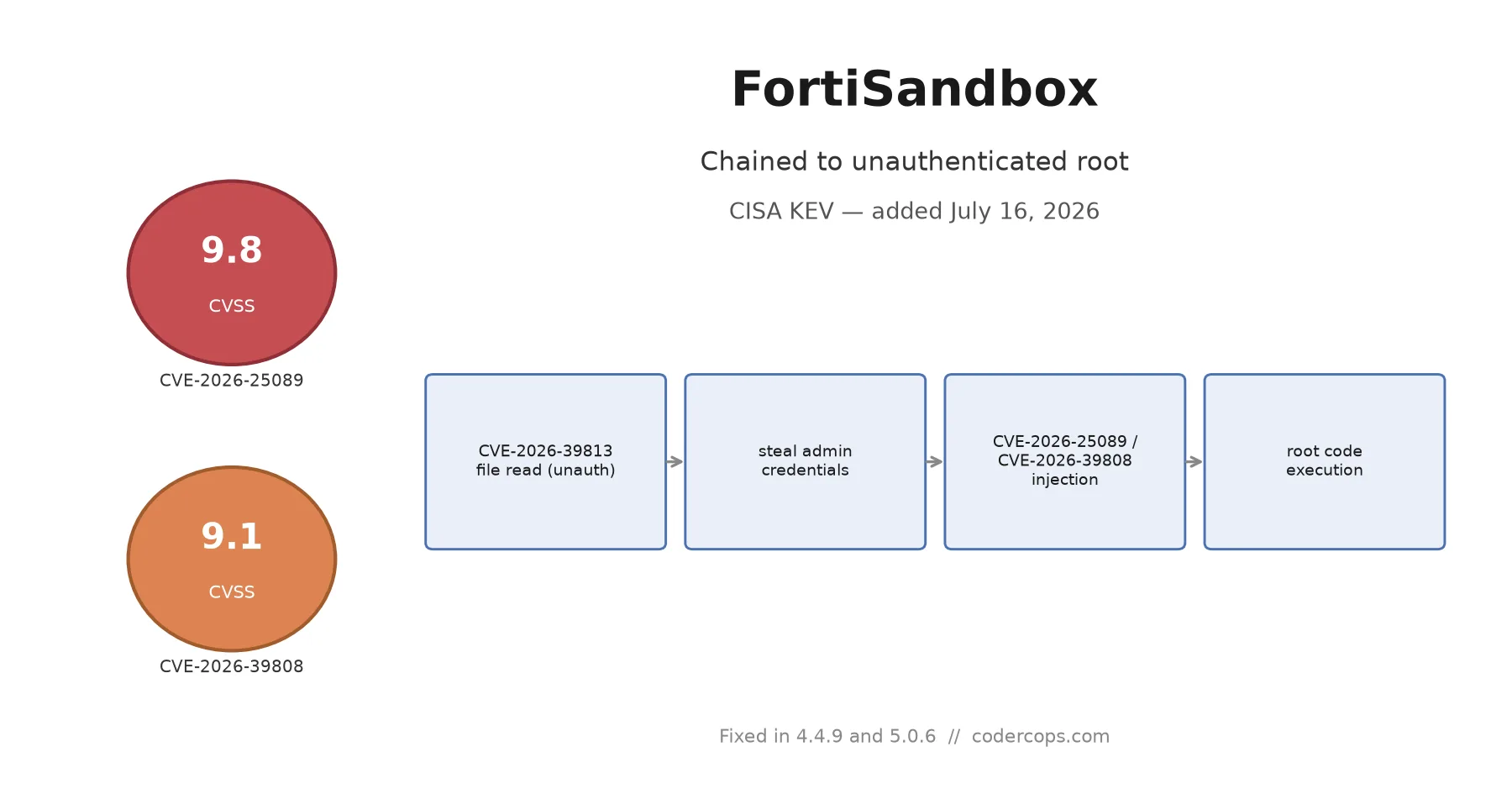
CVE-2026-25089 (CVSS 9.8) lives in the web UI’s “Start VNC” feature. Fortinet’s own product security team found it internally, credited to Adham El Karn. CVE-2026-39808 (CVSS 9.1) is a different bug in the FortiSandbox API, at the /fortisandbox/job-detail/tracer-behavior endpoint. The vulnerable parameter is jid, a GET parameter that the application hands to an OS-level process without stripping shell metacharacters:
GET /fortisandbox/job-detail/tracer-behavior?jid=1234|<command>A pipe character followed by an arbitrary command in that parameter executes as root. No sanitization, no allowlist, just a raw pass-through into a shell call.
Used individually, both bugs assume the attacker already has a session on the management interface. That’s the part that changes with the third CVE in the chain.
Why “authenticated” doesn’t hold as a mitigation
CVE-2026-39813 is a path traversal vulnerability in FortiSandbox’s JRPC API. On its own it’s a file-read bug: point it at the right path and it hands back file contents an unauthenticated caller shouldn’t see. Point it at FortiSandbox’s configuration database, and it hands back stored admin credentials.
The chain security researchers documented runs like this:
- CVE-2026-39813 reads the config database via path traversal, no login required.
- Credentials extracted from that database get the attacker an authenticated session.
- CVE-2026-25089 or CVE-2026-39808 takes it from there, injecting OS commands that execute as root.
Three bugs, individually rated as needing some form of access, that in sequence produce unauthenticated root code execution. This is the pattern that makes “but that one needs credentials” a weak argument during triage: if a lower-severity bug on the same box can hand an attacker those credentials, the chain’s actual severity is the severity of its worst step, not its first one. It’s the same logic behind treating idempotency and authorization as separate concerns rather than assuming one control covers a whole request path.
Who’s exposed
| Branch | Status |
|---|---|
| 4.2.x (all releases) | Vulnerable |
| 4.4.0 – 4.4.8 | Vulnerable |
| 4.4.9 and later | Fixed |
| 5.0.0 – 5.0.5 | Vulnerable |
| 5.0.6 and later | Fixed |
| FortiSandbox Cloud / PaaS, below 5.0.6 | Vulnerable |
If your instance is internet-facing, which some FortiSandbox management interfaces are despite Fortinet’s guidance to keep them isolated, treat this as urgent rather than routine. Security researchers reported scanning and exploitation attempts against the chain in the weeks before CISA’s KEV listing made it official, and public detail on the vulnerable endpoints is now widely available, which tends to widen the pool of attackers capable of using it.
What to check this week
Confirm your FortiSandbox build number against the fixed floors above, patch to 4.4.9 or 5.0.6 if you’re behind, and while you’re in there, pull the management interface off any network path it doesn’t strictly need. FortiSandbox’s entire job is to sit near untrusted content; giving it a smaller attack surface of its own is not optional hardening, it’s the appliance doing the one thing it was bought to do. If you can’t patch immediately, restrict access to the web UI and API to a management VLAN and review recent VNC session and JRPC access logs for requests you can’t account for.
Command injection chains that start with an unauthenticated file read are common enough that they’re worth checking for by pattern, not just by CVE number, the next time your security team reviews an appliance that touches anything untrusted by design.
Frequently asked questions
- What is CVE-2026-25089?
- It's an OS command injection vulnerability in FortiSandbox's web UI, specifically the 'Start VNC' feature, discovered internally by Fortinet's own product security team. It carries a CVSS score of 9.8 and, used on its own, requires authenticated access to the management interface.
- What is CVE-2026-39808?
- A separate OS command injection bug, CVSS 9.1, in the FortiSandbox API at the tracer-behavior endpoint. The vulnerable jid parameter gets passed to an OS-level process without stripping shell metacharacters, so a request with a pipe character followed by a command runs that command as root.
- How do attackers get around needing credentials?
- By chaining in a third bug, CVE-2026-39813, a path traversal flaw in FortiSandbox's JRPC API. It lets an unauthenticated attacker read files off the appliance, including the configuration database that holds admin credentials. Steal the credentials with 39813, then use them to reach 25089 or 39808 for command execution. The end result functions as unauthenticated root access even though the individual command-injection bugs technically want a login.
- Is this actually being exploited, or just theoretical?
- CISA added CVE-2026-25089 and CVE-2026-39808 to the Known Exploited Vulnerabilities catalog on July 16, 2026, which only happens with confirmed evidence of real-world exploitation. Security researchers had already reported active scanning and exploitation attempts against the chain in the weeks before the KEV listing.
- What FortiSandbox versions are safe?
- 4.4.9 and 5.0.6 fix the vulnerabilities applicable to each branch. If you're running 4.2.x, anything below 4.4.9, or anything below 5.0.6 on-prem, or FortiSandbox Cloud or PaaS builds below 5.0.6, treat the appliance as exposed until you upgrade.
Sources
Sponsored
More from this category
More from Cybersecurity
Sponsored
Discussion
Join the conversation.
Comments are powered by GitHub Discussions. Sign in with your GitHub account to leave a comment.
Sponsored