Cybersecurity · Vulnerability Management
CVE-2026-20230: Cisco Unified CM SSRF Chain That Leads to Root
An unauthenticated SSRF in Cisco Unified CM is being exploited to write files, plant a webshell, and reach root. The chain, and how to patch or work around.

Prathviraj Singh
5 min read
Sponsored
If your organization runs Cisco Unified Communications Manager for VoIP, and the WebDialer service is switched on, you have an unauthenticated path to root sitting on your network right now unless you’ve already patched or disabled it. CVE-2026-20230 has been under active exploitation since the weekend of June 21-22, and CISA’s federal remediation deadline already passed on June 28. If you’re not a federal agency, that deadline doesn’t apply to you directly, but the exploitation activity does.
What the bug actually does
Unified CM’s WebDialer service doesn’t properly validate specific HTTP requests before acting on them. That’s a textbook SSRF setup: an attacker crafts a request that makes the server issue an internal request on the attacker’s behalf, one the attacker couldn’t make directly because it’s supposed to stay inside the trust boundary.
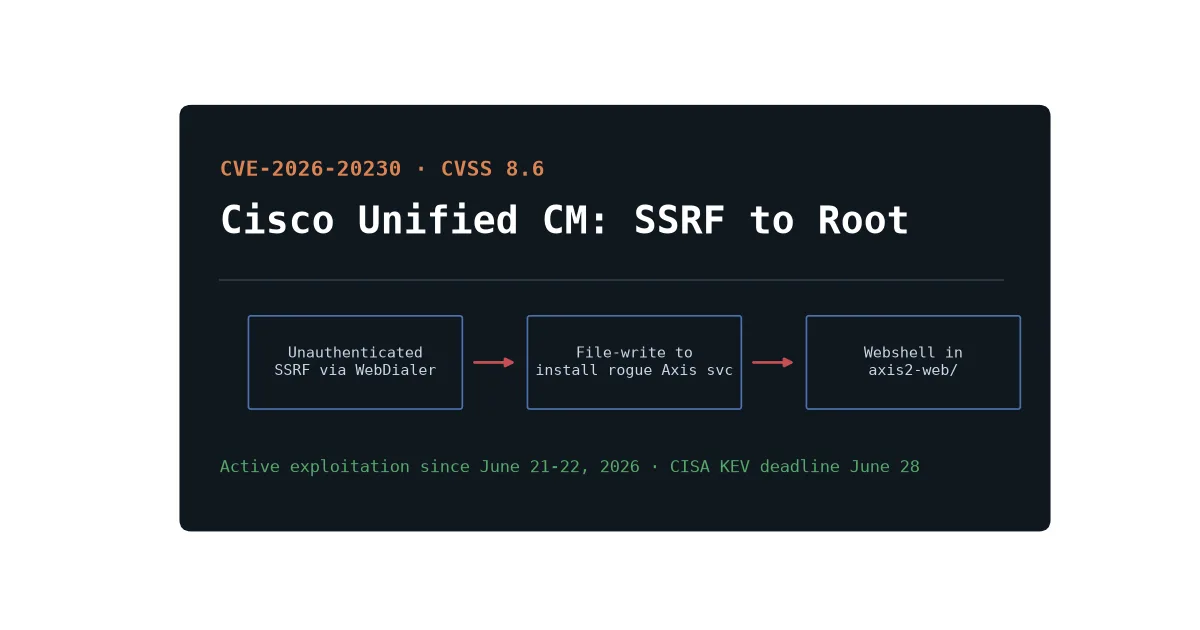
Here, the internal requests can use file:// URIs, which means the SSRF isn’t just a way to probe internal network segments, it’s a way to write arbitrary files to the underlying operating system. That distinction matters. Plenty of SSRF bugs are limited to information disclosure or blind requests to internal services. This one gives an attacker a write primitive on the host filesystem, and a write primitive is most of the way to code execution if you know what to write.
The chain from SSRF to webshell
Researchers tracking exploitation in the wild have reconstructed the path attackers are using once they have the file-write primitive:
Unauthenticated attacker
    │
    ├─ Crafted HTTP request to WebDialer ──► SSRF triggers internal file:// write
    │
    ├─ Write files to install a rogue Apache Axis service on the host
    │
    ├─ Use the rogue Axis service to write a JSP file-writer to disk
    │
    └─ Drop a webshell into /platform-services/axis2-web/
           │
           └─► Persistent, authentication-free remote code execution over HTTP
Each step alone is unremarkable. Chained together, they turn “the server will fetch an internal URL for me” into “the server will now run any command I send it over plain HTTP, indefinitely.” Threat detection startup Defused first observed this being exploited over the June 21-22 weekend, and reporting since then describes broader scanning activity, including Tor-anonymized sweeps, looking for exposed WebDialer endpoints.
Who’s affected
| Product | Affected | Fixed in |
|---|---|---|
| Unified CM 14.x | Yes | 14SU6 |
| Unified CM 15.x | Yes | 15SU5 (not due until September 2026) |
| Unified CM SME | Yes, same conditions | Same as above per train |
The precondition that matters most: WebDialer has to be enabled for the vulnerability to be reachable. If your deployment doesn’t use WebDialer, you’re not exposed to this specific CVE, though it’s worth confirming that rather than assuming it.
What to do, in order
- Check whether WebDialer is enabled. If it isn’t, and you don’t need it, leave it off and you’ve sidestepped this vulnerability entirely.
- If you’re on the 14 train, patch to 14SU6. This is a full fix, not a mitigation.
- If you’re on the 15 train, you’re waiting on 15SU5 in September. Until then, disabling WebDialer is your primary control. Cisco’s advisory covers interim guidance if disabling it isn’t operationally feasible.
- Assume compromise if WebDialer was internet-reachable before you patched. Given active exploitation since June 21-22, check for the specific artifacts described in the attack chain: an unexpected Apache Axis service, unfamiliar files under
/platform-services/axis2-web/, or JSP files you didn’t deploy. - Treat this as a KEV-catalog item even if you’re not a federal agency. CISA’s Binding Operational Directive deadlines apply to federal civilian agencies specifically, but the underlying signal, “this is being exploited right now, not theoretically”, applies to anyone running the affected software.
Why VoIP infrastructure keeps getting overlooked
Unified CM sits in a category of infrastructure that rarely gets the same patch cadence as web-facing application servers, partly because it’s telephony infrastructure and partly because it’s often managed by a networking or telecom team rather than the security team watching CVE feeds. That’s precisely why it’s an attractive target: an unauthenticated RCE chain on a system with elevated internal trust and a slower historical patch cycle is a better return on attacker effort than the same bug in a system everyone already watches closely. If you’re mapping out where the rest of your infrastructure sits on that same spectrum, our breakdown of Zero Trust architecture covers why “internal” shouldn’t imply “trusted” for exactly this class of system.
The practical lesson isn’t specific to Cisco. Any service that fetches URLs on a caller’s behalf, whether it’s a webhook handler, an image proxy, or a dial-by-URL feature like WebDialer, needs to validate what it’s being asked to fetch as rigorously as it validates a login request. An unauthenticated feature with internal fetch capability is a root-access vulnerability waiting for someone to find the right URI scheme.
Frequently asked questions
- What is CVE-2026-20230?
- A server-side request forgery (SSRF) vulnerability in Cisco Unified Communications Manager and Unified CM Session Management Edition, caused by improper input validation of HTTP requests handled by the WebDialer service. An unauthenticated remote attacker can send a crafted request that makes Unified CM issue internal requests on the attacker's behalf, including file:// requests that write arbitrary files to the underlying OS.
- Do I need to be logged in to exploit this?
- No. That's what makes it a critical-severity bug rather than a routine one. No credentials, no prior access, and no user interaction are required, only network reachability to a Unified CM instance with WebDialer enabled.
- How does a file-write bug turn into remote code execution?
- The observed attack chain uses the SSRF to install a rogue Apache Axis service on the target, then uses that service to write a JSP file-writer to disk, and finally drops a command-execution webshell into the /platform-services/axis2-web/ directory. From there the attacker has a persistent, authentication-free way to run commands over HTTP, and Cisco notes the file-write capability alone could be used to escalate to root.
- What versions fix this?
- 14SU6 fixes it on the 14 train. On the 15 train, the full Service Update (15SU5) isn't scheduled until September 2026, so anyone running 15.x needs to rely on Cisco's interim guidance and the WebDialer workaround until that ships.
- What's the fastest thing I can do if I can't patch today?
- Disable the WebDialer service. Cisco and multiple independent researchers confirm WebDialer must be enabled for this vulnerability to be reachable at all. Turning it off removes the attack surface immediately, no maintenance window required, though you lose WebDialer functionality until you patch and re-enable it.
Sources
- Cisco Security Advisory: Unified Communications Manager SSRF Vulnerability
- CISA: Adds Two Known Exploited Vulnerabilities to Catalog (June 25, 2026)
- BleepingComputer: CISA sets urgent deadline to fix Cisco flaw exploited in attacks
- The Hacker News: Cisco Unified CM flaw exploited after PoC reveals file-write path to root
Sponsored
More from this category
More from Cybersecurity
Sponsored
Discussion
Join the conversation.
Comments are powered by GitHub Discussions. Sign in with your GitHub account to leave a comment.
Sponsored