AI Integration · Machine Learning
Decision Trees: Advantages, Disadvantages, and Applications
Understand decision tree algorithms for classification and regression, their pros and cons, and build an Iris classifier with Python code.

Anurag Verma
5 min read

Sponsored
Introduction to Decision Trees
Decision trees are a type of supervised machine-learning algorithm used for both regression and classification problems. This guide walks through their key advantages and disadvantages, common applications, and a hands-on Python example. They are tree-based models that split the data into smaller subsets based on certain conditions. The final output is obtained by combining the results of multiple splits. Decision trees are simple, interpretable, and easy to visualize, making them a great choice for data scientists.
Here’s a simple example of how a decision tree could be used for a binary classification problem. Let’s say we have a dataset of students and their study habits, and we want to classify each student as either “pass” or “fail”. The features in our dataset might include the number of hours the student studies per week, their test scores, and their attendance record.
Here’s an example of how a decision tree could look for this problem:
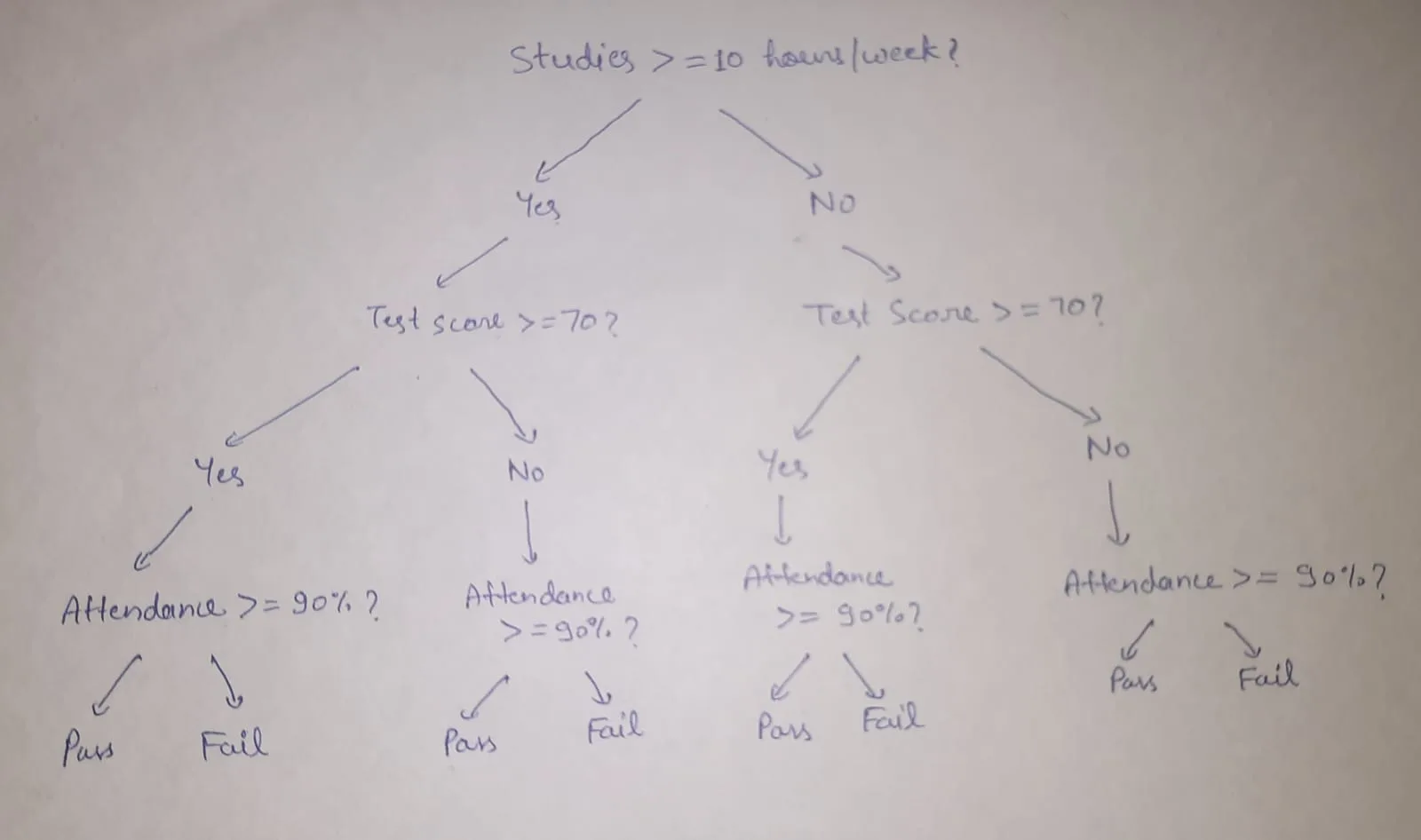
In this example, we start at the root node and ask the first question: “Does the student study >= 10 hours per week?” Depending on the answer, we follow the corresponding branch and ask the next question. For example, if the answer is “YES”, we then ask “Does the student have a test score >= 70?” and so on, until we reach a leaf node, which represents the final prediction.
In this way, the decision tree learns from the training data to make predictions for new, unseen data. The idea is to create a tree where each internal node represents a feature that maximizes the separation between the classes in the data, and each leaf node represents a class label.
Advantages of Decision Trees
-
Easy to understand: Decision trees are easy to understand and interpret, even for non-technical people. This makes them a great tool for explaining complex models to stakeholders.
-
Handle Non-Linear Relationships: Decision trees can handle non-linear relationships between features and target variables, making them a great choice for datasets with complex relationships.
-
Handle Missing Values: Decision trees can handle missing values in the data, making them a great choice for datasets with missing values.
-
Little Data Preparation: Decision trees require little data preparation, making them a great choice for datasets that have not been cleaned or preprocessed.
Disadvantages of Decision Trees
-
Overfitting: Decision trees are prone to overfitting, especially when the tree is deep and complex. This can result in poor generalization performance on unseen data — see our guide to overfitting and underfitting for how to spot and fix it.
-
Instability: Decision trees can be unstable, meaning that small changes in the data can result in different trees. This makes them less suitable for datasets with high variability. Random forests, which train many trees and average their predictions, address both of these weaknesses.
Where to Use Decision Trees
-
Classification Problems: Decision trees are a great choice for classification problems, especially when the relationships between features and target variables are non-linear.
-
Regression Problems: Decision trees can also be used for regression problems, although they are not as commonly used as they are for classification problems.
Where Not to Use Decision Trees
-
High-Dimensional Data: Decision trees are not well suited for high-dimensional data, as the number of splits required to split the data becomes very large.
-
Large Datasets: Decision trees can become slow and inefficient on large datasets, making them a poor choice for large datasets.
Example: Predicting Diabetes
To illustrate the use of decision trees, let’s consider a simple example of predicting diabetes based on certain features. Here is an example of how to build a decision tree for this problem in Python using the scikit-learn DecisionTreeClassifier:
import pandas as pd
from sklearn.tree import DecisionTreeClassifier
from sklearn.model_selection import train_test_split

# load the data
data = pd.read_csv("diabetes_data.csv")

# split the data into training and testing sets
train_data, test_data, train_target, test_target = train_test_split(data.drop("Outcome", axis=1), data["Outcome"], test_size=0.2)

# build the decision tree model
model = DecisionTreeClassifier()
model.fit(train_data, train_target)

# evaluate the model on the testing set
accuracy = model.score(test_data, test_target)
print("Accuracy:", accuracy)
In this example, we used the diabetes_data.csv dataset, which contains various features related to diabetes, such as age, blood pressure, and glucose level. The target variable, Outcome, indicates whether the patient has diabetes (1) or not (0). We split the data into training and testing sets and then built a decision tree model using the DecisionTreeClassifier class from scikit-learn. Finally, we evaluated the model on the testing set and printed the accuracy.
Visualizing Decision Trees
One of the benefits of decision trees is their interpretability and easy visualization. In Python, we can visualize decision trees using the plot_tree function from the sklearn library. Here is an example of how to visualize the decision tree from the previous example:
from sklearn import tree
import matplotlib.pyplot as plt

plt.figure(figsize=(20,10))
tree.plot_tree(model, filled=True)
plt.show()
In this example, we import the tree module from the sklearn library and the matplotlib.pyplot module for plotting. Then, we use the plot_tree function to visualize the decision tree and display it using the show function from matplotlib.pyplot.
Conclusion
Decision trees are a simple machine learning algorithm that works for both regression and classification problems. They are easy to understand and visualize, and can handle non-linear relationships and missing values in the data. That said, they are prone to overfitting and instability and are not well-suited for high-dimensional data or large datasets. With the right data and appropriate modifications, decision trees can be a great tool for data scientists.
Frequently asked questions
- What is the biggest weakness of decision trees?
- Overfitting. A deep, complex tree can fit the training data almost perfectly while generalizing poorly to new data. Pruning the tree or limiting its maximum depth helps, but the underlying instability, where small data changes reshape the tree, remains a real limitation.
- When should I use a decision tree instead of another algorithm?
- Decision trees work well for classification or regression problems with non-linear relationships, especially when you need a model stakeholders can actually read and understand. Avoid them for high-dimensional data or very large datasets, where they get slow and lose accuracy.
- Do decision trees need a lot of data preprocessing?
- No, that's one of their advantages. Decision trees handle missing values and don't require feature scaling the way algorithms like SVMs or KNN do, so they need comparatively little data preparation before training.
- How is a random forest different from a single decision tree?
- A random forest trains many decision trees on different subsets of the data and features, then averages their predictions. This fixes much of the overfitting and instability of a single tree, at the cost of losing the easy visual interpretability that a single tree offers.
- Can decision trees handle both classification and regression?
- Yes. The same underlying algorithm splits data based on feature conditions for both tasks; classification trees predict a category at each leaf, while regression trees predict a continuous value, typically the average of the training examples in that leaf.
Sponsored
More from this category
More from AI Integration
Sponsored
Discussion
Join the conversation.
Comments are powered by GitHub Discussions. Sign in with your GitHub account to leave a comment.
Sponsored