AI Integration · AI Safety
Guardrails AI vs NeMo Guardrails vs Llama Guard in 2026
Guardrails AI validates structured output, NeMo Guardrails controls dialog flow, and Llama Guard classifies safety. Here is which one fits your LLM app.

Abhishek Gupta
7 min read
Sponsored
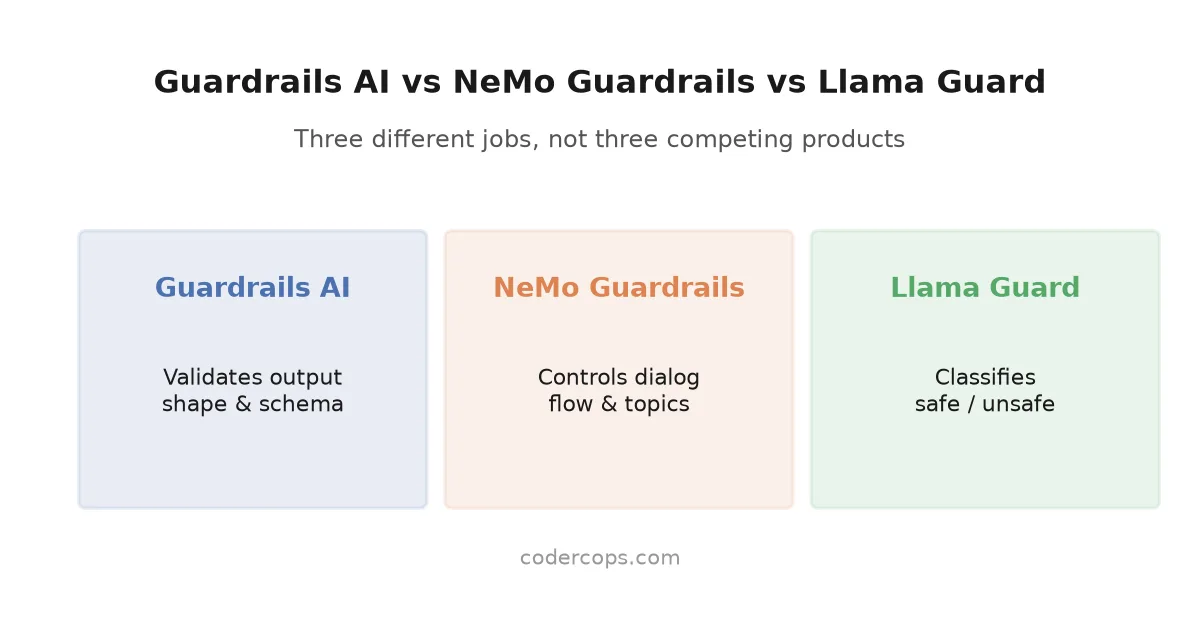
Choose Guardrails AI if your problem is getting an LLM to reliably emit valid JSON, a specific schema, or content free of a defined category (PII, profanity, off-brand claims). Choose NeMo Guardrails if you’re building a multi-turn conversational agent and need to control what topics it will and won’t engage with. Choose Llama Guard if you need a fast, cheap, model-agnostic yes/no safety check in front of or behind any LLM call, including as one layer of defense against prompt injection attacks. Most teams past the prototype stage end up running two of the three, because they solve different problems.
Why this comparison keeps confusing people
Search “LLM guardrails” and you’ll find these three named in the same breath constantly, as if they’re competing products. They’re not. Guardrails AI is a validation library. NeMo Guardrails is a conversation-flow controller. Llama Guard is a classifier model. The confusion is understandable because “guardrails” as a category name got applied to all three, but picking the wrong one because you assumed they’re interchangeable means shipping the wrong kind of safety net for the failure mode you actually have.
At a glance
| Guardrails AI | NeMo Guardrails | Llama Guard | |
|---|---|---|---|
| What it actually does | Validates LLM output against schemas and rules | Controls dialog flow, topic boundaries, jailbreak resistance | Classifies text as safe/unsafe with a category |
| Mechanism | Python validator chain (50+ in the Hub) | Colang DSL across 5 rail types | 12B-parameter classifier model |
| Typical latency | 50-200ms per validation | Under 50ms per check (GPU) | Model inference time, varies by serving setup |
| Best fit | Structured output, format enforcement | Multi-turn conversational agents | Fast input/output content classification |
| License | Open source Hub + paid enterprise tier | Open source | Open weights (Llama license) |
| Runs where | Your app process | Your app process | Anywhere you can serve a 12B model |
How each one actually works
Guardrails AI: validating the shape of what comes out
Guardrails AI wraps an LLM call and checks the response against validators you specify: a JSON schema, a regex, a “must not contain X” rule, a custom Python function. Its Hub ships more than 50 pre-built validators, so instead of writing your own PII detector or profanity filter, you install one and chain it into the validation pipeline. Each validator runs in the 50-200ms range, and because you can chain several, total added latency scales with how many checks you stack on a given response.
The failure mode it solves: an LLM that’s supposed to return {"status": "approved", "reason": string} occasionally returns prose, a markdown code fence around the JSON, or a field name that’s almost right. Guardrails AI catches that before it hits your downstream parser and, depending on configuration, can retry the generation or fail closed instead of passing malformed data further into your system. If you’re already fighting this problem without a validator, our guide to reliable JSON output covers the model-side half of the fix; Guardrails AI is the enforcement layer on top of it.
The enterprise tier (SOC 2 compliance, SSO, audit logs, a managed cloud) exists for teams that need to answer a vendor security questionnaire about their guardrails layer, not for teams that just want the validation logic.
NeMo Guardrails: controlling where the conversation goes
NVIDIA’s NeMo Guardrails takes a different angle entirely: it’s not checking output format, it’s governing conversational behavior across a multi-turn interaction. You define rails in Colang, a domain-specific language purpose-built for this, across five stages: input rails process what the user sent before it reaches your model, dialog rails control the flow of the conversation itself, retrieval rails filter what comes back from a knowledge base before it’s used, execution rails gate tool and function calls, and output rails check the final response.
That’s the tool for “this support bot should never discuss pricing for the enterprise tier” or “if the user asks about a competitor, redirect to this specific talking point,” rules that live at the level of conversation strategy, not output format. Colang 2.0 rewrote both the language and runtime with a flows engine that supports multiple parallel flows and pattern matching over a stream of events, which is a meaningfully more powerful model than Colang 1.0’s linear rail definitions if your bot’s logic branches heavily.
Performance-wise, rails run under 50ms per check on GPU, because they’re pattern and intent matches, not full generation calls. That matters if you’re layering several rails per turn in a live conversation where added latency is directly felt by the user.
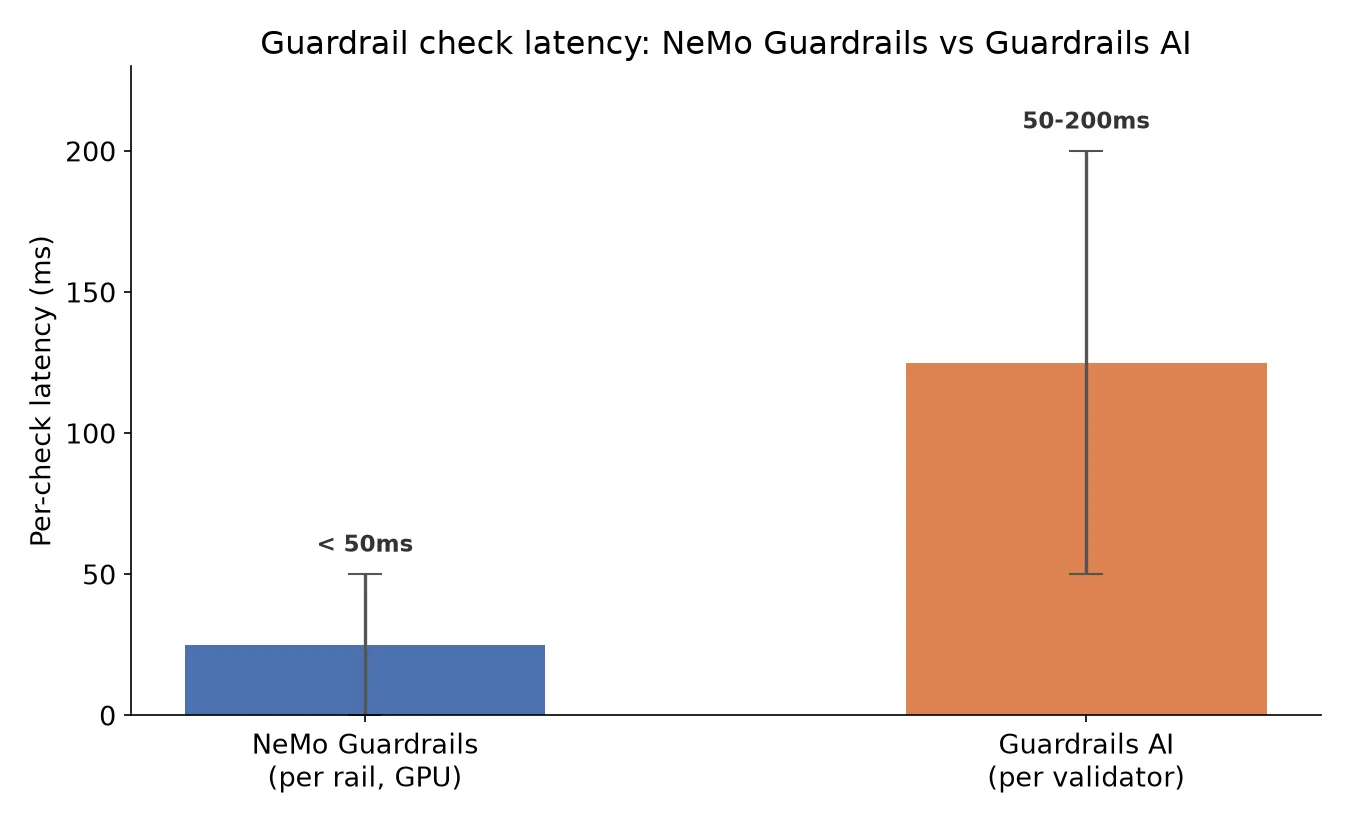
Guardrails AI’s validators sit in a noticeably higher latency band, 50-200ms per validation, because a validator is doing real work against the response text (schema parsing, regex matching, sometimes a secondary model call for semantic checks), not a lightweight pattern match against a conversation state machine. Neither number includes the LLM generation call itself, both are the added overhead of the guardrail layer on top of it.
Llama Guard: a fast yes/no on content safety
Llama Guard 4 is Meta’s open-weight safety classifier: 12 billion parameters, natively multimodal (it can classify content in images as well as text since its April 2025 release), trained against the MLCommons safety taxonomy plus an added Code Interpreter Abuse category for tool-calling use cases. Feed it a prompt or a response, and it returns a safe/unsafe verdict with a category code, nothing more elaborate than that.
The number worth remembering: on Meta’s own benchmark, Llama Guard posts roughly a third the false-positive rate of using GPT-4 as an ad hoc safety classifier. That’s the actual value proposition. Using a general-purpose model to gate content sounds convenient until you measure how often it flags benign content as unsafe, and Llama Guard is specifically trained to be better calibrated for that one job than a general chat model repurposed for it.
Because it’s a standalone model, not a library, you’re responsible for serving it. That means its latency depends entirely on your inference setup: fine on a GPU-backed endpoint you already run, a genuine added cost if you’re spinning up dedicated infrastructure just to run a 12B classifier in front of every request.
Licensing and what it actually costs you
Llama Guard and the open-source core of NeMo Guardrails are both free, no hosted API, run-it-yourself. NeMo Guardrails carries an implicit cost path if you want NVIDIA’s enterprise support and NIM-based deployment tooling, which runs under NVIDIA AI Enterprise licensing. Guardrails AI’s open-source Hub costs nothing; its commercial product adds the compliance and access-control features that don’t matter until a customer’s security team asks for them, at which point they matter a lot.
None of these carry a per-token API fee the way calling an external moderation API does. The cost you’re actually paying is compute (for NeMo’s rails and especially for serving Llama Guard) and engineering time to wire the validation logic into your app correctly, which is not nothing.
Which one to actually pick
If your LLM call is a single-turn completion that needs to come back in a specific shape (structured extraction, a function-calling response, a classification label), start with Guardrails AI. If you’re building a conversational agent with multiple turns and topics you need to keep it away from, NeMo Guardrails is the right layer, and Guardrails AI can still sit on top of its output. If your concern is content safety broadly, harmful, unsafe, or policy-violating content, in front of or behind any model, Llama Guard is the purpose-built tool, and it’s model-agnostic enough to sit in front of a non-Llama API call without any friction.
The mistake to avoid is picking one and assuming you’re covered. A support agent that validates its JSON output with Guardrails AI but has no dialog-level topic control can still be walked into discussing something it shouldn’t, just in a well-formed JSON envelope. If you’re setting up an AI red-teaming pass before launch, test each layer’s failure mode independently, not just the combined pipeline, so you know which guardrail actually caught (or missed) each attack.
Frequently asked questions
- What's the difference between Guardrails AI and NeMo Guardrails?
- Guardrails AI validates the shape and content of an LLM's output against rules you define, things like 'this must be valid JSON matching this schema' or 'this must not contain a phone number.' NeMo Guardrails, from NVIDIA, controls the flow of a multi-turn conversation using Colang, deciding what topics are allowed, when to pull in retrieval, and how to respond to specific user intents. One validates output shape; the other governs conversation behavior. Many production apps use both.
- Is Llama Guard only for Llama models?
- No. Llama Guard is a standalone classifier you can put in front of any LLM's input or behind any LLM's output, regardless of which model generated the text. It happens to be built by Meta and trained on the MLCommons safety taxonomy, but nothing about its architecture ties it to Llama-family models specifically. It's commonly deployed as a lightweight safety gate in front of GPT, Gemini, or Claude API calls too.
- Do I need a guardrails framework if I already have a system prompt?
- A system prompt is a request, not an enforcement mechanism. The model can ignore it under adversarial input, and even well-behaved models drift on long conversations. A guardrails framework checks the actual output (or input) against a rule you control outside the model's own reasoning, which is what a system prompt structurally cannot do. If your app has any compliance, safety, or format requirement you can't afford to violate, a system prompt alone isn't sufficient.
- Which guardrails framework is fastest?
- NeMo Guardrails posts the fastest per-check latency of the three at under 50ms on GPU, because its rails are lightweight pattern and intent checks rather than full model inference. Guardrails AI's validators run 50-200ms depending on which ones you chain. Llama Guard is a full 12B-parameter model inference call, so its latency depends on your serving setup, typically higher than either of the other two unless you've optimized the deployment specifically.
- Can I use more than one of these together?
- Yes, and in production it's common. A typical stack runs Llama Guard as a fast content classifier at the input and output boundary, then Guardrails AI to enforce structured output shape on whatever gets through, with NeMo Guardrails layered in if the app is a multi-turn conversational agent that needs topic and flow control. They're complementary layers, not competing choices, for anything beyond a simple single-turn completion endpoint.
Sources
Sponsored
More from this category
More from AI Integration
Sponsored
Discussion
Join the conversation.
Comments are powered by GitHub Discussions. Sign in with your GitHub account to leave a comment.
Sponsored