Business · Industry Trends
Emergent Hit $1.5B Building Apps From Prompts
Emergent raised $130M at a $1.5B valuation with 12M apps built and 200,000 paying customers. What that scale signals, and where custom development wins.

Anurag Verma
4 min read
Sponsored
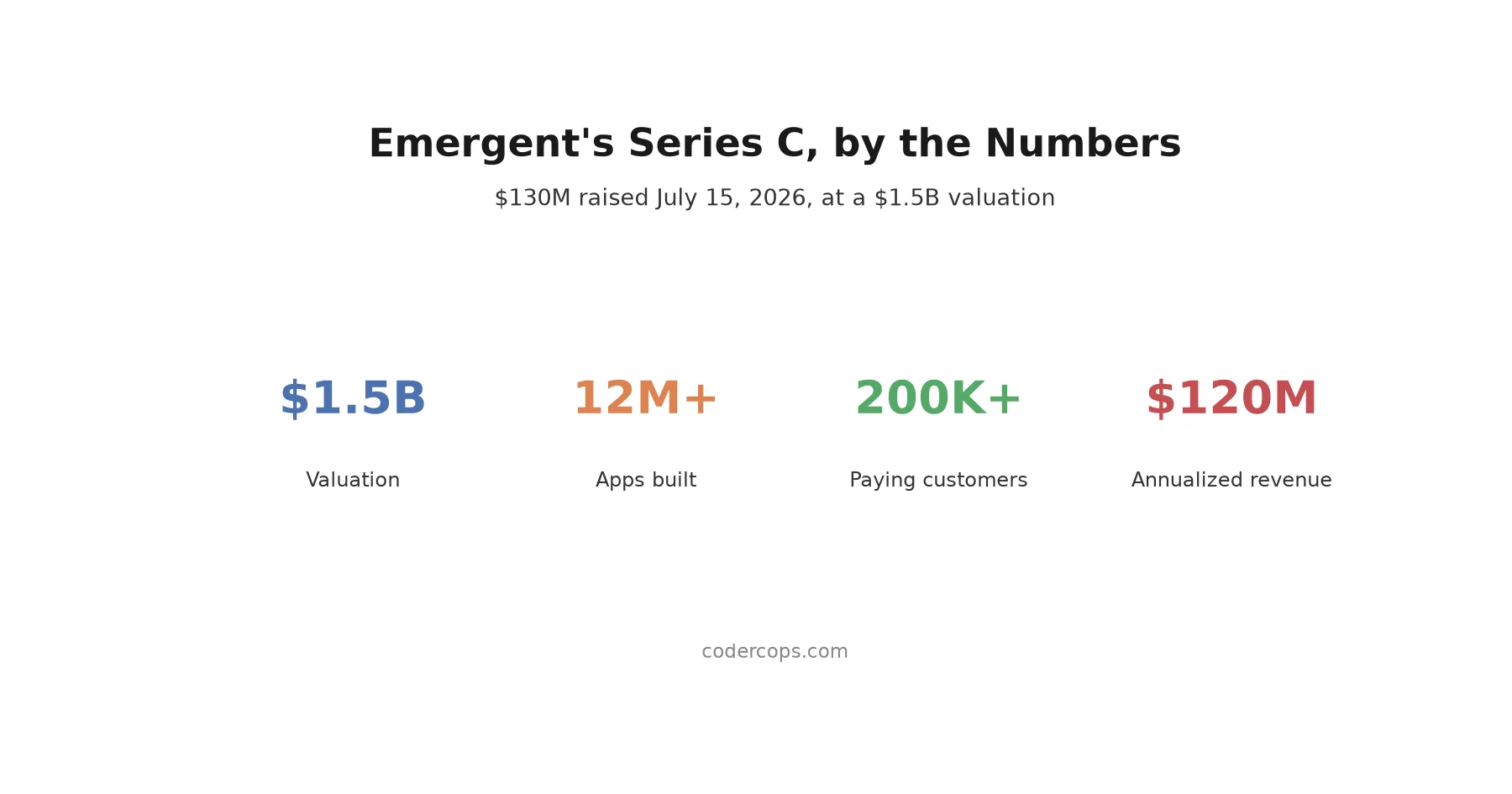
An Indian startup called Emergent raised $130 million on July 15, 2026, at a $1.5 billion valuation, a little over a year after it publicly launched. The round was led by Creaegis, with Khosla Ventures, SoftBank Vision Fund 2, Lightspeed, and Y Combinator all participating. The company’s pitch: describe an app in plain English, and a coordinated set of AI agents builds and deploys it, no code required. The traction numbers are the part worth taking seriously: 12 million-plus apps built, 200,000-plus paying customers, $120 million in annualized revenue. This isn’t a demo that went viral. It’s a business with real, recurring revenue at meaningful scale.
How it actually works
Emergent isn’t a single model generating a single file. It runs a network of specialized, autonomous agents that divide the work the way a small dev team would: one agent handles UI design, another configures the backend database, a third writes the business logic, and a fourth manages cloud deployment. The user’s job is to describe what they want; the coordination between agents is what turns that description into a deployed, working application.
That architecture is the more interesting story than the funding number itself. It’s a concrete example of multi-agent orchestration, not a single chatbot, being the thing that made a natural-language-to-app product actually work well enough for 200,000 people to pay for it.
The scale is real, the target customer is specific
It’s worth being precise about who is actually using this. Emergent’s own framing is founders and small business owners with no technical background, people who previously either paid an agency a few thousand dollars for a simple internal tool, hired a freelancer, or just didn’t build the thing at all because the cost didn’t make sense for what they needed. Twelve million apps built sounds enormous until you consider that a large share of those are simple, self-contained tools: an internal tracker, a basic customer portal, a straightforward booking form. That’s a real market, and Emergent is capturing a meaningful piece of it. It is not the same market as a company that needs a system integrated with its existing ERP, handling regulated data, or built to scale past a few thousand users.
What this actually changes for agencies
The honest read is that this kind of platform competes directly for a category of work that was often marginal for a services business anyway: the client who needs something simple, fast, and cheap, and was never going to be a good long-term account. Losing that segment to a $7.99-a-month app builder isn’t really a loss for an agency built around solving harder problems.
The real risk is more subtle: a founder who actually needs custom integration work, real scalability, or compliance-aware architecture starts with a tool like Emergent because it’s fast and cheap, gets to a working prototype, and only discovers the gap between “working demo” and “production system that survives real usage” once they’ve already sunk months into an approach that doesn’t hold up. That’s not a reason to dismiss the category, it’s a reason for agencies to be sharper about explaining, up front, exactly where that gap shows up: data model rigidity as usage grows, the absence of a real testing or deployment pipeline, and the lack of a system built with anyone accountable for its long-term behavior.
We’ve covered this shift from a few different angles, including whether vibe coding is actually replacing traditional programming. Emergent’s numbers are a concrete data point in that conversation: the tools are good enough now that dismissing them outright is a mistake, but the boundary between “AI can build this” and “this needs an engineering team” hasn’t moved as much as a $1.5 billion valuation might suggest.
The practical response
Agencies that treat this purely as a threat are missing half the picture. The same multi-agent, prompt-to-scaffold approach that powers Emergent is worth adopting internally for the genuinely commodity parts of a build, boilerplate, CRUD scaffolding, basic UI generation, so engineering time goes toward the parts of a project that actually require judgment: architecture decisions, integration work, security, and the ongoing maintenance relationship that a one-time app generator was never built to provide.
If you’re evaluating whether a project in front of you is a good fit for a prompt-to-app tool or needs a team that owns the outcome long-term, the honest test is whether the requirements list includes integration with something that already exists, a compliance obligation, or an expectation that the system still works and evolves in three years. If any of those apply, that’s custom development territory regardless of how good app builders get in the meantime.
Frequently asked questions
- What does Emergent actually do?
- Emergent lets someone describe an app in plain English and get a working, deployed full-stack web or mobile application without writing code. Under the hood it runs a set of specialized AI agents in coordination: one designs the interface, one configures the backend database, one writes business logic, and one handles cloud deployment. It's aimed at founders and small business owners without a technical background.
- How big is Emergent, really?
- By the company's own numbers at the time of its Series C: more than 12 million applications built on the platform, over 200,000 paying customers, and a $120 million annualized revenue run rate. The $130M round, led by Creaegis with Khosla Ventures, SoftBank Vision Fund 2, Lightspeed, and Y Combinator participating, valued the company at $1.5 billion, achieved just over a year after its public launch.
- Does a startup like Emergent threaten software development agencies?
- For a specific slice of work, yes, the simple, self-contained internal tool or basic customer-facing app that a non-technical founder used to either pay an agency for or not build at all. For the work agencies actually compete for, systems with real integrations, scale requirements, security and compliance obligations, or anything that needs to evolve over years rather than exist as a static prototype, the threat is much smaller. AI app builders are good at getting from zero to a working demo fast; they're not yet a substitute for an engineering team that owns a production system long-term.
- Should an agency be worried about AI app-building platforms taking clients?
- The more useful frame is which clients, not whether. A prospect who was never going to pay agency rates and just needed a quick internal tool was often a bad-fit client anyway. The clients agencies should worry about losing are the ones whose actual needs (integration complexity, compliance, long-term maintenance) get incorrectly matched to a prompt-to-app tool by a founder who doesn't yet know the difference, and then come back six months later needing a rebuild. That's an argument for clearer positioning about what custom development actually buys a client, not a reason to dismiss the category.
- What should agencies actually do in response to this trend?
- Use the same AI tooling internally to move faster on the parts of a build that are genuinely commodity work, scaffolding, boilerplate, simple CRUD interfaces, while being explicit with prospective clients about where a $1.5B-valued app builder stops being the right tool: once an application needs to integrate with existing systems, handle real scale, or meet a compliance requirement, that's exactly the point where professional engineering judgment starts mattering more than generation speed.
Sources
Sponsored
Sponsored
Discussion
Join the conversation.
Comments are powered by GitHub Discussions. Sign in with your GitHub account to leave a comment.
Sponsored