AI Integration · Model Releases
Gemini 3.6 Flash: Cheaper, Faster, More Agentic
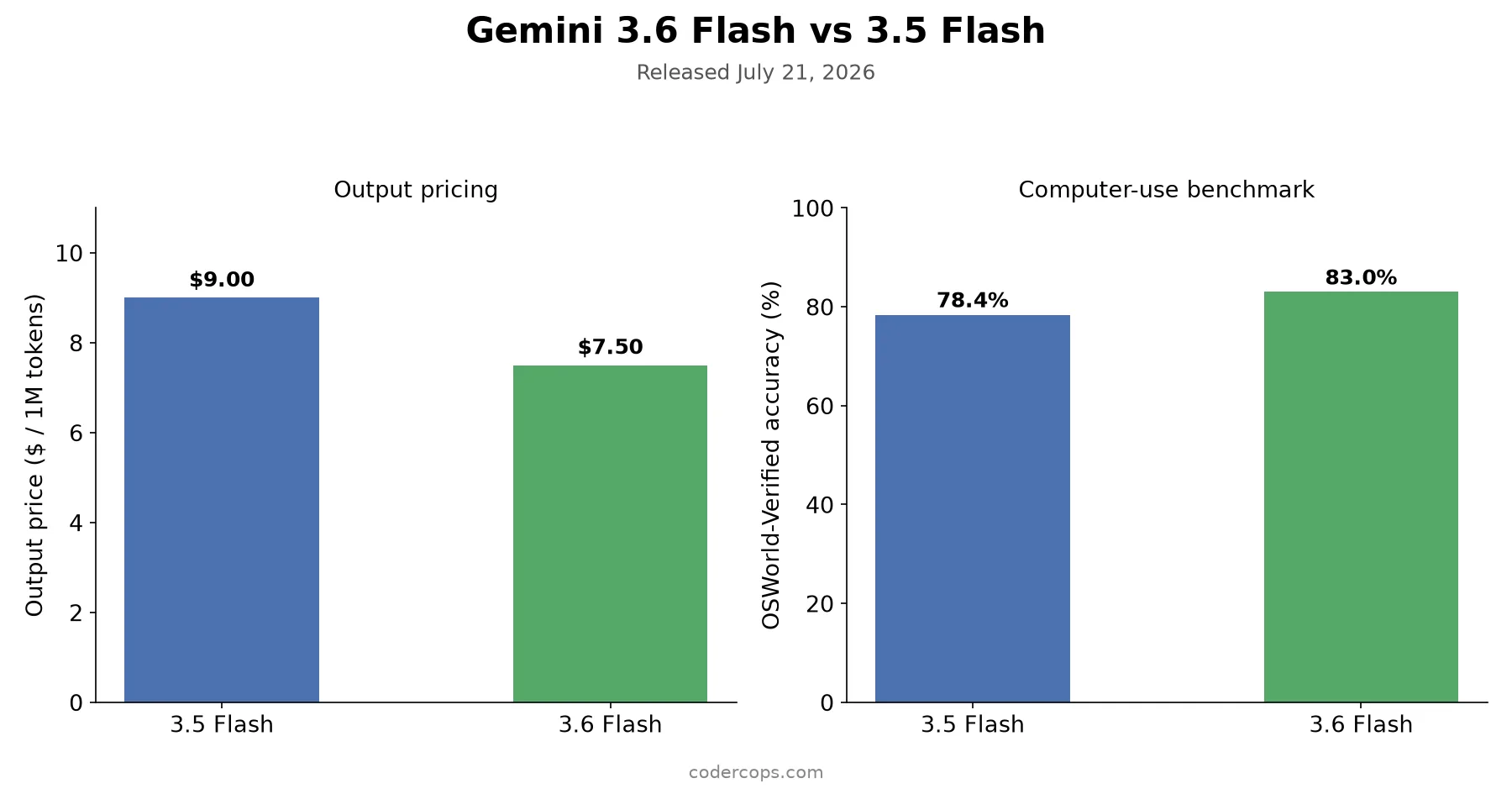
Gemini 3.6 Flash cuts output tokens up to 17%, drops output pricing to $7.50 per million, and lifts computer-use accuracy from 78.4% to 83%. Who cares.

Shashikant Gupta
5 min read
Sponsored
Google shipped three new Gemini models on July 21, 2026: Gemini 3.6 Flash, 3.5 Flash-Lite, and a specialized security variant called 3.5 Flash Cyber. The headline number is the pricing: output tokens drop from $9 to $7.50 per million, a straightforward win if you’re already running production traffic through the Flash tier. The more interesting number is 17%, the reported cut in output tokens needed to complete the same tasks, which means the real cost drop for agentic workloads is larger than the price change alone suggests.
What actually shipped
Three models, one tier, no Pro update:
- Gemini 3.6 Flash: the new general-purpose workhorse, positioned as the default choice for coding, knowledge work, and multimodal tasks.
- Gemini 3.5 Flash-Lite: the most cost-optimized model in the lineup, for high-volume, latency-sensitive use cases where 3.6 Flash’s capability is more than you need.
- Gemini 3.5 Flash Cyber: a variant fine-tuned specifically for finding and fixing cybersecurity vulnerabilities, priced for teams that want a specialized model rather than steering a general-purpose one toward security work with prompting alone.
Gemini 3.5 Pro did not get an update in this release. Google paired the announcement with a public tease of Gemini 4, without a ship date, which is the more likely explanation: Pro-tier gains are probably landing with the next major version rather than as an interim bump.
The numbers that matter for a production decision
| Metric | Gemini 3.5 Flash | Gemini 3.6 Flash |
|---|---|---|
| Output price (per 1M tokens) | $9.00 | $7.50 |
| Input price (per 1M tokens) | N/A | $1.50 |
| Output tokens for equivalent tasks | baseline | up to 17% fewer |
| OSWorld-Verified (computer use) | 78.4% | 83% |
| Knowledge cutoff | January 2025 | March 2026 |
The token-efficiency number is worth sitting with. A 17% cut in output tokens needed for the same task, layered on top of a lower per-token price, compounds. If your current 3.5 Flash spend is meaningful, this isn’t a marginal update, it’s a real reduction in what the same workload costs to run, assuming your prompts and tooling carry over cleanly, which for most Flash-tier use cases they should.
The knowledge cutoff jump, from January 2025 to March 2026, closes a gap that mattered for anything touching current library versions, recent APIs, or anything that needed the model to reason about the state of the world in the last year rather than a year and a half ago. That’s a quiet but practical improvement for coding assistants and research tools specifically.
Where the gains actually come from
Google attributes the coding improvements to higher precision with fewer unwanted edits and fewer execution loops, which is a different kind of gain than raw benchmark accuracy. An agent that needs three tool calls instead of five to finish a task isn’t just faster, it’s cheaper and less likely to compound small errors across a longer chain. That’s also the direct explanation for the 17% token reduction: fewer reasoning steps and fewer redundant tool calls per completed workflow, not just terser individual responses.
The computer-use jump from 78.4% to 83% on OSWorld-Verified is the number to watch if your product does anything with browser or desktop automation. A five-point gain on a benchmark that’s already in the high 70s is a meaningfully smaller error rate in relative terms, and computer-use tasks tend to fail in ways that compound (one wrong click early in a sequence derails everything after it), so accuracy gains near the top of the scale matter more than the raw percentage suggests.
Practical guidance
If you’re already running 3.5 Flash in production, testing 3.6 Flash as a drop-in swap is close to a no-brainer: same tier, lower price, fewer tokens per task, better benchmarks. The one caveat is anything tuned tightly to 3.5 Flash’s specific output style, tone, or latency characteristics, since a model swap can shift those even when the API surface is identical. Run your existing eval suite against 3.6 Flash before flipping production traffic, the same discipline you’d apply to any model upgrade, and don’t skip it just because the version bump looks incremental.
If you’re choosing a model for a new agentic build today, 3.6 Flash’s combination of lower cost per task and better multi-step tool-use accuracy makes it a reasonable default starting point for most workloads that don’t specifically need Pro-tier reasoning depth. We’ve written before about feature-flagging AI features precisely because model swaps like this one can shift output behavior in ways worth rolling out gradually rather than all at once, and that guidance applies directly here.
If your team is evaluating which model tier actually fits a specific workload rather than defaulting to whichever one is newest, that’s exactly the kind of architecture decision worth bringing in outside eyes on before you’ve built three months of product around an assumption that turns out to be wrong.
Frequently asked questions
- What exactly did Google release on July 21, 2026?
- Three models: Gemini 3.6 Flash, the new general-purpose workhorse tier; Gemini 3.5 Flash-Lite, the cheapest, most cost-optimized option in the lineup; and Gemini 3.5 Flash Cyber, a variant specifically fine-tuned for finding and fixing cybersecurity vulnerabilities. Notably, there was no accompanying update to Gemini 3.5 Pro, which Google addressed directly rather than leaving unexplained.
- How much cheaper is Gemini 3.6 Flash than its predecessor?
- Output pricing dropped from $9 per million tokens (3.5 Flash) to $7.50 per million tokens (3.6 Flash), roughly a 17% price cut on output. Input pricing sits at $1.50 per million tokens. Combined with the token-efficiency gains, the effective cost per completed task drops by more than the sticker price difference alone suggests, since 3.6 Flash also uses fewer output tokens and fewer tool calls to finish the same workflow.
- Is Gemini 3.6 Flash actually better at coding and agentic tasks, or just cheaper?
- Both, according to Google's own benchmarks. On coding tasks, 3.6 Flash produces higher precision with fewer unwanted code edits and fewer execution loops than 3.5 Flash. On computer-use tasks, measured by OSWorld-Verified, accuracy rose from 78.4% to 83%. It also completes multi-step agentic workflows using fewer reasoning steps and tool calls, which is the efficiency gain behind the reported 17% output-token reduction.
- Why didn't Google update Gemini 3.5 Pro alongside these models?
- Google didn't ship a Pro-tier update in this release, focusing instead on the Flash tier and a specialized security variant. Combined with the public tease of Gemini 4 in the same announcement, the more likely read is that Pro-tier improvements are being folded into that next major release rather than shipped incrementally in the interim.
- Should my team switch from 3.5 Flash to 3.6 Flash right away?
- For most workloads built on 3.5 Flash, yes, since 3.6 Flash is a drop-in upgrade on the same tier with lower per-token pricing, fewer tokens used per task, and better benchmark scores across coding and computer-use. The one thing worth testing before a blanket swap is any workflow tuned tightly around 3.5 Flash's specific output style or latency profile, since a model swap can shift both even when the interface stays the same.
Sources
Sponsored
More from this category
More from AI Integration
Sponsored
Discussion
Join the conversation.
Comments are powered by GitHub Discussions. Sign in with your GitHub account to leave a comment.
Sponsored