Business · Hiring
How to Hire a Go Developer in 2026: What to Screen
Go runs Kubernetes, Docker, Prometheus, and most cloud tooling. What the language attracts, what it demands, and how to screen for the right profile.

Prathviraj Singh
8 min read

Sponsored
Go occupies a specific and important niche in 2026. It is the language of cloud infrastructure. Kubernetes, Docker, Prometheus, etcd, Terraform, Grafana Loki, Cilium, and most of the tooling that modern infrastructure teams depend on day-to-day were written in Go. If you are hiring someone to build, extend, or maintain infrastructure components, you are almost certainly hiring into Go territory.
Go also runs a significant share of backend APIs, particularly at teams that have prioritized simplicity, performance, and operational predictability. The language’s ability to produce a single static binary with no runtime dependency has proven attractive for teams that deploy frequently and want predictable performance without the JVM overhead or the Node.js event loop’s quirks.
The challenge with hiring Go developers is that the talent pool is smaller than JavaScript or Python, the language’s characteristics attract a specific personality type, and the most common failure mode is hiring a developer who learned Go syntax but never internalized its idioms.
Two distinct profiles to hire for
Before writing the job description, decide which of these you need.
Infrastructure and platform engineers write Kubernetes operators, custom controllers, CLI tools, observability agents, CI/CD components, and internal platform tooling. They need deep concurrency knowledge, familiarity with the CNCF ecosystem, and the ability to read and contribute to complex Go codebases like controller-runtime or client-go. These roles are genuinely specialized and the talent pool is thin.
API and service engineers build HTTP or gRPC services, usually backed by PostgreSQL or Redis, that do the work of an application’s backend. They need good database design sense, HTTP fundamentals, and solid Go idioms, but they do not need to know the Kubernetes API machinery. These roles have a larger talent pool and a shorter ramp time.
Both profiles need the same Go fundamentals. The screen differs primarily in the depth of concurrency and systems knowledge it probes.
Goroutines and the concurrency question
The most common gap in Go developers who come from other languages is a surface-level grasp of goroutines.
Every developer who claims Go knowledge knows that go func() launches a goroutine and that channels are used to communicate between them. That part is in every Go tutorial. The production knowledge is in what happens when you get it wrong.
Ask this: “What is a goroutine leak, and how do you detect one in a running service?”
A developer who has not worked with production Go will give a vague answer about goroutines that “do not finish.” A developer who has hit this in production will tell you:
- A goroutine leak is a goroutine that is blocked indefinitely, usually waiting on a channel that will never be written to or a context that was not cancelled properly.
- In a long-running service, goroutine leaks cause the goroutine count to grow over time, eventually exhausting memory.
- You detect them with
runtime.NumGoroutine()in your metrics, or with a/debug/pprof/goroutineendpoint. - You fix them by ensuring every goroutine has an exit condition, usually through context cancellation.
Follow up: “Show me how you would launch 10 concurrent HTTP requests and collect all 10 results, handling both successes and errors, without leaking goroutines.”
The clean answer uses sync.WaitGroup or errgroup.WithContext, channels with a known buffer size, and proper context propagation. Any answer that creates goroutines without managing their lifecycle is a signal to probe further.
Error handling philosophy
Go’s if err != nil pattern gets mocked by developers coming from exceptions-based languages. The mockery is usually a signal.
Ask: “Go’s error handling is verbose compared to most modern languages. What do you think of the design choice, and how do you handle errors in practice?”
You are not looking for enthusiasm about the pattern. You are looking for whether the candidate understands why it exists.
A passing answer: “The explicitness is intentional. It makes the error handling visible in the code rather than hidden in a stack trace somewhere. The caller has to decide what to do with an error at the point it occurs, which leads to better-structured error handling. The downside is verbosity, but you can use fmt.Errorf('wrapping message: %w', err) to wrap errors with context without losing the original. I think it’s a reasonable tradeoff for production systems where understanding failures matters.”
A failing answer: “It’s annoying and verbose. I try to minimize it.” (Then watch how they handle errors in the take-home.)
The error wrapping question is important. Senior Go developers use %w with fmt.Errorf to add context at each layer of the call stack, and use errors.Is and errors.As for checking error types. Developers who return errors raw or ignore them in non-critical paths create debugging nightmares.
Interfaces and implicit satisfaction
Go interfaces are satisfied implicitly. There is no implements keyword. Any type that has the right methods satisfies an interface, whether it was written with that interface in mind or not.
This surprises developers from Java, C#, or Rust, and the surprise often creates subtle design errors.
Ask: “How does Go handle polymorphism, and how is it different from Java?”
A passing answer names implicit interface satisfaction, explains that any type with the matching method set satisfies an interface automatically, and mentions that this means you can define interfaces near the consumer (in the package that uses the behavior) rather than near the implementer. Bonus if they mention that small interfaces are more composable in Go than large ones (“the bigger the interface, the weaker the abstraction” is a Go proverb for a reason).
A failing answer describes inheritance or describes explicit interface registration. This suggests they have not written idiomatic Go yet.
Follow-up for senior candidates: “How do you design a package’s public interface in Go so that it is easy to mock in tests?”
The answer involves: using interfaces in function signatures (accept the interface, return the concrete type), keeping interfaces small (one or two methods if possible), and defining the interface in the package that consumes it rather than the package that implements it. This is the “accept interfaces, return structs” idiom and it matters for testability.
The context package
The context package is how Go propagates cancellation, deadlines, and request-scoped values through a call stack. It is everywhere in production Go: HTTP handlers, database calls, gRPC, goroutines launched during a request.
Ask: “Walk me through how you would use context in an HTTP handler that makes two database calls and one external API call. What happens when the client disconnects mid-request?”
Senior answer: They pass r.Context() from the incoming request through to every downstream call. Each database query and HTTP client call accepts a context. When the client disconnects, Go’s HTTP server cancels the request context. The database calls and external API call check the context, return context.Canceled errors, and the handler exits cleanly without doing unnecessary work. They mention that not propagating context means the server continues processing work after the client is gone, wasting resources and potentially causing issues.
Any answer that treats context as a key-value bag for arbitrary data (like a Java ThreadLocal) rather than a cancellation and deadline signal has missed the point.
Take-home task
For mid-level and above, use a take-home rather than a live coding exercise.
The task:
Write a command-line tool that accepts a list of URLs as arguments, fetches each URL concurrently (but no more than 5 at a time), and prints a summary: URL, HTTP status code, response time in milliseconds, and content-length header (or “unknown” if missing). Requests should time out after 10 seconds each. The tool should exit cleanly if the user presses Ctrl-C.
Expected time: 2-3 hours for a mid-level engineer. Expected deliverable: a single Go file or small module that compiles and runs correctly, with tests for any non-trivial logic.
What you are evaluating:
- Goroutine concurrency with a semaphore or worker pool (the “no more than 5 at a time” constraint)
- Context usage for timeout and cancellation
- Proper error handling and user-facing output
- Signal handling for Ctrl-C (
os.Signal,syscall.SIGINT) - Code that a reader can follow without comments
Red flags: spawning 100 goroutines without a limit, ignoring the context, using time.Sleep for cancellation, or crashing on the first non-200 response.
What Go developers look for in a role
Go engineers tend to have strong opinions about operational simplicity. They often chose Go because they wanted software that is easy to build, deploy, and debug, without a large runtime or a complex dependency chain.
Roles that appeal to experienced Go engineers tend to involve: greenfield infrastructure or platform work, real performance or reliability constraints that justify Go’s overhead vs Python/JavaScript, a team that values simplicity over abstraction, and deployment environments where a single static binary is an advantage.
Roles that drive Go engineers away: codebases with heavy OOP abstractions translated from Java, lots of interface{} usage, or Go used in places where a shell script would have been clearer.
For a broader view of the hiring process, see the technical interview framework and what a vetted developer process looks like.
If you would rather skip the search, codercops screens Go developers and hands you a vetted shortlist. See available Go developers on codercops and post your role to get matched.
Frequently asked questions
- What are the most common Go roles and how do they differ?
- The three most common Go roles are: backend API engineers (building REST or gRPC services, usually with PostgreSQL or Redis), infrastructure/DevOps engineers (Kubernetes operators, CLI tools, observability agents — this is where Go really dominates), and platform engineers (developer tooling, internal APIs, CI systems). The screening criteria overlap but differ in emphasis. Infrastructure roles need deeper concurrency knowledge; API roles need stronger SQL and database design skills.
- How much experience does a Go developer need before they are effective?
- Go's syntax is simple enough that a competent developer from another language can write useful code within weeks. The trap is that Go's concurrency model, error handling philosophy, and interface system require more time to internalize. A developer with six months of Go experience may be productive on straightforward services. Production concurrency (goroutine pools, context-based cancellation, proper shutdown sequences) typically takes 12-18 months of regular Go work to internalize.
- Should I require Go for infrastructure roles that touch Kubernetes or cloud tooling?
- Not necessarily as a hard requirement, but Go fluency dramatically increases a candidate's effectiveness in those roles. Kubernetes, Docker, Prometheus, etcd, Terraform providers, and most CNCF projects are written in Go. An infrastructure engineer who can read and contribute to those codebases is more effective than one who treats them as black boxes. If the role involves writing Kubernetes operators or custom controllers, Go is effectively mandatory.
- What is the Go standard for error handling and why does it matter?
- Go uses explicit error return values rather than exceptions. Every function that can fail returns an error as its last return value: `result, err := doSomething()`. The caller is expected to check `err != nil` before using `result`. This makes error handling visible in the code and prevents silent failures. Developers who find this pattern tedious and work around it (by ignoring errors or using `_ = err`) create unreliable software. The pattern exists for a reason and how a candidate talks about it tells you a lot about their approach to reliability.
- What is the typical salary range for a Go developer?
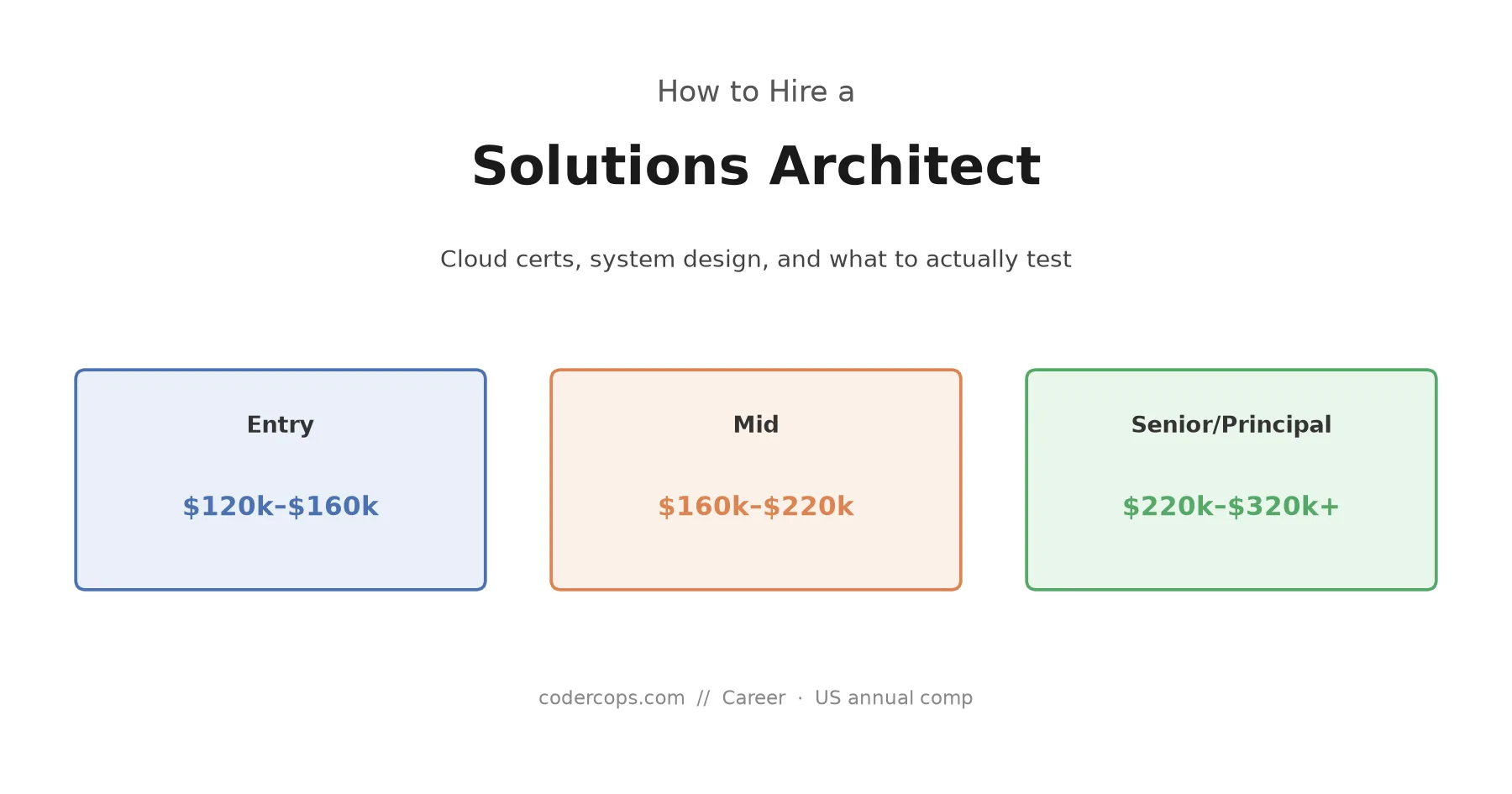
- Go developers command a premium over generalist backend roles because the talent pool is smaller. In 2026, a mid-level Go backend engineer (2-4 years Go-specific experience) in the US typically ranges from $130,000-$175,000. Senior Go engineers with infrastructure or platform experience run $175,000-$230,000+. Remote international rates vary significantly; for vetted remote options, see our guide on [what it costs to hire a developer](/blog/what-it-costs-to-hire-a-developer-2026/).
Sources
Sponsored
Sponsored
Discussion
Join the conversation.
Comments are powered by GitHub Discussions. Sign in with your GitHub account to leave a comment.
Sponsored