Business · Enterprise AI
IBM and OpenAI's Enterprise Deal: What It Means Beyond the Press Release
IBM is embedding GPT-5.6, Codex, and ChatGPT Work into IBM Consulting Advantage and training thousands of consultants on OpenAI's stack. Here's what the partnership actually covers, and what it signals for teams choosing between a systems integrator and a direct AI vendor relationship.

Anurag Verma
5 min read
Sponsored
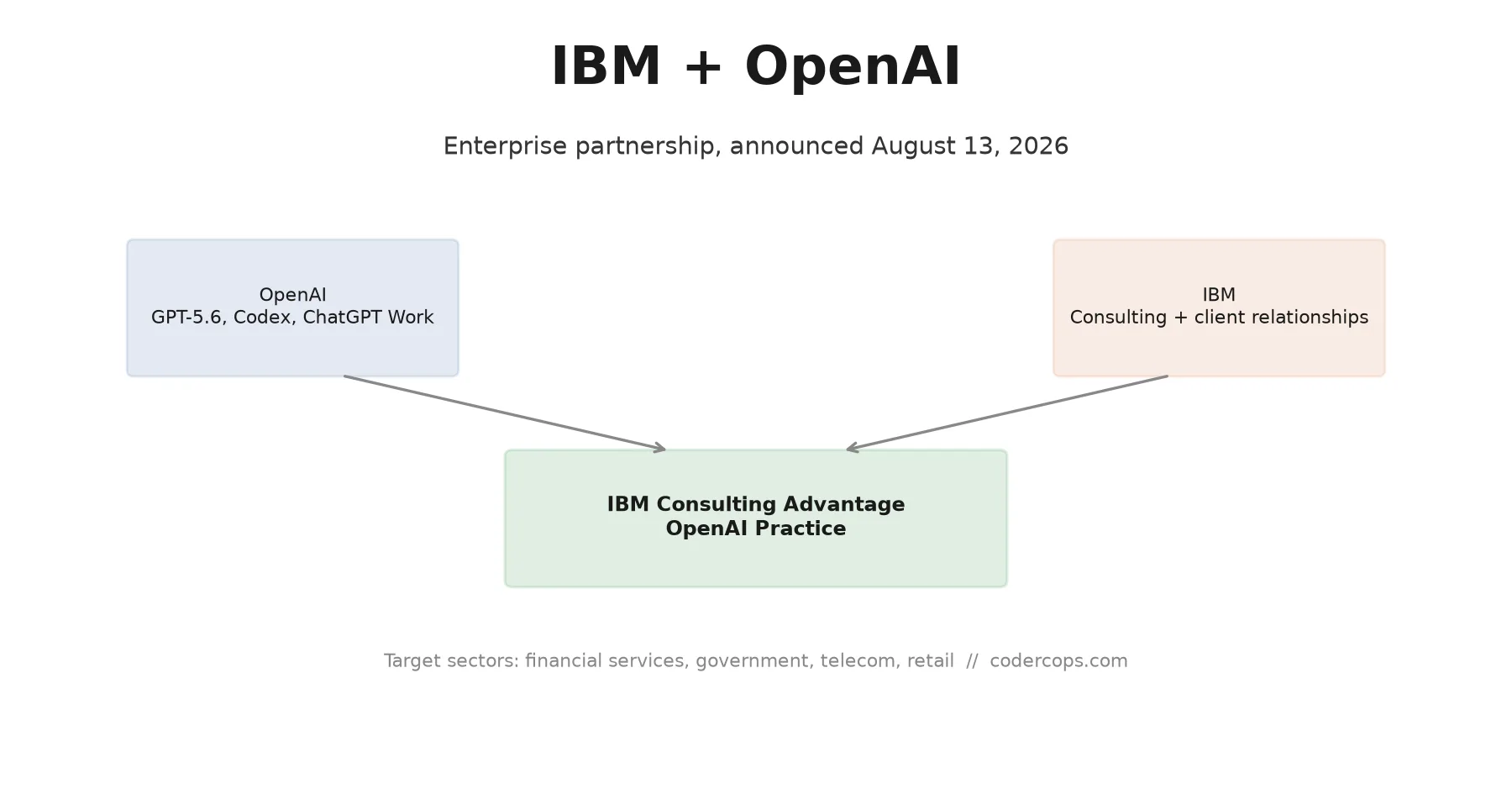
IBM and OpenAI announced a strategic partnership on August 13 that’s worth reading past the headline for, because the interesting part isn’t that a consulting giant is adding AI to its pitch (every consulting giant is doing that), it’s the specific shape of what’s being bundled and who it’s aimed at. IBM is folding GPT-5.6, Codex, and ChatGPT Work directly into IBM Consulting Advantage, its platform for delivering AI-driven consulting work, and standing up a dedicated practice around it. If your organization is anywhere near a build-vs-buy-vs-integrate decision on enterprise AI, this deal is a useful data point regardless of whether IBM is on your vendor shortlist.
What’s actually in the deal
The core of the announcement is straightforward: IBM Consulting Advantage, the platform IBM’s consultants use to deliver AI-assisted work to clients, now embeds OpenAI’s frontier models and tools, GPT-5.6 as the primary model, plus Codex and ChatGPT Work, as first-class components rather than something layered on top separately.
Around that core, IBM is building organizational structure to sell it. The company is launching a dedicated OpenAI Practice, staffed by consultants trained and certified through OpenAI’s Partner Network program, and reportedly planning to train thousands of people against that certification. That’s a meaningfully different commitment than a logo swap on a slide deck. Certifying a workforce at that scale is a multi-quarter operational bet, not a press-cycle announcement.
The initial industry targets are financial services, government, telecommunications, and retail, four sectors that share a common trait: heavy regulatory overhead, large legacy technology estates, and consulting budgets that already exist for exactly this kind of modernization work. IBM’s framing points the deployment at finance, procurement, customer operations, and human resources workflows within those industries, which reads less like “we’ll help you build an AI product” and more like “we’ll help you replace manual process work with AI-assisted process work,” a narrower and more executable pitch than the open-ended one a lot of AI partnerships lead with.
The security track is separate, and specific
Alongside the general consulting integration, the companies called out a distinct security-focused component: the OpenAI Daybreak Cyber Partner Program, paired with IBM’s Autonomous Security offering. This is aimed specifically at AI-supported security operations, threat detection and response workflows augmented by OpenAI’s models, delivered through IBM’s existing security consulting relationships.
Splitting this out as its own named track suggests both companies see enterprise security operations as a distinct buying motion from general workflow modernization, with its own compliance requirements and its own sales cycle. That tracks with what we’ve seen elsewhere in how organizations are structuring AI governance and regulation compliance: security and compliance-adjacent AI deployments tend to move through a different approval chain than general productivity tooling, even inside the same company.
What wasn’t said
Financial terms weren’t disclosed, and that’s worth sitting with for a second rather than skipping past. Deal size, revenue share, or exclusivity terms (if any) aren’t public, which is typical for partnerships at this scale but also means there’s no number to compare against what a similar in-house build, or a direct OpenAI enterprise contract without an integrator in the middle, would actually cost. Treat the coverage of this announcement as a go-to-market signal: it tells you IBM and OpenAI both want the market to see them as the default enterprise pairing for this kind of work, which is a real strategic move, not a technical spec you can evaluate line by line yet.
The actual decision this should inform
For a team weighing how to bring AI into core operations, this partnership isn’t the answer, it’s context for a question you still have to answer yourself: do you want a systems integrator managing the model relationship, contract, compliance posture, and integration work on your behalf, or do you have (or can you build) the internal capability to work with a model provider directly?
| Path | What you’re paying for | Where it fits |
|---|---|---|
| Integrator-managed (IBM + OpenAI, or similar) | Vendor relationship management, compliance groundwork, staffed delivery team | Large, regulated orgs without deep in-house AI integration capability |
| Direct model provider relationship | Lower overhead, more control, but you own the integration and compliance work | Teams with existing engineering capacity to build and maintain the integration |
| Specialized agency partner | Faster time-to-value than building in-house, more tailored than a large integrator’s standard playbook | Mid-size teams that need hands-on build work without a multi-year integrator engagement |
Deals like this one are useful precisely because they make the market’s pricing of “managed AI integration” more visible, even for organizations that will never sign with IBM. If you’re scoping that decision for your own team, our services page walks through how we think about the build-vs-integrate tradeoff for AI-driven work, which is the same tradeoff this announcement is really about, just at a different scale.
The takeaway
Strip away the press-release framing and this is IBM formalizing a bet that enterprise AI adoption, especially in regulated industries, will keep flowing through consulting relationships rather than direct vendor contracts, and OpenAI formalizing a bet that IBM’s existing client relationships are worth more than trying to sell GPT-5.6 into those accounts alone. Neither bet tells you what’s right for your organization. What it does tell you is that the market for managed AI integration is real and growing, which is worth knowing whether you end up buying into it or building your own path around it.
Frequently asked questions
- What did IBM and OpenAI actually announce?
- On August 13, 2026, IBM announced a strategic partnership to embed OpenAI's frontier models, GPT-5.6, along with Codex and ChatGPT Work, into IBM Consulting Advantage, IBM's platform for delivering AI-driven consulting services. The deal includes a dedicated IBM OpenAI Practice with consultants trained through OpenAI's Partner Network certification program.
- Which industries is the partnership targeting first?
- IBM named financial services, government, telecommunications, and retail as initial focus areas, aiming to modernize workflows across finance, procurement, customer operations, and human resources within those sectors.
- Is there a security-specific piece to this deal?
- Yes. The companies said they'll expand collaboration through the OpenAI Daybreak Cyber Partner Program alongside IBM Autonomous Security, aimed at strengthening AI-supported security capabilities for enterprise customers, separate from the general consulting integration.
- Were financial terms disclosed?
- No. IBM and OpenAI announced the partnership without disclosing deal value, which is standard for enterprise AI partnerships at this scale but means there's no public number to compare against similar integrator deals.
- Does this change anything for a company not using IBM Consulting?
- Indirectly. It's a signal that large systems integrators are betting on managed AI-model relationships as a service line, not just point-tool adoption. If your organization is deciding between hiring a specialized team, working with an integrator, or building in-house, this kind of deal is useful evidence for how the market is pricing that decision, even if you never touch IBM Consulting Advantage directly.
Sources
Sponsored
More from this category
More from Business
 R.01
R.01 Arc.dev Alternatives in 2026: When a Curated Marketplace Is and Isn't the Answer
 R.02
R.02 Braintrust Alternatives in 2026: What the No-Fee Model Actually Costs You
 R.03
R.03 Gun.io Alternatives in 2026: Hiring Senior Contractors Without Overpaying for Vetting
Sponsored
Discussion
Join the conversation.
Comments are powered by GitHub Discussions. Sign in with your GitHub account to leave a comment.
Sponsored