AI Integration · Machine Learning
K-Nearest Neighbors for Regression and Classification
Understand the KNN algorithm — how it works, distance metrics, choosing K, and its applications in both classification and regression tasks.

Anurag Verma
3 min read

Sponsored
K-nearest neighbors (KNN) is a supervised learning algorithm used for classification and regression. The algorithm works by finding the k closest data points (neighbors) to a given test data point and making a prediction based on their labels/values. The prediction is typically the average (for regression) or the majority class label (for classification) among the k nearest neighbors.
How the algorithm works
In mathematical terms, KNN is a non-parametric method. Given a training dataset of N labeled points in a d-dimensional feature space, where each point is represented by its d feature values and a class label, the KNN algorithm works as follows:
-
For a new test data point with feature values x, the Euclidean or other distance metric is used to calculate the distance between x and each of the N training data points.
-
The K nearest neighbors are selected based on the distances, where K is a user-defined parameter.
-
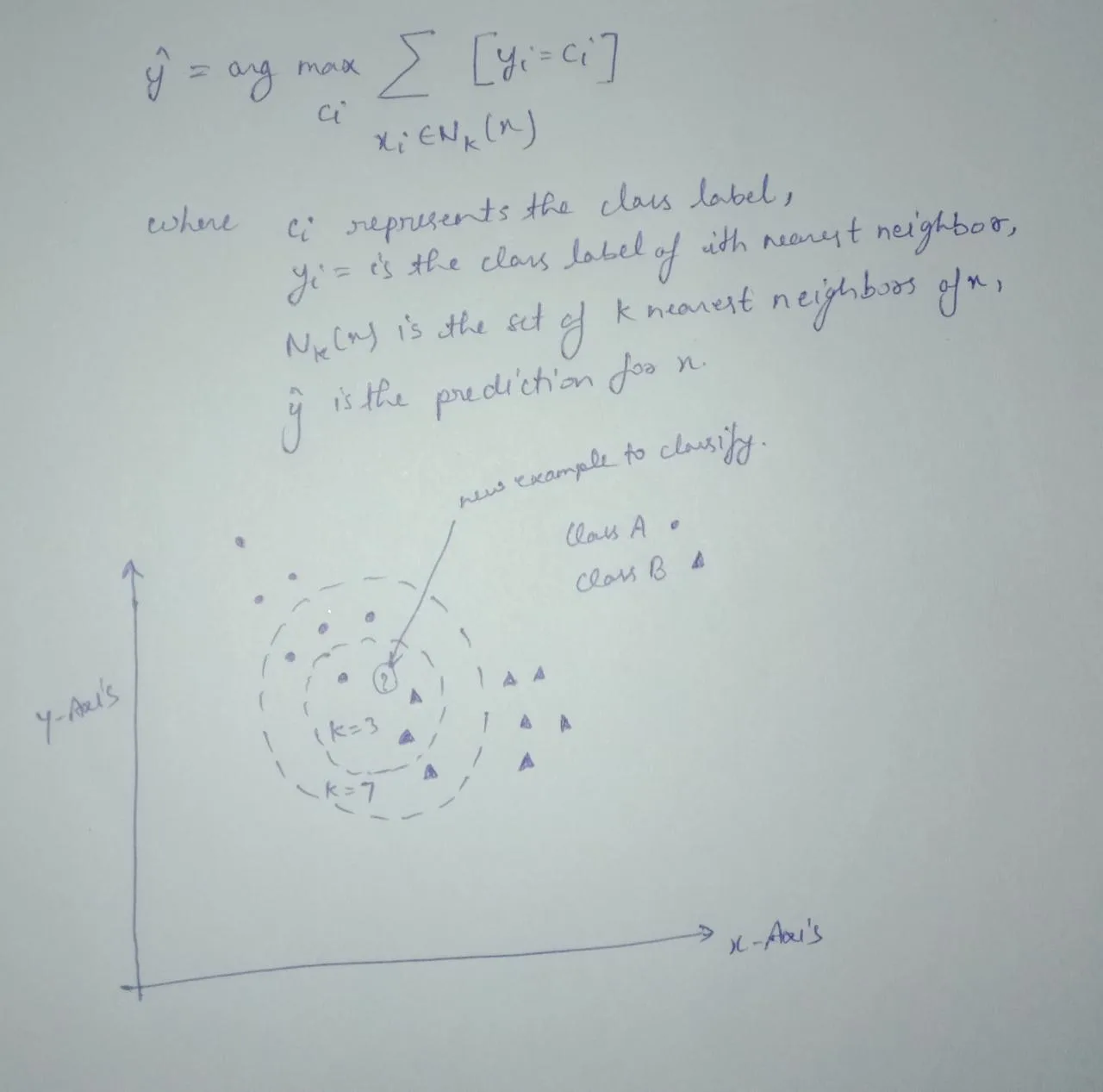
For a classification problem, the K nearest neighbors are assigned to their respective class labels and the majority class label is used as the prediction for x. This can be represented as:
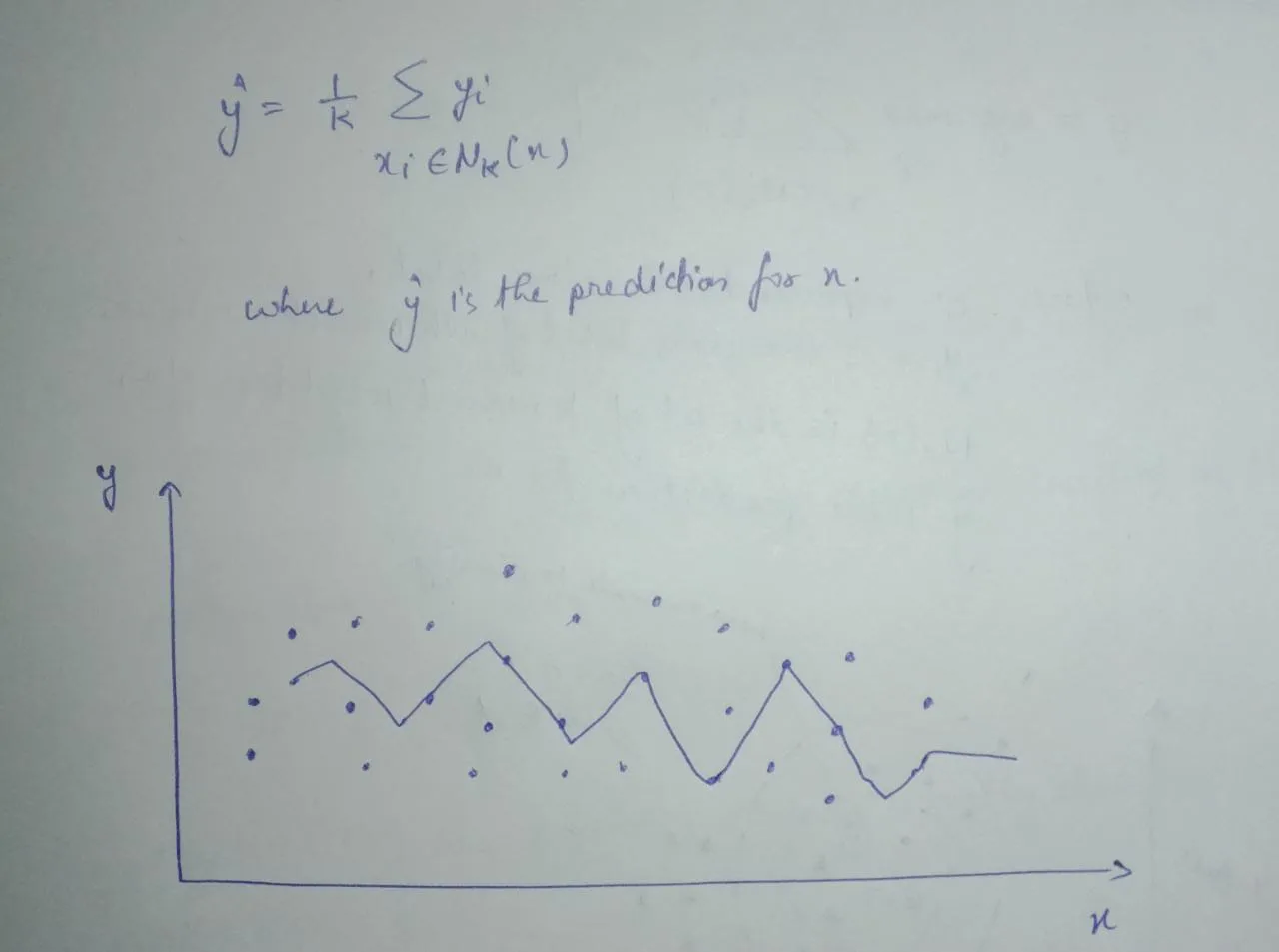
- For a regression problem, the K nearest neighbors are used to predict the value of x by taking the average of their labels. This can be represented as:
When to reach for it
In conclusion, KNN is a simple yet powerful algorithm that is easy to understand and implement. It does not make any assumptions about the underlying data distribution and is suitable for a wide range of applications. However, the performance of KNN can be affected by the choice of K and the distance metric used. It is also important to preprocess the data and normalize the features to prevent the influence of one feature on the results. In addition, KNN is not recommended for large datasets as the computation time increases linearly with the size of the dataset. Overall, KNN is a good starting point for many classification and regression problems, but it is important to evaluate its performance and consider other algorithms if needed.
GitHub link: Complete-Data-Science-Bootcamp
Main Post: Complete-Data-Science-Bootcamp
Frequently asked questions
- How do I choose K?
- By validation, not by rule of thumb. Sweep a range of K values and measure error on held-out data. Small K makes the model sensitive to individual noisy points; large K averages over neighbours that are not actually similar, which blurs real boundaries. For binary classification an odd K avoids ties. The one useful heuristic is that the best K usually grows with dataset size and with noise level.
- Why does feature scaling matter so much for KNN?
- Because the algorithm is entirely distance. Euclidean distance sums squared differences across every dimension, so a feature ranging over 0 to 100,000 contributes far more to the total than one ranging over 0 to 1, regardless of which actually predicts the label. Without normalising or standardising, you are effectively letting the unit of measurement pick your features for you.
- Does the distance metric change the results?
- Yes, sometimes substantially. Euclidean is the default and works well for continuous features on a comparable scale. Manhattan distance can behave better in high dimensions. For categorical or mixed data neither is really appropriate, and you need something like Hamming or Gower distance. Treat the metric as a modelling choice, the same way you treat K.
- Why is KNN slow on large datasets?
- There is no training phase to amortise the cost, so every prediction compares the new point against every stored training point. Compute time grows linearly with the training set, and memory does too, since you have to keep all of it. Spatial index structures like KD-trees or ball trees help in low dimensions, but their advantage fades as dimensionality rises.
- When is KNN still the right choice?
- On small to medium datasets where the decision boundary is irregular and you do not want to assume a functional form. It is also a genuinely useful baseline: it is quick to implement, has one main hyperparameter, and if a more complex model cannot beat a tuned KNN, that tells you something worth knowing before you invest further.
Sponsored
More from this category
More from AI Integration
Sponsored
Discussion
Join the conversation.
Comments are powered by GitHub Discussions. Sign in with your GitHub account to leave a comment.
Sponsored