AI & ML · Model Training
LoRA vs QLoRA: Fine-Tuning on a Single GPU
LoRA and QLoRA fine-tune a multi-billion-parameter model on one consumer GPU by training small adapter weights. How each works, and when to pick which.

Shashikant Gupta
5 min read
Sponsored
Fine-tuning used to mean one of two things: pay for a cluster of data-center GPUs, or don’t fine-tune at all. LoRA and QLoRA changed that math enough that fine-tuning a multi-billion-parameter model on a single GPU sitting under a desk is now routine. The short version: LoRA trains a small set of extra weights instead of the whole model, and QLoRA does the same thing while also shrinking the frozen base model with quantization. The difference between them is entirely about memory and speed, not about what kind of task they’re suited for.
What full fine-tuning actually costs
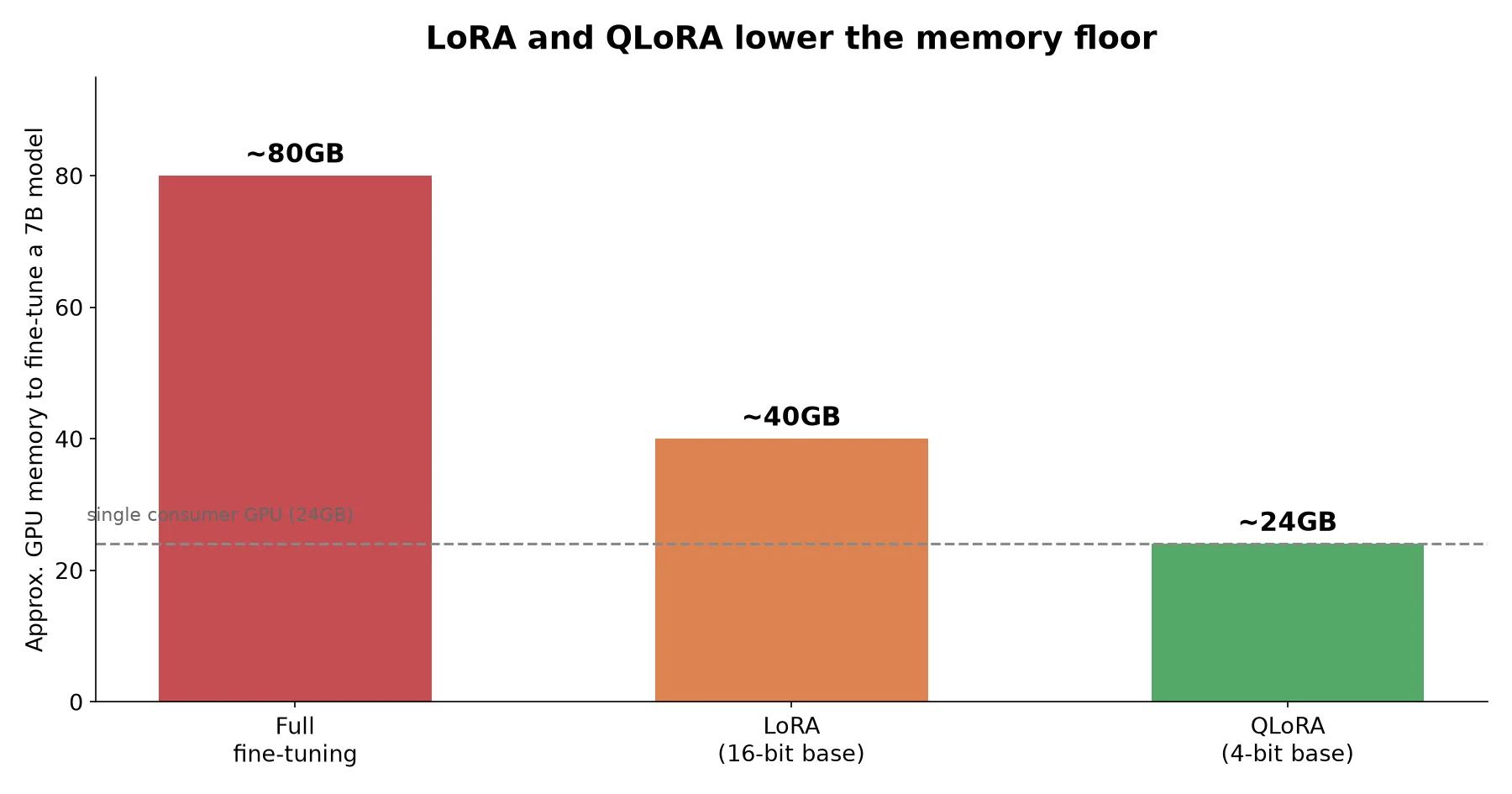
To see why LoRA matters, it helps to see what it’s replacing. Full fine-tuning updates every parameter in a model. For a 7-billion-parameter model, that’s not just 7 billion weights in memory, it’s 7 billion weights plus optimizer state (typically 2-3x the parameter count for Adam-family optimizers) plus gradients plus activations. Add it up and a 7B model needs somewhere around 80GB or more of GPU memory to fully fine-tune at reasonable batch sizes, well beyond what a single consumer card provides, and the threshold only gets steeper for 13B, 34B, and 70B+ models.
That memory floor is the whole reason parameter-efficient fine-tuning methods exist.
How LoRA works
LoRA (Low-Rank Adaptation) starts from an observation: when you fine-tune a model for a specific task, the actual change needed in each weight matrix tends to have low intrinsic rank, meaning it can be well approximated by the product of two much smaller matrices. Instead of updating the full weight matrix W, LoRA freezes W entirely and adds a trainable update ΔW = A × B, where A and B are small, low-rank matrices injected alongside the frozen layer.
# Conceptually, a LoRA-adapted linear layer
# W is frozen (the original pretrained weight)
# A and B are the only trainable parameters
def lora_forward(x, W, A, B, alpha, rank):
    frozen_output = x @ W
    lora_output = (x @ A @ B) * (alpha / rank)
    return frozen_output + lora_output
If W is a 4096x4096 matrix (16.7 million parameters), a LoRA adapter with rank 8 only needs A (4096x8) and B (8x4096), about 65,000 parameters combined, roughly 250 times fewer than the full matrix. Applied across a model’s attention and feed-forward layers, this typically cuts trainable parameters by 100x or more, which cuts optimizer memory by a similar factor since Adam only needs to track state for the parameters actually being trained.
How QLoRA extends it
LoRA already shrinks the trainable parameter count dramatically, but the frozen base model still has to sit in GPU memory at whatever precision it’s loaded in, typically 16-bit, which is still tens of gigabytes for anything past a few billion parameters. QLoRA closes that remaining gap by quantizing the frozen base model down to 4-bit precision before attaching LoRA adapters on top.
The frozen weights get compressed roughly 4x compared to 16-bit, while the LoRA adapters themselves still train in higher precision, so the parts actually being updated don’t lose fidelity. The result, per the original QLoRA paper, is a technique that matches full 16-bit fine-tuning performance closely across evaluated benchmarks while cutting memory requirements enough that a 7B-13B model becomes trainable on a single 24GB consumer GPU, and a 33B-65B model becomes trainable on a single 48GB GPU instead of a multi-GPU server.
LoRA vs QLoRA, side by side
| LoRA | QLoRA | |
|---|---|---|
| Base model precision | Typically 16-bit | 4-bit quantized |
| Trainable parameters | Small (adapter only) | Small (adapter only) |
| Memory floor | Lower than full fine-tuning, still needs the full base model in memory | Lowest of the three, frozen weights are 4-bit |
| Training speed | Faster than QLoRA | Slower, due to quantization/dequantization overhead |
| Typical hardware for a 7B model | 1x 40-48GB GPU | 1x 24GB consumer GPU |
| Quality vs full fine-tuning | Very close | Very close, marginally more approximation |
Picking one in practice
If you have access to a GPU with enough memory to hold the base model at full precision, plain LoRA trains faster per step and avoids the quantization overhead, so it’s the better default when memory isn’t the binding constraint. If you’re working on a single consumer GPU, or you’re trying to fine-tune a larger model than your hardware would otherwise support, QLoRA is what makes the job possible at all, and the quality gap is small enough that it’s rarely the reason to avoid it.
Either way, the output is the same shape: a small adapter, typically megabytes rather than gigabytes, that can be merged into the base model for a single fine-tuned checkpoint, or kept separate and swapped in and out at inference time. That second option is why teams running several fine-tuned variants for different tasks tend to keep one base model in memory and load different adapters per request instead of hosting several full model copies, which is a meaningfully cheaper way to serve task-specific models at scale.
If you’re evaluating whether to fine-tune at all versus lean on retrieval or prompt engineering instead, that’s a separate decision worth making first. But once fine-tuning is the right call, LoRA and QLoRA are why it no longer requires a line item for a GPU cluster to try it.
Frequently asked questions
- What's the actual difference between LoRA and QLoRA?
- LoRA freezes the base model's original weights and trains a small pair of low-rank matrices alongside them, which are the only parameters that get updated. QLoRA does the same thing, but first quantizes the frozen base model to 4-bit precision, which drastically cuts the memory needed to hold the base model during training. QLoRA is LoRA plus quantization, not a separate technique.
- Do I need a data center GPU to fine-tune a 7B parameter model?
- With QLoRA, no. A 7B model fine-tuned with QLoRA typically fits on a single consumer GPU with 24GB of VRAM, like an RTX 4090. Full fine-tuning of the same model would need 80GB or more just for optimizer state, which means multiple data-center-class GPUs.
- Does QLoRA produce a worse model than full fine-tuning?
- The original QLoRA paper found it matches full 16-bit fine-tuning performance closely across benchmarks, with the gap small enough to be a reasonable trade for most applied use cases. It's not lossless, quantization introduces some approximation, but for task-specific fine-tuning it's rarely the limiting factor on quality.
- When should I choose LoRA over QLoRA?
- Choose LoRA on a full-precision base model when you have the GPU memory to spare and want the fastest training loop or the highest fidelity to full fine-tuning. Choose QLoRA when memory is the constraint, which for most teams working outside a dedicated ML infrastructure budget is most of the time.
Sources
Sponsored
Sponsored
Discussion
Join the conversation.
Comments are powered by GitHub Discussions. Sign in with your GitHub account to leave a comment.
Sponsored