Industry News · Product Launches
Meta's Pocket Turns Prompts Into Mini-Games
Meta quietly launched Pocket, a vibe-coding app that turns prompts into playable mini-games with a social feed. What it signals, and where it stops mattering.

Anurag Verma
7 min read
Sponsored
Meta didn’t announce Pocket. Reverse engineer Alessandro Paluzzi found it sitting live on the Apple App Store and Google Play, quietly soft-launched in Brazil, and reported it on July 2, 2026. No keynote, no press release, no big reveal, just an app that lets anyone type “a game where you dodge falling coconuts” and get something playable back in seconds. That quiet rollout is itself informative. Meta is treating natural-language game generation as something to test carefully in one market before deciding whether to push it worldwide, not as a headline feature to announce with fanfare.
A month on from that discovery, it’s worth asking the question that actually matters to anyone who runs an engineering team or hires developers for a living: does this change anything about how software gets built professionally? The short answer is no, but the reasons why are more useful than the dismissal.
What Pocket actually does
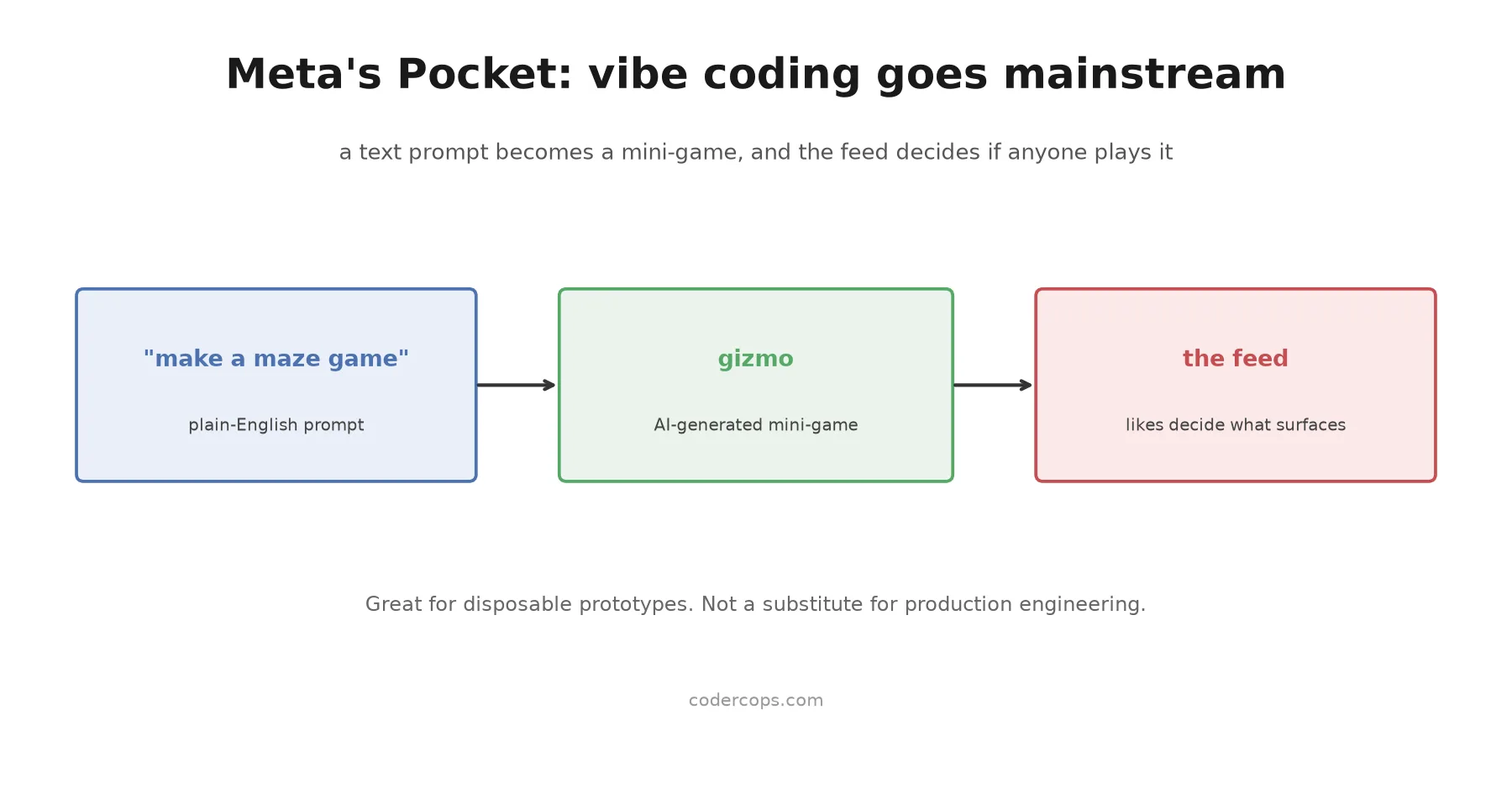
Pocket lets a user describe a mini-game or interactive experience in plain English and get a working “gizmo” back, no code touched by the user at any point. It builds directly on Meta’s acquisition of the Gizmo team from Atma Sciences, a startup that had already been developing AI-generated interactive content before the deal. The generation piece is the part everyone focuses on, but it’s arguably the less interesting half of the product.
The other half is a feed. Users scroll through gizmos other people have made, like and comment on them, and the ones that get traction rise to the top the same way a video does on any short-form content app. Meta is applying the exact engagement mechanics that made Reels and Instagram Stories work to AI-generated software. That’s a deliberate design choice, not an afterthought. It reframes “making a mini-game” as a form of social content creation rather than a technical act, and it puts distribution pressure on quality in a way a standalone generation tool never would: a gizmo nobody engages with just disappears down the feed, the same way a boring post does.
The real signal, and it’s not the AI
The interesting part of Pocket isn’t that a large language model can generate a playable mini-game from a prompt. Plenty of tools already do variations of that, including Roblox’s own text-to-game feature and a growing list of AI app builders aimed at non-technical founders. The interesting part is who is building this and why.
Meta has some of the best data in the world on what makes people open an app repeatedly, and it’s betting that “describe a game, get a game, scroll a feed of other people’s games” is a behavior enough people will adopt to justify building and shipping a dedicated product for it, quietly, into a market of over 200 million people. That’s a bet on consumer demand for prompt-to-software creation as a mainstream pastime, not a developer productivity story at all. It sits in the same family as the natural-language programming trend we’ve covered before in our breakdown of what vibe coding actually is, except aimed squarely at people who have never written a line of code and never intend to.
That’s worth taking seriously precisely because it’s not really about engineering. If Meta is right that a meaningful slice of its user base wants to make things, not just watch things, that’s a genuine shift in what a social platform is for. Whether it succeeds is a separate question from whether the underlying appetite is real, and a soft-launch limited to one country, with no public numbers yet, means it’s too early to know which way that goes.
Where this is genuinely useful
Give Pocket its due. Fast, disposable, natural-language creation is good for exactly the things it’s built for: throwaway entertainment, testing an idea in minutes instead of days, and surfacing latent demand that a formal spec process would never catch. A teenager who wants to see a dodge-the-coconuts game exist for the next ten minutes doesn’t need a build pipeline, a database schema, or code review. They need the game to exist now, and Pocket is a reasonable answer to that need.
There’s also a legitimate prototyping lesson in here for professional teams. The instinct to type a rough idea and see something react to it immediately, rather than write a spec document first, is a genuinely faster way to figure out whether an idea is worth pursuing. Product teams already use lightweight, disposable tools this way, and a consumer version at Meta’s scale is further evidence that the instinct is right, at least for the discovery phase of building something.
Where it stops being relevant
Here’s where the line actually sits, and it’s not a fuzzy one. A gizmo that breaks costs nothing. Nobody’s business stops, nobody’s data leaks, nobody’s revenue depends on it working correctly at 3 a.m. on a Tuesday. If the coconut-dodging game glitches, the user scrolls to the next one. That’s the entire failure mode.
A production system doesn’t get that grace. When an inventory system miscounts stock, a company loses money on every order it ships wrong. When an authentication flow has a subtle bug, an attacker finds it before your users do. When a database migration silently drops a constraint, you find out weeks later when the data is already corrupted and nobody can say when it started. None of that is what Pocket, or any consumer vibe-coding tool, is built to handle, and none of it is what these tools are being marketed to handle. The comparison only becomes unfair when someone starts assuming that because AI can generate a fun ten-minute game from a sentence, it can also generate a system that needs to stay correct, secure, and maintainable for the next five years under conditions the original prompt never described.
State management at real scale, with concurrent users and consistency guarantees, is a different problem than rendering a single-player mini-game session. Security is a different problem than “nothing bad happened during the demo.” Data integrity is a different problem than “the game looked right when I played it once.” Integration with a decade of existing enterprise systems, none of which read anyone’s mind about undocumented edge cases, is a different problem than starting from a blank canvas. And maintaining something as requirements shift over years is a different discipline entirely from generating a first draft. These aren’t reasons to dismiss what Pocket does. They’re reasons it isn’t in competition with what a production engineering team does, and treating the two as the same category is where the confusion starts. Our framework for deciding between quick, generated approaches and real custom builds covers this same tradeoff in more depth, and it applies here just as directly as it does to any other low-code versus custom development decision.
What this actually means for engineering teams
The honest takeaway isn’t “AI can’t build real software, so ignore this.” It’s that the gap between what generation tools do well and what production engineering requires is widening in public awareness at the same time the tools themselves are getting more capable. Both things are true at once, and pretending Pocket is either irrelevant hype or a preview of the end of professional development misreads what’s actually happening.
What Pocket really changes is expectation, not capability. When someone can type a sentence on their phone and get a working mini-game back in seconds, “why does my internal tool take six weeks” becomes a harder question to answer with a shrug. The right answer isn’t defensiveness. It’s clarity about what the six weeks actually buys: correctness under real load, security that holds up against people trying to break it, data that stays consistent, and a system someone can still safely change two years from now. Pocket is a fun, well-targeted product for what it does. It’s also a useful reminder that the gap between a working demo and a system you can trust with your business is exactly where professional engineering earns its keep, and that gap isn’t closing anytime soon.
Frequently asked questions
- What is Meta's Pocket app?
- Pocket is an app from Meta that lets users generate mini-games and interactive experiences, called gizmos, from a plain-English text prompt. It also includes a social feed where users can scroll, like, and comment on gizmos made by other users, with popular ones surfacing to the top. It was spotted on the Apple App Store and Google Play around June 29-July 2, 2026, and is currently in soft-launch in Brazil only.
- Is Pocket related to Meta's earlier Gizmo acquisition?
- Yes. Pocket builds on Meta's acquisition of the team behind Gizmo, from the startup Atma Sciences, which had already been working on AI-generated interactive content before joining Meta.
- Does Pocket mean AI can now build real software from a prompt?
- It means AI can now generate small, disposable, single-purpose interactive experiences from a prompt reliably enough to ship to consumers at scale. That is a different achievement from building software with real data integrity requirements, multi-user state, security obligations, and years of maintenance ahead of it. Pocket doesn't attempt that, and the gap between the two is the whole point.
- Should a software agency be worried about tools like Pocket?
- Not about Pocket specifically. It's aimed at consumers making disposable, social mini-games, not businesses commissioning production systems. What agencies should pay attention to is the broader pattern: mainstream comfort with natural-language software generation is rising fast, which means clients arrive with higher expectations for speed and lower tolerance for hearing 'that will take three months,' even when the underlying problem genuinely requires it.
Sources
Sponsored
More from this category
More from Industry News
Sponsored
Discussion
Join the conversation.
Comments are powered by GitHub Discussions. Sign in with your GitHub account to leave a comment.
Sponsored