AI Integration · Game Development
Roblox Build Turns a Prompt Into a Playable Game
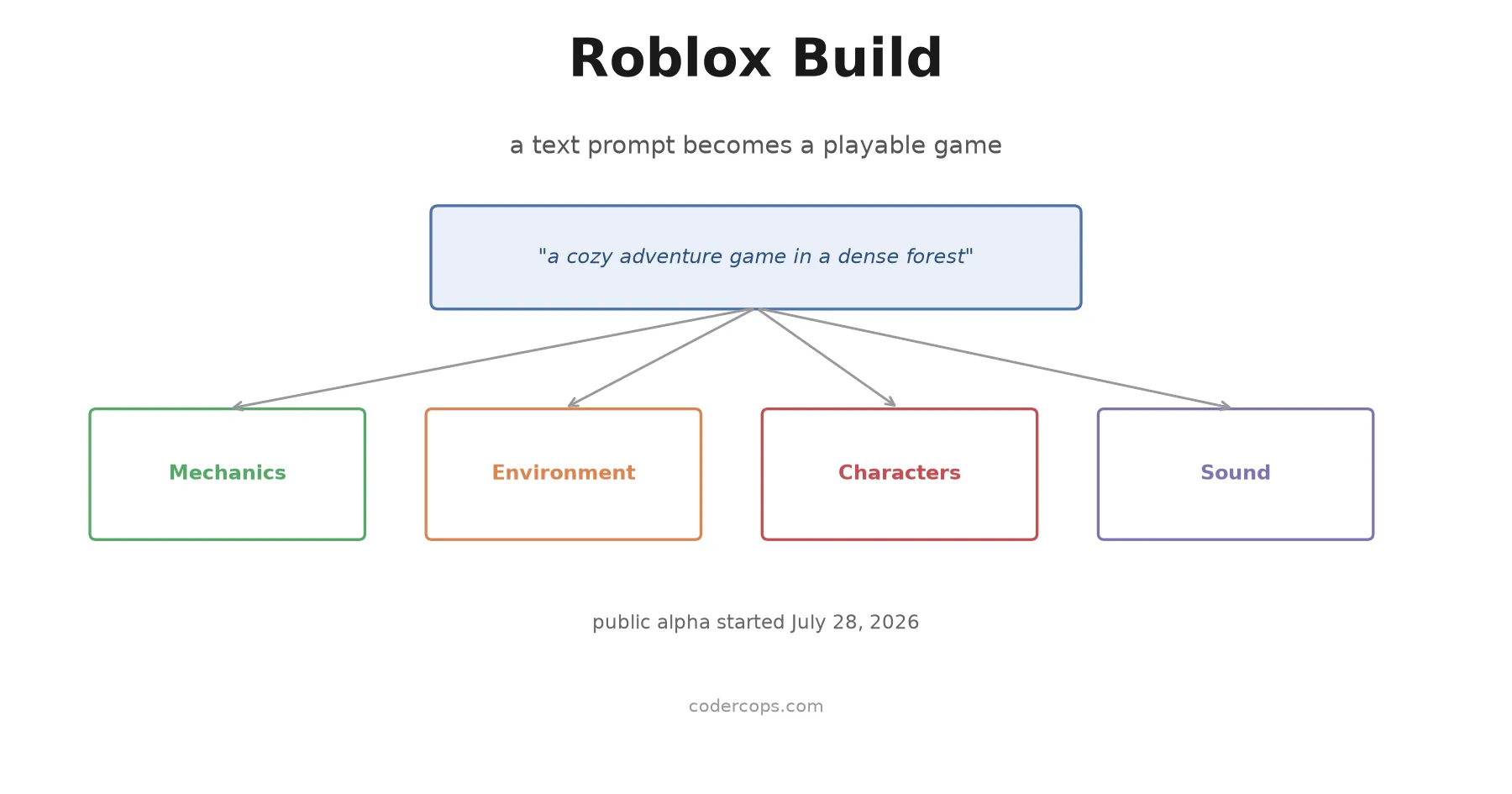
Roblox launched Build on July 16: a mobile tool generating a playable prototype, mechanics, environment, characters, and sound, from a text description.

Anurag Verma
5 min read
Sponsored
Roblox announced Build on July 16, 2026: type “a cozy adventure game set in a dense forest” into a tab in the mobile app, and the system generates a functional starting game you can immediately play, on your phone, with no code written by you. Public alpha testing opened July 28, 2026, in New Zealand, for age-verified users 9 and older. This isn’t a tech demo. It’s shipping into a platform with hundreds of millions of monthly users, and it’s worth understanding what it actually does before deciding what it means.
What Build actually generates
A user describes what they want, in whatever language a person would naturally use to describe a game idea, not a prompt-engineered spec. The system responds with a working prototype: core gameplay mechanics, an environment, characters, a visual style, and sound, coordinated together rather than generated as disconnected pieces. According to Roblox, Build runs on a collection of AI models that handle these different components and coordinate them into a single playable output.
The result lands as a dedicated tab in the mobile app. A user can immediately playtest it, tweak it, and keep iterating from the phone. Critically, Build connects directly into Roblox Studio on desktop, so anyone who wants to go past what the mobile generation produces can pick up the same project in the full professional editor. It’s positioned as a starting point, not a finished-product generator, and not a replacement for the tool serious Roblox developers already use.
The rollout is deliberately narrow
The public alpha started in a single country, New Zealand, with an explicit age floor: users need to be age-verified and at least 9 to use Build at all, and at least 16 to publish a Build-generated game for a global audience. A free, basic tier ships alongside paid options. This is a controlled rollout for a company that has faced real scrutiny over child safety on its platform, and the staged approach (small market first, age gates from day one, publishing rights gated separately from creation rights) reads as a deliberate response to that history rather than a standard soft-launch pattern.
The part that actually matters: how it’s ranked
The detail worth paying attention to isn’t the generation technology. It’s this: Roblox has said every published experience, whether built traditionally in Studio or generated through Build, enters the same candidate pool for recommendations, and gets ranked primarily on player retention. A Build-generated game that nobody keeps playing doesn’t get promoted just because it was made with AI, and a traditionally coded game doesn’t get an advantage over a generated one that people actually stick with.
This is the right design decision, and it’s also the thing that will determine whether Build succeeds as more than a novelty. Generative tools are good at producing an impressive first five minutes. They are not automatically good at producing something with the kind of core loop that keeps a player coming back on day three. If Build-made games wash out of the recommendation pool en masse within a few weeks of the alpha, that tells you the generation quality gap is real. If a meaningful share stick around, it tells you the gap between “generated prototype” and “game with actual retention” is smaller than skeptics assume.
What this means beyond Roblox specifically
Text-to-game generation is the latest instance of a pattern that’s been playing out across creative and technical tooling throughout 2026: AI collapsing the distance between “I have an idea” and “I have something I can react to and iterate on.” The same shift is visible in how developers describe using AI coding tools, and we’ve written before about what that shift actually looks like in practice for vibe coding in software development: the pattern of describing intent in natural language and iterating on a generated starting point rather than writing every line by hand. Build is the game-development version of the same idea, aimed at a much less technical audience than most AI coding tools target.
It’s also relevant to the ongoing question of what AI tooling actually does to entry-level creative and technical work. We’ve covered the software engineering side of that question in our look at whether AI is actually replacing junior developers, and the honest answer there was “it’s more complicated than the headlines.” The same caution applies here. Lowering the barrier to a working game prototype doesn’t automatically produce good games, any more than AI-assisted code generation automatically produces good software. It changes where the actual skill bottleneck sits: less in “can I make something work at all,” more in “can I make something worth someone’s continued attention.” That’s a harder problem, and it’s the one Build’s retention-based ranking is quietly testing at scale.
For a platform with Roblox’s user base, even a modest improvement in how many people get past the empty-project problem and into an iterable first draft is a meaningful shift in who ends up making games at all. Whether that translates into more good games, or just more games, is what the alpha data over the next few months will actually answer.
Frequently asked questions
- What is Roblox Build?
- Build is a mobile-first feature inside the Roblox app that generates a playable game prototype from a text prompt. A user describes a game idea, and the system generates gameplay mechanics, an environment, characters, visual style, and sound as a starting point the user can immediately playtest and edit.
- When does Roblox Build become available to everyone?
- Roblox announced Build on July 16, 2026. Public alpha testing began July 28, 2026, starting in New Zealand for age-verified users 9 and older. Users 16 and up can publish their creations to a global audience during the alpha; a free tier and paid options are both planned.
- Do games made with Build get ranked differently than games made the traditional way?
- No. Roblox has said that every published experience, regardless of how it was made, enters the same candidate pool and is ranked primarily on player retention. A generated game with no ongoing engagement won't surface in recommendations any more than a traditionally coded one would.
- Does Build replace Roblox Studio for serious game development?
- No. Build is explicitly positioned as a starting point. It connects directly to Roblox Studio on desktop, so a generated prototype can be handed off to the full professional editor for anyone who wants to go beyond what the mobile tool produces.
Sources
Sponsored
More from this category
More from AI Integration
Sponsored
Discussion
Join the conversation.
Comments are powered by GitHub Discussions. Sign in with your GitHub account to leave a comment.
Sponsored