
Sponsored
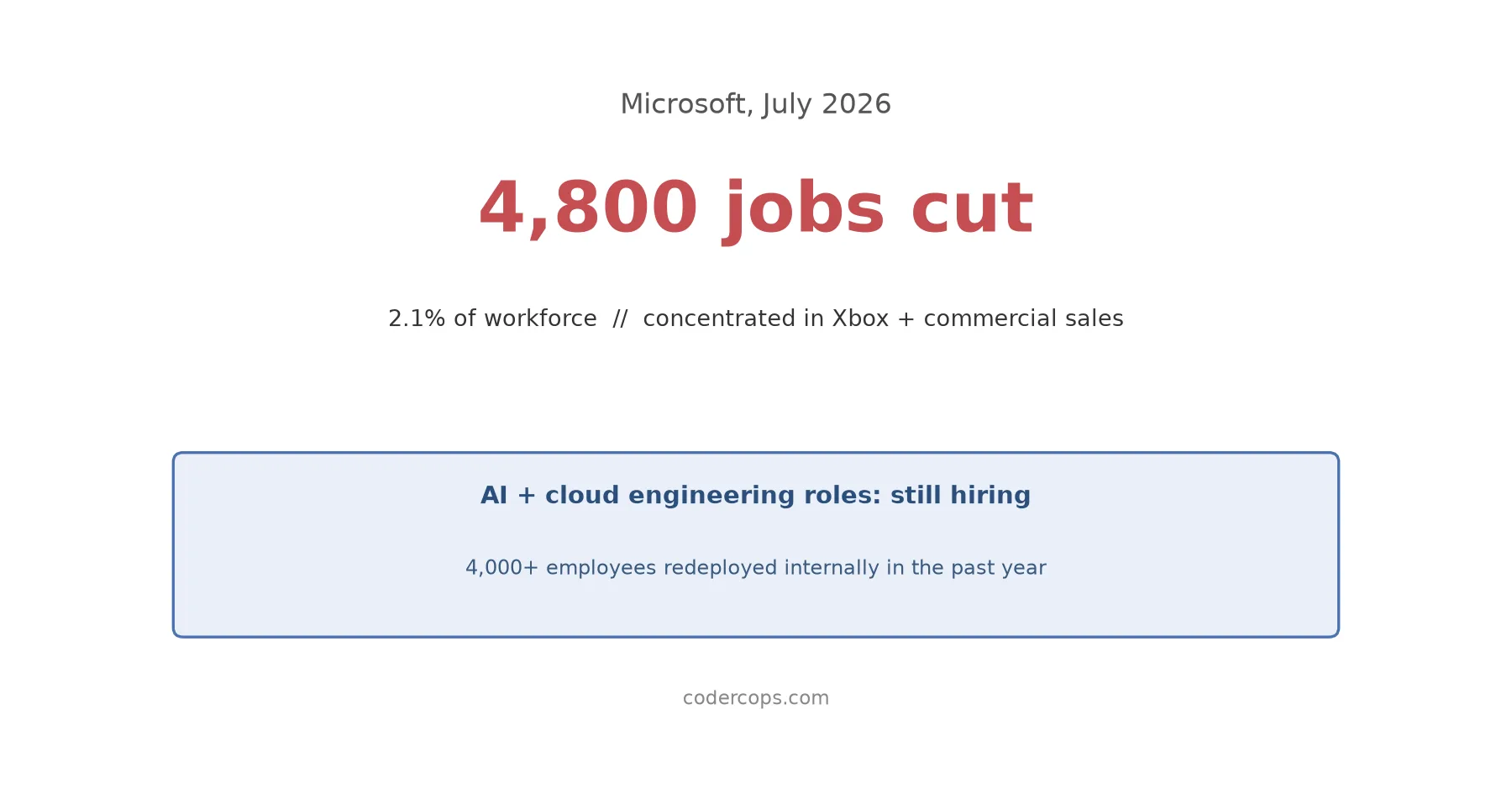
On July 6, 2026, Microsoft told about 4,800 employees, 2.1% of its global workforce, that their roles no longer existed. Xbox took the biggest hit: roughly 1,600 people immediately, with the company signaling total reductions in gaming could reach around 3,200, close to a fifth of the division, by the end of its fiscal year. Commercial sales was the other major target.
The headline write-itself version of this story is “AI is replacing workers at Microsoft.” That’s too simple, and it’s not what the data in the announcement actually supports. The more useful read is narrower and more actionable: Microsoft is cutting sales-adjacent and production headcount while continuing to hire and redeploy people into AI, cloud, and security roles. If you run an engineering team, or you’re deciding what to specialize in, that distinction matters more than the topline number.
What actually got cut
| Detail | Figure |
|---|---|
| Total roles eliminated | ~4,800 (2.1% of global workforce) |
| Xbox immediate cuts | ~1,600 |
| Xbox total FY reduction (projected) | ~3,200 (~20% of division) |
| Hardest-hit functions | Xbox, commercial sales |
| Employees redeployed in past year | 4,000+ (per Microsoft, including 500 in July alone) |
| Tech industry layoffs, H1 2026 | ~154,000 (Meta, Oracle, Amazon, Cognizant, others) |
Two things stand out. First, this wasn’t an engineering-org purge. Xbox studios and commercial sales are the divisions absorbing the cut, alongside a broader restructuring that includes plans to spin off several gaming studios. Second, Microsoft is explicit that a meaningful share of its workforce reduction over the past year came through redeployment, not termination. Whether or not you take that framing at face value, it tells you where the company thinks it still needs people: internally mobile roles it’s willing to retrain for, which skews toward technical and AI-adjacent work.
The pattern behind the headline
Microsoft isn’t shrinking. It’s one of the largest capital spenders on AI infrastructure in the world, and its cloud and AI engineering orgs have kept hiring through 2026 even as other divisions contracted. What’s happening is reallocation: money and headcount are moving away from functions with high sales-and-support headcount and relatively thin technical moats, toward functions built around AI infrastructure, platform engineering, and security.
This is consistent with what’s showing up in the broader labor data. Software engineering job postings are actually up double digits year over year in 2026, even as high-profile layoffs dominate headlines (see our data-driven look at the 2026 software engineering job market for the numbers). The jobs disappearing and the jobs opening are not the same jobs. A sales operations analyst and a platform engineer are not interchangeable, and treating “154,000 tech layoffs” as one undifferentiated trend obscures more than it reveals.
Where the AI angle is real: support, QA at scale, first-line sales operations, and other process-heavy roles are exactly where copilots and AI agents are furthest along at handling routine work without direct human execution. Those are also disproportionately the roles that show up in the Xbox and commercial sales cuts. It’s not that AI wrote the pink slips. It’s that AI tooling changed the cost-benefit math on keeping large teams in functions where output can now be partly automated, and companies are acting on that math faster in low-margin or non-core divisions.
What this means if you’re hiring or building a team
If you run engineering at an agency or a product company, three things are worth taking from this, not as prediction but as a pattern you can check against your own org:
Generalist, process-heavy roles are more exposed than specialist technical ones. This mirrors what we’ve found working with client teams: the roles most at risk from AI tooling right now are the ones with high repetition and low judgment requirements, not senior engineering. Junior developer hiring has contracted too, but for a related and distinct reason. See our analysis of whether AI is actually replacing junior developers for why that’s a training-pipeline problem more than a technology-elimination one.
Redeployment beats layoffs when the skill gap is closable. Microsoft’s claim of 4,000+ internal moves in a year is a data point worth taking seriously even from a company managing its own narrative: retraining an experienced employee into an adjacent technical role is often cheaper and faster than hiring externally, especially for roles touching internal systems and institutional knowledge. If you’re planning headcount changes, a redeployment-first approach is worth pricing out before you default to layoffs.
Don’t read “big company cuts jobs” as “the market is contracting.” It’s tempting to treat a 4,800-person layoff at Microsoft as a market signal you should act on. It mostly isn’t. It’s a company-specific reallocation decision inside a labor market where software engineering postings are still growing. If you’re making hiring or career decisions, look at postings and comp data for your specific stack and role, not aggregate layoff headlines.
The honest uncertainty here
None of this means AI-driven headcount reduction is a myth. It’s real, and it’s accelerating in functions where AI tools have matured fastest: content operations, tier-1 support, basic QA, and parts of sales engineering. What the Microsoft numbers don’t support is the version of the story where engineering headcount broadly contracts because AI writes the code now. The company is still hiring engineers. It’s cutting the roles around them that AI tooling has made cheaper to run leaner.
If you’re deciding where to invest your own skills or your team’s headcount in the second half of 2026, the Microsoft cuts are a useful data point, not a verdict. Track what’s actually happening to postings in your specific domain before you draw conclusions from a single company’s restructuring announcement.
Frequently asked questions
- Did Microsoft's July 2026 layoffs affect software engineers?
- Not primarily. The cuts were concentrated in Xbox (about 1,600 roles immediately, with total gaming-division reductions expected to reach roughly 3,200 by fiscal year end) and commercial sales. Microsoft has continued hiring in AI, cybersecurity, and cloud engineering even while cutting elsewhere.
- Why is Microsoft laying people off while spending billions on AI?
- The two aren't contradictory from Microsoft's perspective. Capital is shifting from headcount-heavy functions (sales operations, support, parts of gaming) toward AI infrastructure and the engineering roles that build on it. It's a reallocation, not a retreat.
- Is this part of a bigger trend across the tech industry?
- Yes. Roughly 154,000 tech jobs were cut industry-wide in the first half of 2026, including rounds at Meta, Oracle, Amazon, and Cognizant. Microsoft's cut is one of the larger single announcements but fits a pattern that started well before 2026.
Sources
Sponsored

Sponsored
Discussion
Join the conversation.
Comments are powered by GitHub Discussions. Sign in with your GitHub account to leave a comment.
Sponsored