Web Development · JavaScript
State of JavaScript 2025: What the Data Says
25,000+ responses, and the picture is consolidation, not churn. Vite at 98% satisfaction, TypeScript exclusive for 40%, React dominant but contested.

Shashikant Gupta
7 min read
Sponsored
The State of JavaScript 2025 survey closed in late 2025, and the results came out in March 2026. Over 25,000 developers responded across questions covering every meaningful tool in the ecosystem: front-end frameworks, meta-frameworks, runtimes, build tools, testing libraries, language features.
What the data shows is less dramatic than the “everything is being disrupted” narrative that circulates online. The things that are working are consolidating their lead. The things people complain about are generating more explicit complaints than before. A few categories have real surprises.
Build tools: Vite at 98%, the number that stands out
The build tools category is the clearest story in the 2025 survey.
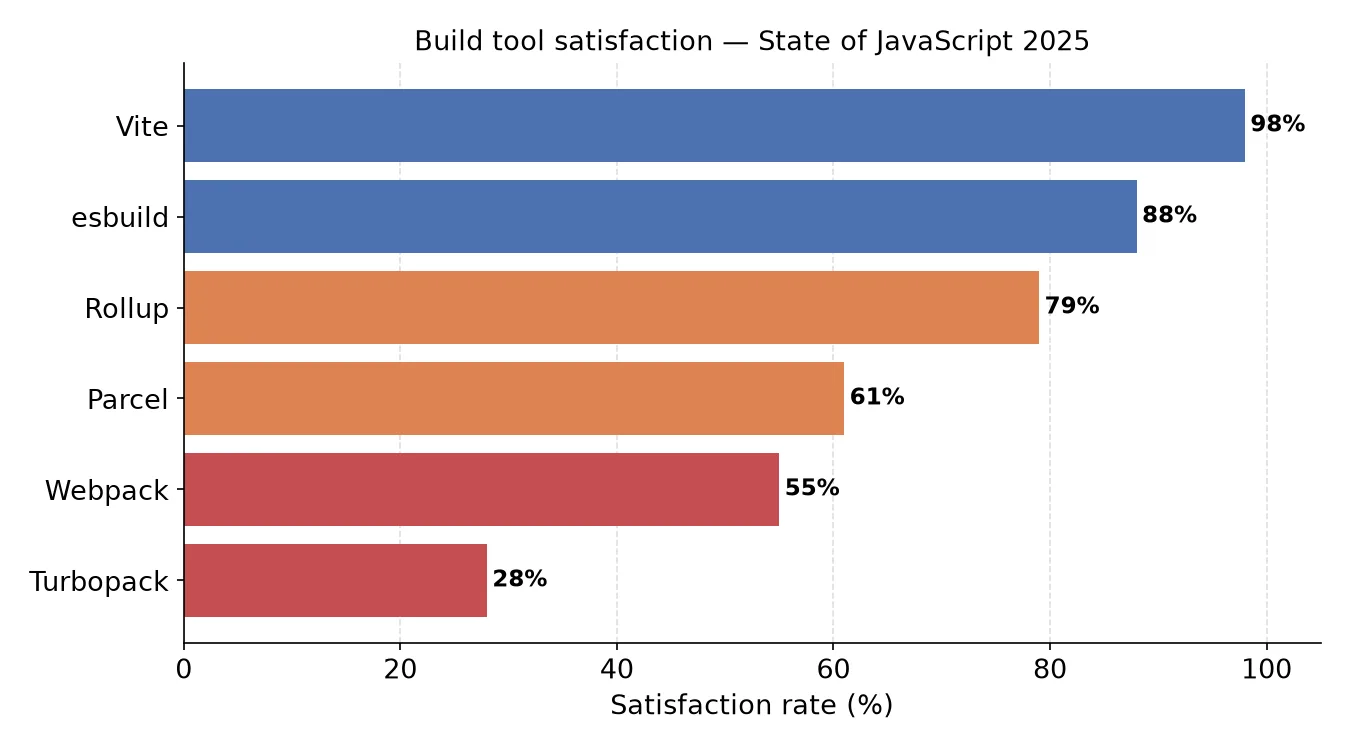
Vite hit 98% satisfaction, the percentage of users who have used a tool and would use it again. That’s not just high; the survey’s historical data doesn’t show another tool reaching that number at Vite’s scale. esbuild is at 88%, Rollup at 79%, Parcel at 61%, Webpack at 55%, and Turbopack at 28%.
Turbopack’s 28% needs context: that number is usage, not satisfaction. Turbopack ships as the default bundler in Next.js 15+, which means many developers are using it without having chosen it. The satisfaction number among those who actively opted into Turbopack is higher, but it’s still early-stage tooling in comparison to Vite’s maturity.
The practical takeaway: if you’re starting a new project and don’t have a framework that forces a bundler choice, Vite is the current default. Rolldown (a Rollup-compatible bundler written in Rust, intended to eventually power Vite) jumped from 1% to 10% usage in 2025, which suggests awareness is building ahead of what could be a significant Vite performance improvement in the coming year.
Front-end frameworks: React holds, but Next.js generates the most controversy
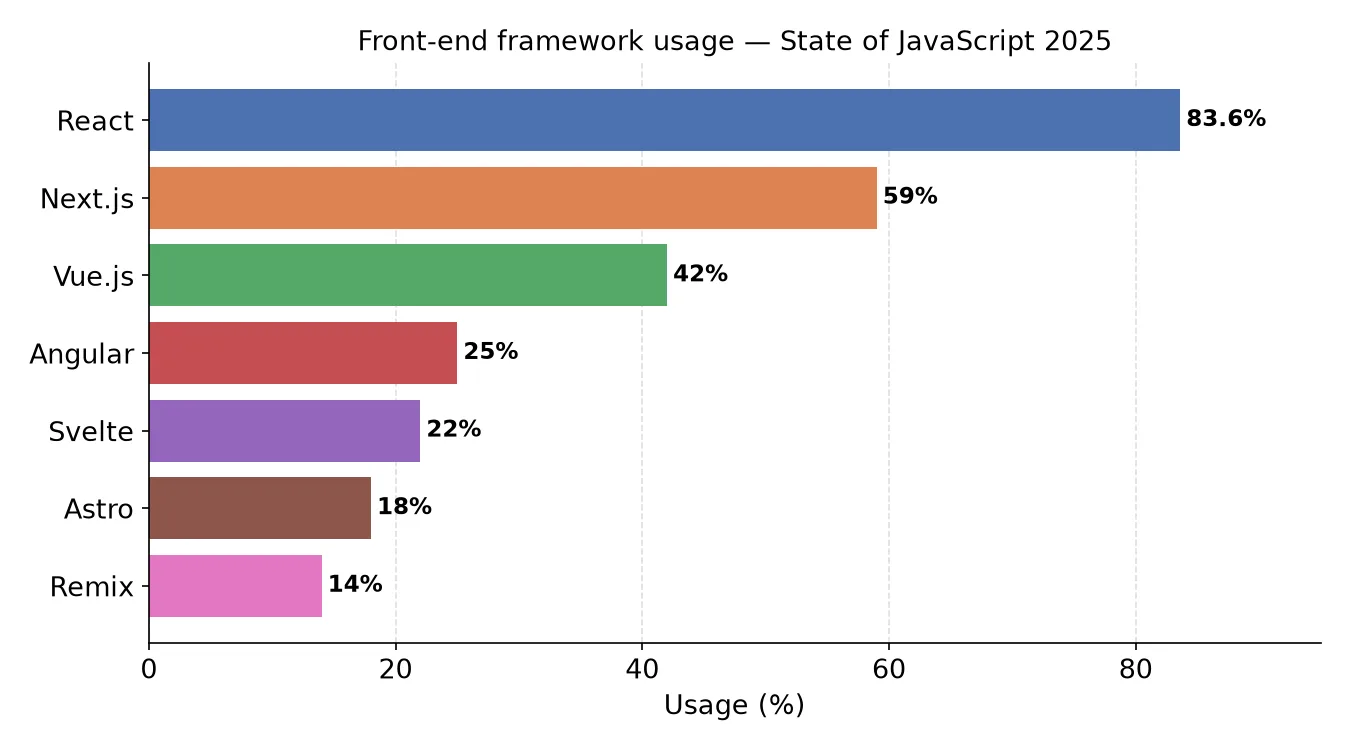
React usage holds at 83.6%, nearly unchanged from prior years. The framework is so deeply embedded in the hiring market, the existing codebase, and the tooling ecosystem that churn is slow even when developers are critical of it.
Next.js usage is at 59%, making it the dominant meta-framework. But 59% with the most comments of any project in the survey, roughly split between positive (21%) and negative (17%). That’s unusual; most tools at that usage level have strongly consolidated sentiment by now.
The complaints cluster around specific pain points:
- The App Router transition: many teams find the mental model of Server Components and the mixing of async components with client components genuinely confusing
- Vercel dependency concerns: the perception (fair or not) that optimal Next.js requires Vercel hosting
- Router model complexity: confusion about what renders where, when, and with what data
None of this translates to a usage cliff. Teams don’t migrate off Next.js lightly. But it does explain why Astro and TanStack Start are getting traction among teams starting new projects.
Svelte holds at 22% usage with high satisfaction, lower than React by a significant margin, but developers who use it tend to stay with it. Vue at 42% is the established second-tier framework for teams that have made a deliberate choice away from React.
TypeScript: the debate is over
The survey tracks TypeScript adoption across three categories: TypeScript only, mix of TypeScript and JavaScript, and JavaScript only. In 2025:
- 40% use TypeScript exclusively: no JavaScript files in their projects
- 35% use both: primarily TypeScript, with some JavaScript
- 25% use JavaScript only
The split between “TS only” and “mix” has been moving in one direction for several years. The practical conclusion: new projects default to TypeScript. Teams that started TypeScript migrations years ago are now in the “exclusively TypeScript” camp. The question at the start of a project is no longer “should we use TypeScript” but “how strict should our tsconfig.json be.”
For teams hiring JavaScript engineers, this data point matters. A developer whose portfolio shows JavaScript-only projects in 2025 needs to be able to explain why, or the hiring market will read it as unfamiliarity with the ecosystem default. The TypeScript Developer hiring guide covers what to look for beyond the syntax.
Runtimes: Node.js at 90%, Bun at 21% and growing
Node.js dominance remains at 90%, a number that’s barely moved in five years. The runtime question was never really a competition for most teams; Node.js has the deepest ecosystem integration and no meaningful migration pressure.
Bun’s growth from 17% to 21% is the interesting signal. What’s driving it isn’t usually “we replaced Node.js with Bun.” It’s “we replaced npm with Bun’s package manager on our Node.js project.” The install speed difference is real and immediate. The runtime switch comes later, if at all.
The satisfaction data for Bun is high among users who have adopted it. The caveat: satisfaction surveys self-select toward early adopters who made a deliberate choice. Bun’s compatibility story has improved significantly through 2025, but it’s still not a drop-in Node.js replacement for everything.
Deno at roughly 8% is the perennial “interesting project people aren’t using.” The 2.9 release’s introduction of deno desktop and better npm/pnpm compatibility may shift this, though the survey data predates June 2026.
AI tools in the workflow
The survey added more granular AI tool tracking in 2025. The numbers that stand out:
- Claude usage doubled from 22% to 44%
- Cursor more than doubled from 11% to 26%
- GitHub Copilot maintained strong usage as the incumbent
- ChatGPT for coding remains widely used but flat
The AI tool category is now past the “I tried it once” phase. Usage rates this high, from a survey population that skews toward active developers, means these tools are embedded in daily workflows for a substantial fraction of respondents. The interesting follow-up question (which the survey doesn’t directly answer) is how much code AI tooling actually produces vs. how much it assists with. The distinction matters for how teams think about quality and review.
What to take from this
A few decisions this data should inform:
On tooling: Vite is the safe default for new projects. Webpack migrations are worth prioritizing if you’re still on it. The satisfaction gap between Webpack (55%) and the alternatives is real, and the technical debt of maintaining Webpack config accumulates. For framework selection, Next.js is fine if your team has already internalized the App Router model, but if you’re starting fresh and your primary use case is content or marketing sites, Astro has earned a serious look.
On TypeScript: The 40% exclusive usage rate means TypeScript-first should be the default assumption unless there’s a specific reason otherwise. It’s past the “optional enhancement” phase.
On Bun: Worth trying as a package manager replacement first. The install speed improvement is real with no migration risk if you keep Node.js as the runtime. Runtime migration is a separate, larger decision.
On AI tools: If your team isn’t using any AI coding assistance, the survey data puts you in the 25% or so who aren’t. That’s not a reason to adopt if the tools don’t fit your workflow, but it’s worth intentional evaluation rather than passive avoidance.
The State of JavaScript survey is a lagging indicator: it captures what developers actually use, not what they’re experimenting with. But that’s what makes it useful. The 2025 data reflects months of real project decisions, not blog post hype cycles.
Frequently asked questions
- What is the State of JavaScript survey?
- The State of JavaScript is an annual developer survey that asks respondents about the JavaScript tools, frameworks, and features they use. The 2025 edition collected over 25,000 responses from developers worldwide. Results were published in March 2026. The survey covers front-end frameworks, meta-frameworks, testing tools, build tools, runtimes, and language features.
- Why does Vite have such high satisfaction while Turbopack's usage is low?
- Vite's 98% satisfaction reflects that the developers who have adopted it are overwhelmingly happy with it — it's fast, well-documented, and handles the common case well. Turbopack's 28% usage (it's bundled with Next.js) reflects adoption, not satisfaction, and many of those users are on it involuntarily via Next.js defaults rather than by deliberate choice. The two numbers measure different things.
- Is Next.js losing favor among developers?
- It's complicated. Next.js is still the most used meta-framework at 59% usage. But it generated the most comments of any project in the 2025 survey, with roughly 21% positive sentiment and 17% negative sentiment — more controversy than any other tool. The complaints center on complexity, the App Router transition, vendor lock-in on Vercel, and runtime model confusion (what runs where). The satisfaction among committed users is still reasonable, but the vocal criticism is real.
- What is driving Bun's growth?
- Bun's appeal is speed and consolidation — it replaces npm/yarn/pnpm as a package manager and Node as a runtime in a single binary that's consistently faster at install and startup time. At 21% usage it's past the early-adopter phase. Most teams that have adopted it are using it first as a package manager on Node.js projects, then gradually migrating runtime-specific code. The satisfaction among users is high.
- What does the AI tool adoption data mean for how developers work?
- Claude usage doubled from 22% to 44%, Cursor more than doubled from 11% to 26%, and Copilot continued to hold strong. The practical meaning: AI coding tools have moved from 'interesting experiment' to 'part of the daily workflow' for a significant portion of the survey population. This doesn't mean AI is writing most code — it means the tooling layer has shifted and developers who aren't using these tools are increasingly in the minority, at least among respondents to a survey like this.
Sources
Sponsored
More from this category
More from Web Development
Sponsored
Discussion
Join the conversation.
Comments are powered by GitHub Discussions. Sign in with your GitHub account to leave a comment.
Sponsored