Web Development · Language & Standards
TC39's Signals Proposal: Why It Matters Now
TC39 is standardizing signals, the reactive pattern already inside Vue, Solid, Angular, and Preact. Years from browsers, but it changes what to build on.

Abhishek Gupta
5 min read
Sponsored
Reactivity (the pattern where a value change automatically propagates to everything that depends on it) has quietly become the shared foundation under most modern JavaScript frameworks. Vue has it. Solid has it. Preact has it as an add-on. Angular rebuilt its core around it. React has arrived at something adjacent through hooks and re-renders. TC39 now wants to put the underlying primitive into the language itself.
That’s worth understanding even though it won’t affect your code for years. Here’s what it actually proposes, and why it doesn’t change your state-management decision this quarter.
What a signal actually is
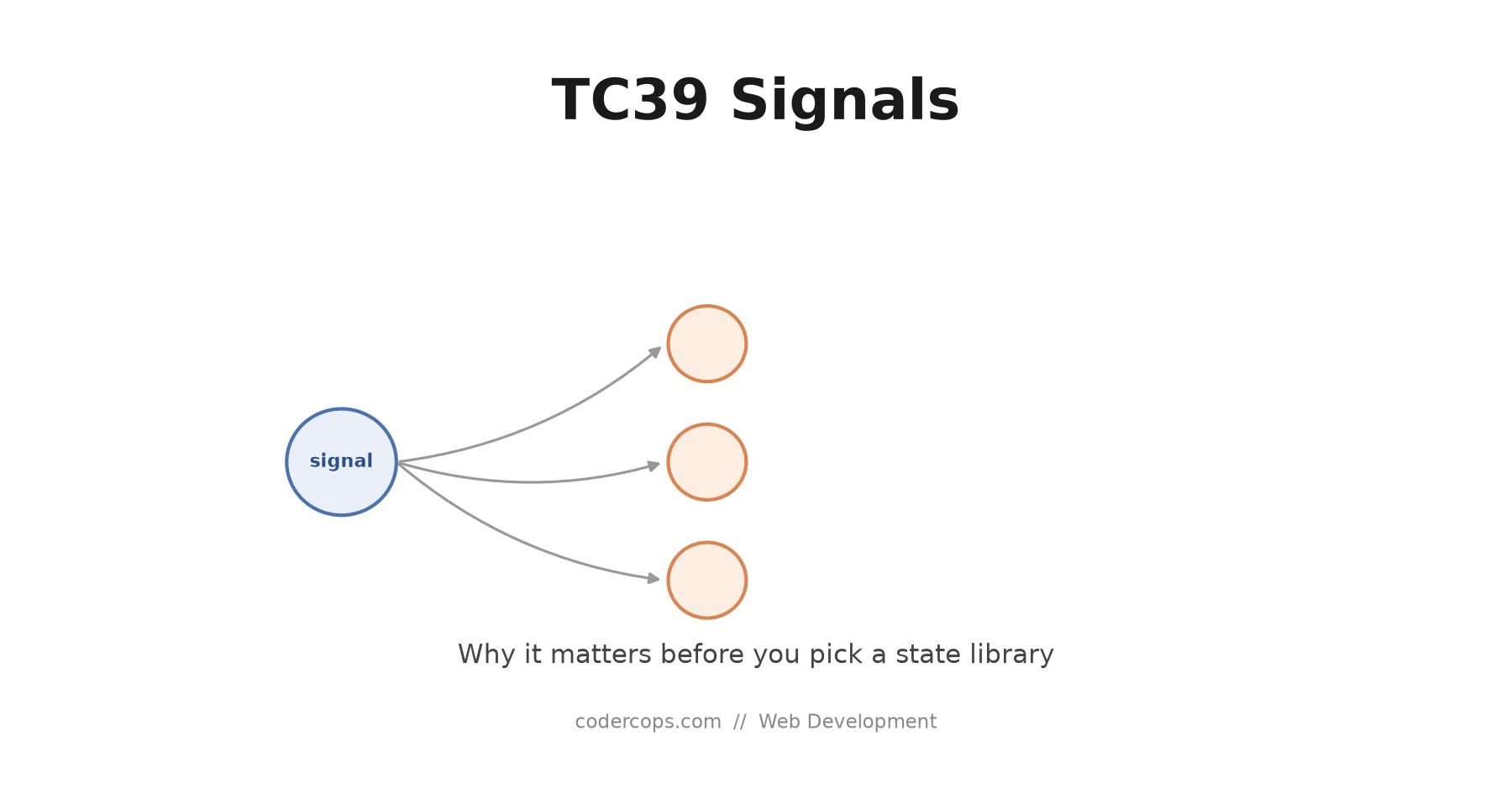
Strip away the framework-specific APIs and a signal is a small, specific thing: a container holding a value, which automatically tracks who reads it, and automatically notifies those readers when the value changes.
// Conceptual, framework-agnostic shape of what the proposal targets
const count = new Signal.State(0);
const doubled = new Signal.Computed(() => count.get() * 2);

console.log(doubled.get()); // 0
count.set(5);
console.log(doubled.get()); // 10, recomputed automatically
No manual subscription. No explicit “re-render this component” call. The dependency graph builds itself as code reads signal values, and updates propagate through that graph when a value changes. This is the core idea every reactive framework already implements in some form; the proposal’s job is to standardize the primitive, not invent a new pattern.
Why frameworks converged on this independently
This didn’t come from one framework’s design meeting. It shows up everywhere because it solves the same problem every UI framework has: knowing precisely what needs to update when data changes, without re-checking everything.
| Framework | Reactivity approach |
|---|---|
| Vue | Proxy-based reactive objects, tracked dependencies |
| SolidJS | Fine-grained signals, no virtual DOM |
| Angular (16+) | Native signals API, replacing zone-based change detection |
| Preact | Signals as an official add-on package |
| React | Hooks plus re-render diffing (a different model, not signal-based) |
Vue and Solid arrived at nearly identical mental models independently. Angular went further and rebuilt its whole change-detection system around signals, moving away from zone.js. That’s not a coincidence, and it’s the strongest evidence that TC39 is standardizing something real rather than picking a side in a framework debate. Our look at Angular’s signals-driven comeback covers what that migration looked like in practice for one framework; TC39’s proposal is the industry-wide version of the same bet.
React is the interesting holdout. Its model (state changes trigger re-renders, which get diffed against a virtual DOM) solves a related problem differently, and it’s not a natural fit for a drop-in signals primitive. Don’t expect React to switch to native signals wholesale even once they land in browsers; expect, at most, interop layers and optional APIs built on top.
What TC39 is and isn’t standardizing
It’s worth being precise here, because “signals are coming to JavaScript” oversells what’s actually proposed. TC39 is standardizing the primitive: Signal.State and Signal.Computed, roughly, plus the semantics for how dependency tracking and change propagation work at the language level.
It is not standardizing:
- A component model or rendering system
- A specific state management pattern (global store vs. local component state)
- Framework-level concerns like effects, lifecycle hooks, or async state
That distinction matters. Native signals would give framework authors a shared, engine-optimized building block to construct reactivity on top of. They would not obsolete the frameworks themselves, any more than the array methods JavaScript standardized obsoleted lodash entirely; they’d just mean less duplicated, less optimizable JavaScript doing the same fundamental job across every framework’s bundle.
The realistic timeline
Per the proposal’s own contributors, native signals being available across browsers going back a few versions is at least 2-3 years out at an absolute minimum, contingent on smooth progress through TC39’s stage process (which has stalled or reworked plenty of proposals before). All contributors have signed the required IP agreements and the plan is to present formally to committee, but “presented to committee” and “shipped in every evergreen browser” are years apart in practice.
For comparison, that’s a longer horizon than the release cycle of any framework covered on this blog. Nothing about choosing a state management approach today should be delayed waiting on this.
What to actually do with this information
If you’re picking a state management library for a project starting now, pick based on today’s tradeoffs: bundle size, your team’s familiarity, the specific problem (local component state versus global app state versus server state), and how well it’s actually maintained. Our comparison of Zustand and Jotai for React state management is still the right reference point for that decision, and nothing here changes its conclusions.
Where TC39’s Signals proposal is genuinely useful is as a directional signal for architecture decisions with a longer horizon: if you’re evaluating a new framework, or deciding how deeply to couple your application logic to a specific reactivity implementation, it’s worth knowing that the ecosystem is converging on this pattern at the language level. That convergence is a reasonable tiebreaker when two frameworks are otherwise close, not a reason to hold off shipping anything today.
Reactivity is becoming a language feature, eventually. Build your app with the tools that fit it now, and let the standard catch up.
Frequently asked questions
- What is TC39's Signals proposal, in plain terms?
- It's a proposal to add a native reactive value type to JavaScript: a signal is a container that holds a value, tracks which parts of your code read it, and automatically notifies those readers when the value changes. Right now, every framework (React, Vue, Solid, Angular) implements some version of this pattern itself, in JavaScript, with its own tradeoffs. The proposal would put the core primitive into the language, so frameworks build on a shared, engine-level implementation instead of each shipping their own.
- Is this the same thing as React state or Vue's reactivity?
- It's the same underlying idea, standardized. Vue's reactivity system, SolidJS's signals, Preact Signals, and Angular's own signals API already do this today, each with their own implementation. React's useState and hooks solve a related problem differently, through re-renders rather than fine-grained dependency tracking. TC39 Signals doesn't replace any of these outright; it gives framework authors a common low-level building block that a browser engine can optimize, instead of every framework shipping its own JavaScript implementation of the same concept.
- When will I actually be able to use native JavaScript signals?
- Not soon. The proposal's own contributors estimate at least 2-3 years at an absolute minimum before Signals are natively available across browsers going back a few versions, and that assumes smooth advancement through TC39's stages. For context, that's a longer runway than most framework release cycles. Nothing about your current stack needs to wait for this.
- Does this mean I shouldn't use Zustand, Jotai, or Redux right now?
- No. Pick a state library based on what your application needs today. The libraries covered in our piece on [Zustand, Jotai, and React state management](/blog/zustand-jotai-react-state-management-2026/) solve real problems now, and native signals are years from being a viable replacement even if the proposal advances cleanly. If anything, some of those libraries already model their APIs on the signals pattern, so adopting one today isn't wasted effort if native signals eventually arrive.
- Why does a proposal that won't ship for years matter today?
- Because it changes the direction framework authors are building toward, not because you can use it yet. Angular already rebuilt its reactivity model around signals ahead of the standard. If TC39 signals eventually land, frameworks that already model their reactivity this way have less to migrate. It's a signal (no pun intended) about where the ecosystem is converging, useful for long-term architecture decisions, not for tomorrow's sprint.
Sources
Sponsored
More from this category
More from Web Development
Sponsored
Discussion
Join the conversation.
Comments are powered by GitHub Discussions. Sign in with your GitHub account to leave a comment.
Sponsored