Cloud & Infrastructure · AI Infrastructure
SambaNova's $1B Round Shows Where AI Chip Money Is Actually Going
SambaNova raised $1B at an $11B valuation to build inference-specific chips, not training hardware. What the inference wave means for production AI.

Abhishek Gupta
6 min read
Sponsored
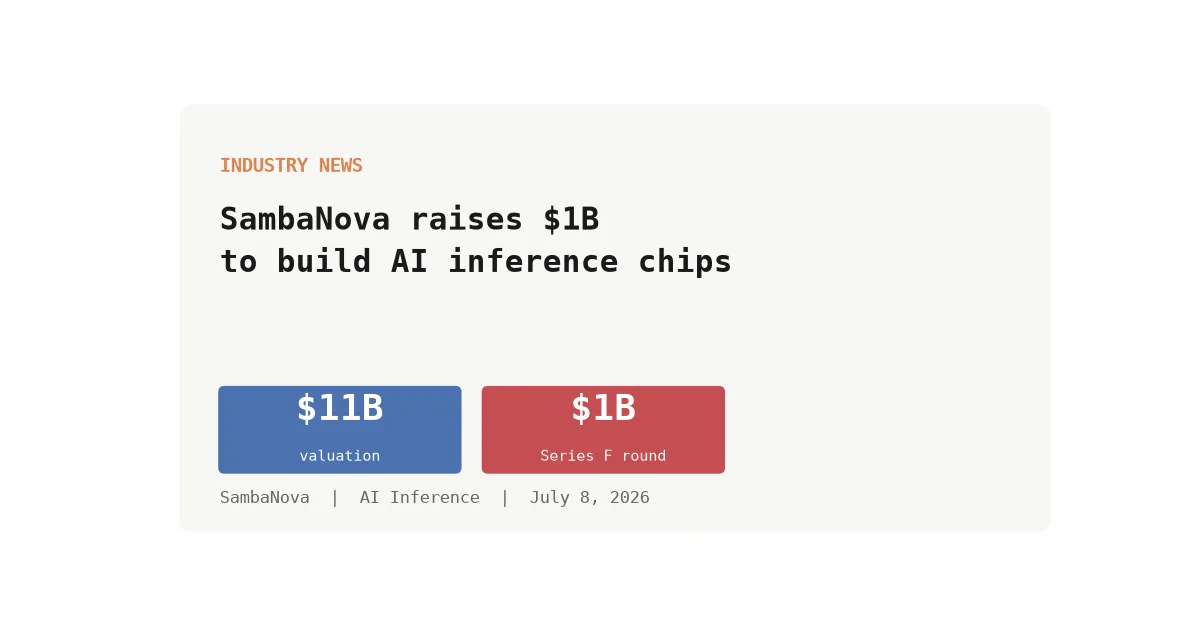
SambaNova Systems raised $1 billion in a Series F on July 8, 2026, at an $11 billion valuation. General Atlantic led the round, with Seligman Ventures, T. Rowe Price Associates, and Capital Group also putting in money. The detail that matters more than the number is what SambaNova actually sells: custom chips, hardware systems, and cloud services built specifically for inference, the part of the AI pipeline where a trained model answers a question, as opposed to training, the part where the model learns in the first place.
That distinction used to be a footnote. It isn’t anymore.
Two different jobs wearing one label
For a few years, “AI chip” mostly meant “chip for training large models,” because training was where the compute bottleneck was. You needed enormous clusters of GPUs to grind through trillions of tokens over weeks. Inference, running the already-trained model to serve a user request, was treated as the easy part: smaller, cheaper, an afterthought bolted onto the training story.
That’s no longer accurate. Once a model is trained, it gets called millions or billions of times in production, and each of those calls costs money and takes time. Training happens once (or periodically, for a retrain). Inference happens constantly, at whatever scale your product reaches. When a product succeeds, its inference bill and its inference latency become the operating cost and the user experience, in a way training cost never does after the model ships.
Here’s a rough way to think about how the two workloads differ:
| Training | Inference | |
|---|---|---|
| Primary goal | Maximize throughput across a huge, mostly static dataset | Minimize latency and cost per individual request |
| Workload pattern | Long-running, batched, predictable | Bursty, request-driven, unpredictable |
| What you’re optimizing | Raw FLOPs over time | Cost per query, response time, tokens per second per dollar |
| Hardware sweet spot | Massive parallel clusters, tolerant of longer job times | Chips tuned for low-latency, high-utilization serving at variable load |
| Cost shows up as | A capital project with a defined end | An ongoing operating expense tied directly to usage |
A chip designed to be excellent at the left column isn’t automatically excellent at the right one. General-purpose GPUs are good at both, which is exactly why Nvidia dominates the whole market. But “good at both” leaves room for a chip built to do only the right column better: better cost-per-query, better latency consistency under bursty traffic, better utilization when requests are small and constant instead of large and batched. That’s the gap SambaNova, along with challengers like Groq and Cerebras, is trying to occupy.
Why JPMorgan matters more than the valuation
The most concrete data point in this round isn’t the $11 billion figure, it’s that JPMorgan Chase picked SambaNova as an inference infrastructure partner and deployed its SN40 and SN50 chip systems for AI inference workloads. A bank of that size doesn’t swap infrastructure vendors on a sales pitch. Getting selected by an organization with that much scrutiny and that little appetite for risk is a stronger endorsement of the underlying product than the size of any funding round.
That said, don’t read too much technical detail into it. We don’t have published throughput or latency benchmarks for the SN40 or SN50 specifically, and this isn’t the place to guess at numbers SambaNova hasn’t disclosed. What we do know is qualitative but real: a major enterprise evaluated a purpose-built inference chip against the alternatives and chose it for production workloads.
Part of a bigger shift, not an isolated bet
SambaNova isn’t the only company raising large rounds around this exact valuation range in the same window. Mid-2026 has seen a run of inference-focused infrastructure companies land big checks at similar valuations, which says less about any one company and more about where investor conviction has moved. The earlier wave of AI infrastructure capital chased training clusters. This wave is chasing the machinery that serves models once they’re already trained, because that’s where the ongoing, compounding cost actually lives.
If you want the broader picture on how the major chip vendors stack up against each other in 2026, our comparison of NVIDIA, AMD, and Intel’s AI chip strategies is a useful companion piece. The short version relevant here: none of those three has a dedicated, inference-only architecture competing directly with what SambaNova, Groq, and Cerebras are building. That’s precisely the gap this round is a bet on.
What this actually means if you’re building a product
If you’re running LLM-backed features in production, the honest takeaway isn’t “switch chip vendors.” It’s that you now have a real decision to make where none existed a couple of years ago. Generic GPU-based inference used to be the only practical option for most teams. That’s no longer strictly true for every workload; for some traffic patterns, a dedicated inference provider can plausibly beat a general-purpose GPU setup on cost, latency, or both.
Whether that applies to your workload depends entirely on your traffic shape, your latency requirements, and your current cost structure, not on how large SambaNova’s funding round was. A $1 billion raise tells you the option exists and is well capitalized. It doesn’t tell you whether it’s the right option for your specific product. That evaluation, benchmarking a dedicated inference provider against what you’re running today on your actual traffic, is exactly the kind of infrastructure work we help clients think through at our team when the GPU bill starts looking like the biggest line item in the budget.
The takeaway for engineering leaders
Inference cost is no longer a rounding error you deal with after the interesting engineering is done. It’s becoming its own specialized market with dedicated hardware, dedicated vendors, and real competitive tension with the default GPU approach. Treat that as a prompt to re-run your own inference cost math at least once a quarter, not as a reason to chase whichever chip vendor made headlines this month. The vendors will keep raising money either way; your job is deciding whether any of it changes your architecture.
Frequently asked questions
- What does SambaNova actually build?
- SambaNova builds custom AI chips, the hardware systems around them, and cloud services, all aimed specifically at inference, meaning the process of running an already-trained model to answer a query, rather than at training new models from scratch.
- Why did SambaNova raise money for inference specifically instead of training?
- Demand for running large language models in production is growing faster than demand for training new ones, and the cost and latency profile of serving inference at scale is different enough from training that purpose-built hardware can have a real advantage. That gap is what's attracting capital right now.
- Is SambaNova replacing Nvidia?
- Not broadly. Nvidia still dominates both training and general-purpose inference. SambaNova, along with companies like Groq and Cerebras, is competing for a specific slice of inference workloads where a purpose-built chip can beat a general-purpose GPU on cost or latency for a given workload. It's competition at the edges, not a takeover.
- What does the JPMorgan deployment tell us?
- It tells us a large, risk-averse financial institution evaluated SambaNova's SN40 and SN50 chip systems for inference workloads and decided the switch was worth it, which is a meaningfully stronger signal than a funding round alone. Enterprises that size don't typically make infrastructure changes on hype.
- Should my team switch to a dedicated inference chip provider?
- Only if you've measured your actual inference cost and latency on your current setup and found a specific bottleneck a dedicated provider addresses. Funding size and a marquee customer are reasons to evaluate an option, not reasons to switch without your own benchmarks.
Sources
Sponsored
More from this category
More from Cloud & Infrastructure
Sponsored
Discussion
Join the conversation.
Comments are powered by GitHub Discussions. Sign in with your GitHub account to leave a comment.
Sponsored