
Sponsored
Most engineering manager hires don’t fail because the person turns out to be dumb or lazy. They fail because the company solved the wrong problem. The classic version: your best individual contributor gets promoted into management because they’re the best individual contributor, with no training, no mentor, and no reduction in their existing workload. Six months later your team’s velocity has dropped, the new manager is miserable, and everyone quietly agrees the promotion “didn’t work out,” as if that was ever a fair test.
The second version is just as common and looks like the opposite mistake: a candidate with an impressive title from a well-known company, ten direct reports on their resume, glowing references from people who worked for them. They interview well. They talk fluently about servant leadership and psychological safety. Then they start the job, and it turns out they haven’t made a real technical trade-off call in years, can’t read a design doc closely enough to ask a sharp question, and the senior engineers on the team figure this out within a month.
Both failures come from testing the wrong thing. Hiring an engineering manager is not the same problem as hiring a senior developer, and the interview process should not pretend it is.
What the job actually requires
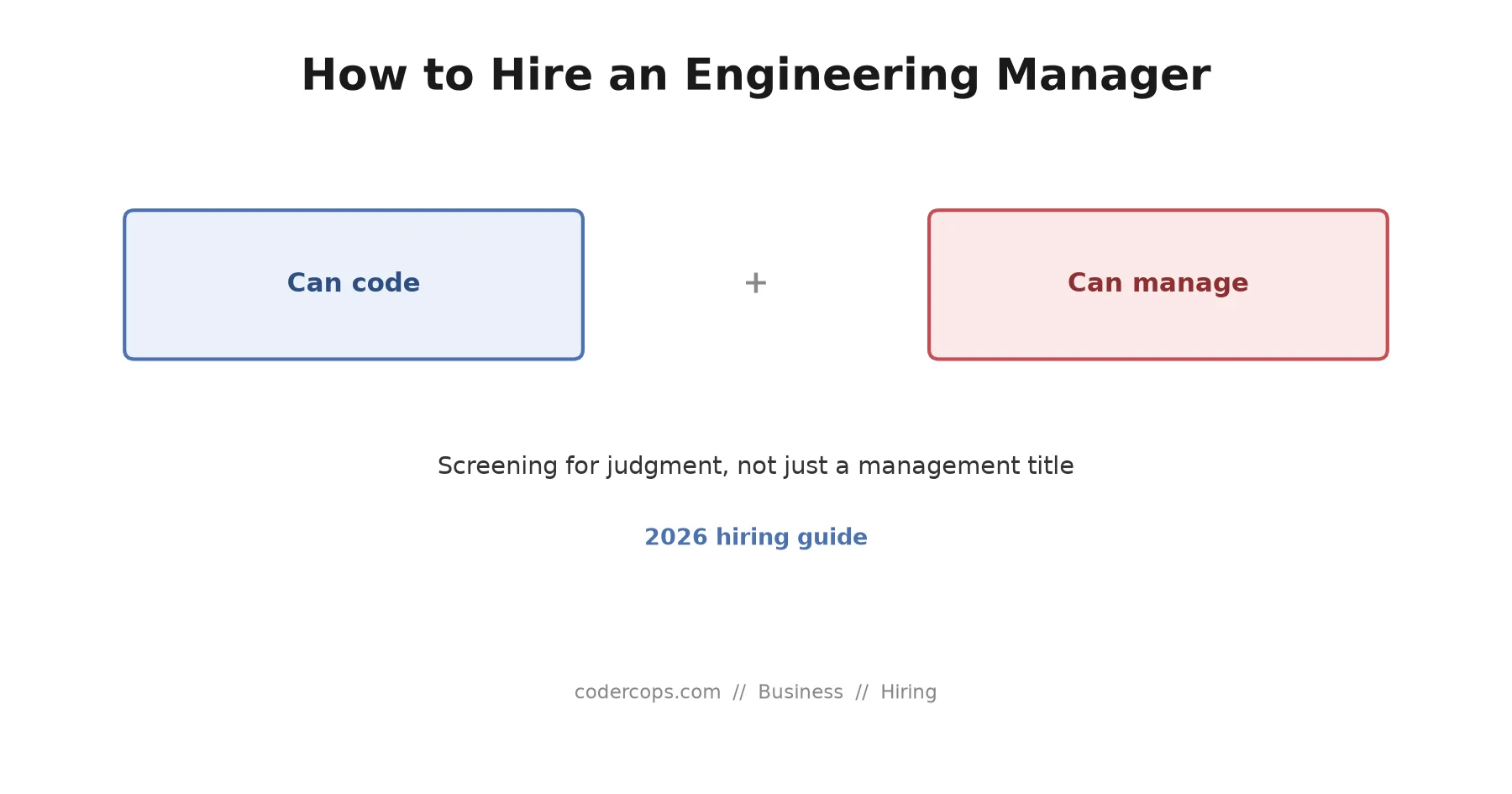
An engineering manager’s real job is making the team more effective than it would be without them, which breaks down into three things that have nothing to do with raw coding ability:
Unblocking people. Removing the thing that’s slowing an engineer down, whether that’s a decision nobody will make, a dependency on another team, or a task that’s dragged on because the requirements were never clear.
Making technical trade-off calls without doing the technical work themselves. Deciding when to pay down debt versus ship the feature, when a design is good enough versus when it needs another pass, when to push back on scope.
Handling people problems directly. Giving feedback that’s actually hard to give, having the conversation with an underperforming report instead of avoiding it for two quarters, and knowing when someone genuinely isn’t going to work out in the role.
None of that shows up on a resume as a line item, and none of it is tested by the kind of technical interview you’d run for a senior developer. If you’re hiring for a pure IC role instead, the process in our guide to hiring a vetted software developer is the right one to use. This one is different on purpose.
The internal promotion trap
Promoting your best engineer into management is not automatically wrong. Some of the best managers were exactly that. The trap is doing it as a reward rather than a hire.
If someone is a strong IC and you want to promote them into management, treat it as seriously as you would treat hiring from outside. Look for the same signals: have they already been unblocking teammates informally, mentoring juniors without being asked, communicating trade-offs to product or leadership in a way non-engineers can follow? If those signs are already there, the promotion is low risk. If they’re absent and the promotion is purely “they’re our best coder, they’ve been here longest, it’s their turn,” you are handing someone a job they’ve never practiced any part of, and you should expect the same learning curve you’d get from a first-time external hire, except now their old technical output is also gone.
Either way, cut their prior workload. A new manager who’s still expected to ship the same volume of code they did as an IC, on top of learning to manage people, is set up to do both jobs badly.
What to actually screen for
Skip the generic “tell me about your leadership style” question. It rewards people who are good at talking about leadership, which is a different skill from being good at it. Ask things that force a specific, checkable answer.
How they’ve handled an underperforming report. Ask for a real example: someone on their team who wasn’t meeting the bar, and what they actually did. A weak answer stays vague (“I coached them and it worked out”) or describes waiting a long time before doing anything. A strong answer names a specific performance gap, describes a direct conversation, a concrete plan with a deadline, and an honest outcome, including if the outcome was that the person eventually left the team. Someone who has never had this conversation, or dodges the question, will avoid having it with your team too.
Technical debt versus feature pressure. Describe a realistic scenario: a deadline is close, a shortcut would hit it, and the shortcut adds debt that will slow the team down for months. Ask what they’d do and how they’d explain the decision to the business side. Look for someone who can articulate the actual cost of the debt in terms a non-engineer would understand, not just “debt is bad” as an article of faith.
A code or design review, live. Hand them a real pull request or design doc (yours, if you can share it, or a public one) and ask them to review it out loud. You’re not testing whether they’d write it the same way. You’re testing whether they can still follow the reasoning, spot a real issue, and ask a question that shows they understood the trade-offs. A manager who goes silent or only comments on formatting has lost the technical thread, and the team will notice fast.
Disagreeing with a business stakeholder. Ask about a time they pushed back on a deadline, a scope decision, or a request from product or sales, and what happened. This is the single best predictor of whether pressure gets absorbed by the manager or passed straight down to the team. Someone who can’t point to a real example of pushing back, even a small one, will fold the first time a VP leans on them.
| What to test | Weak signal | Strong signal |
|---|---|---|
| Underperformance handling | Vague, avoids specifics, “it worked out” | Names the gap, the conversation, the plan, the real outcome |
| Debt vs. feature trade-offs | Treats debt as always bad or always acceptable | Explains cost in terms a non-engineer understands, gives a real example of choosing each way |
| Technical credibility | Can’t engage with a real PR or design doc | Asks a sharp, specific question about the actual trade-off |
| Handling business pressure | No example of pushing back, or pushes back on everything | A specific instance of real pushback with a reasonable outcome |
Where candidates come from, and why the title lies
Three pools produce real EM candidates. Senior ICs ready to move into management, whose signal is whatever informal leading they’ve already done. Managers moving from a bigger company, whose titles can be misleading because a “director” at a 2,000-person company may have been three layers removed from any real technical decision. And managers from smaller, scrappier companies who’ve had to do everything themselves, which tends to produce people with sharper technical judgment relative to the size of team they managed.
Treat the title as the least reliable part of the resume. A “Senior Engineering Manager, 15 reports” from a large company tells you almost nothing about whether this person has made a hard call under pressure recently, or whether they’ve been insulated from every decision that actually mattered by layers of process and other managers above them. Ask the same specific questions regardless of where they come from, and weight the answers over the title every time.
If you’re writing the job posting itself, the same principle applies: describe the actual decisions and trade-offs the role owns rather than a generic list of leadership buzzwords, the same advice we give for writing a technical job description for senior developers applies here almost unchanged, just aimed at management judgment instead of coding ability.
A practical starting point
Don’t hand a new manager, promoted or hired, a team of ten on day one. Start them at four to six direct reports. That’s enough people for real repetition (real 1:1s, real feedback conversations, real prioritization calls) without so many that mistakes compound faster than they can learn from them. Give it 90 days before judging whether the hire was right, and check in at 30 days specifically on whether they’ve had at least one hard conversation with a report, not just easy ones.
The honest test of an engineering manager hire isn’t whether the team likes them in month one. It’s whether, six months in, the team is shipping better work with less friction than it did before, and whether the manager has had at least one conversation that was genuinely uncomfortable and handled it well. If you can’t point to evidence of that yet, you haven’t finished evaluating the hire, whatever the org chart says.
Frequently asked questions
- Should I promote from within or hire an engineering manager externally?
- Promote from within when you have a senior engineer who has already shown signs of the job without the title: reviewing others' work generously, unblocking teammates, communicating trade-offs to non-engineers. Hire externally when nobody on the team has done any of that yet, or when the team has grown past what an internal candidate has managed before. The mistake is picking a lane by default. Promoting your best coder because they're your best coder, or hiring externally because internal promotion feels awkward, both skip the actual question, which is who has shown real management judgment already.
- What's the biggest engineering manager hiring mistake?
- Promoting your strongest individual contributor into management with no training, no mentorship, and no reduction in their technical workload, then being surprised when the team's velocity drops and the new manager burns out. The IC skills that got them promoted (writing good code fast) have almost nothing to do with the manager skills the job actually requires (giving hard feedback, protecting the team from bad deadlines, making trade-off calls under pressure). The second most common mistake is the opposite: hiring someone with an impressive management title from a big company who has not made a real technical judgment call in years and can't earn credibility with a team of engineers who can tell the difference.
- How many direct reports should a new engineering manager start with?
- Four to six is a reasonable starting range for someone new to the role, whether promoted internally or hired externally. Below four, they don't get enough repetition to develop real management instincts. Above eight or so, even an experienced manager starts missing things, and a first-time manager will miss more. Increase the number as they prove they can run 1:1s, give real feedback, and protect the team's time without your intervention.
- Can an engineering manager stop coding entirely?
- Most good ones do stop writing production code day to day, and that's fine. What they can't stop doing is reading code and reasoning about architecture. If a manager can no longer follow a design doc, ask a sharp question about a pull request, or push back on an estimate with any specifics, they lose credibility with the team fast, and engineers stop bringing them real technical problems. The skill that has to persist is technical judgment, not typing speed.
- How is hiring an engineering manager different from hiring a senior developer?
- A senior developer hire mostly fails on technical competence: they can't actually do the work at the level the resume implies. An engineering manager hire rarely fails that way, since most candidates can talk convincingly about architecture. It fails on judgment under interpersonal and organizational pressure: how they handle an underperforming report, whether they'll push back on a bad deadline, whether they protect their team's time or just pass pressure downward. You have to interview for a completely different failure mode, which is why the standard technical screen used for [hiring a vetted software developer](/blog/how-to-hire-vetted-software-developer-2026/) doesn't transfer directly to this role.
Sponsored
Sponsored
Discussion
Join the conversation.
Comments are powered by GitHub Discussions. Sign in with your GitHub account to leave a comment.
Sponsored