Industry News · Corporate Law
Apple's Trade Secrets Suit Against OpenAI, Explained
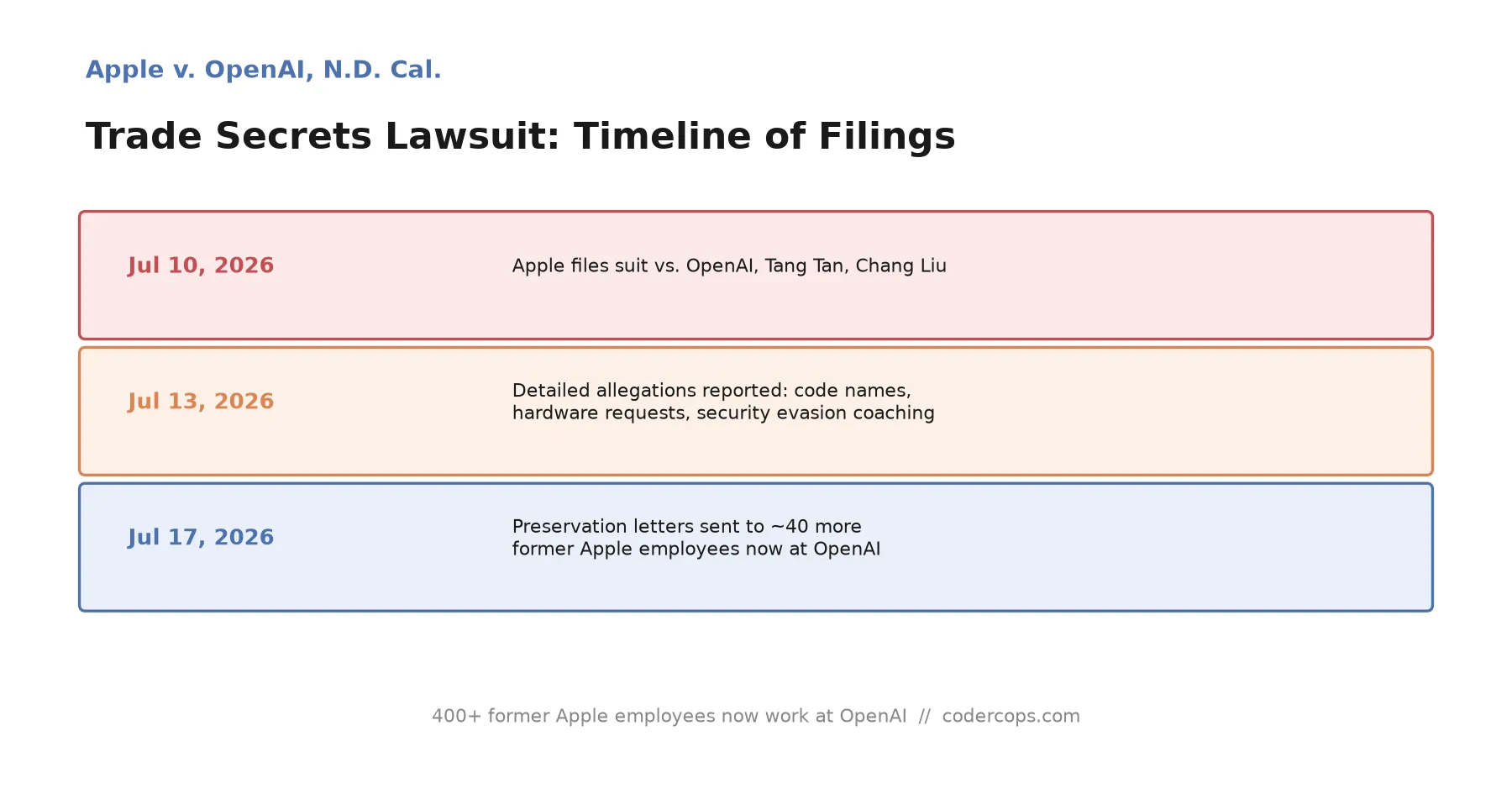
Apple sued OpenAI on July 10 over alleged recruiting and data extraction, then sent preservation letters to 40 more ex-employees. What it means for hiring.

Anurag Verma
5 min read
Sponsored
Apple filed a trade secrets lawsuit against OpenAI on July 10, and a week later widened it by sending legal preservation letters to roughly 40 more former employees. The headlines make it sound like corporate theater, laptops, code names, hardware smuggled into job interviews, and some of the specific allegations genuinely do read that way. But underneath the drama is a plain operational question every company hiring competitively should be asking itself right now: what actually stops this from happening to us, on either side of the recruiting table?
What Apple is actually alleging
Filed in the U.S. District Court for the Northern District of California, the complaint names OpenAI, its affiliated entities, and two individuals: Tang Tan, a former Apple vice president of product design for iPhone and Apple Watch who is now OpenAI’s Chief Hardware Officer, and Chang Liu, a former senior systems electrical engineer who spent eight years at Apple before joining OpenAI.
Against Tan, Apple alleges the misconduct wasn’t just aggressive recruiting; it alleges he used Apple’s internal confidential project code names during OpenAI’s hiring process, asked candidates to bring in Apple hardware components to interviews, coached departing Apple employees on how to evade Apple’s internal security procedures, and asked about details of unannounced Apple products. Against Liu, Apple alleges he failed to return an Apple-issued laptop after leaving in 2026, used it to download confidential technical documents post-departure, and briefed other Apple employees who were applying to OpenAI on what to study before their interviews.
Apple’s framing in the complaint is that this was a scheme operating “at every level,” not a couple of individuals overstepping on their own initiative. OpenAI has denied the allegations have merit.
Why the July 17 escalation matters
A week after filing, Apple sent legal preservation letters, formal notices instructing recipients to retain documents and communications relevant to potential litigation, to roughly 40 more former employees now at OpenAI. Apple’s complaint states that more than 400 former Apple employees currently work at OpenAI in total. The preservation letters don’t mean Apple is suing all 40 of those people. They mean Apple believes the conduct it’s alleging may not be limited to the two named defendants, and it’s preserving its options before evidence has a chance to age out.
That’s a meaningful signal about scope, regardless of how the underlying claims eventually hold up in court. A single-defendant trade secrets case is a dispute. A case where the plaintiff is actively expanding its evidence-preservation net across dozens of additional former employees is a company treating this as systemic.
Where the line actually sits
Competitors hiring each other’s talent is normal, legal, and something we cover regularly on this blog from the hiring side, including in our guide to how to hire a vetted software developer. Nothing about a company recruiting engineers away from a rival is inherently improper, and courts generally protect employee mobility for good reason: locking skilled people to one employer indefinitely is bad for the labor market and bad for innovation.
What Apple alleges goes past ordinary competition into specific, allegedly documented conduct: using confidential internal project names as a recruiting tool, requesting a competitor’s physical hardware from job candidates, and coaching people on evading security controls. If those specific claims are accurate, that’s not aggressive hiring, that’s using the hiring process itself as a vector for extracting confidential information. The distinction matters because it’s the whole basis of the lawsuit: not that OpenAI hired good people, but how the recruiting allegedly happened.
What this means if you’re building or scaling an engineering team
This case is a useful, low-cost prompt to check whether your own basics are actually in place, independent of who’s right in this specific dispute.
| Control | What it protects against |
|---|---|
| IP and confidentiality assignment at hiring | Ambiguity about who owns what an employee builds or knows |
| Documented offboarding checklist with device return verification | Departing employees retaining company hardware or data |
| Exit interview covering confidentiality obligations | Employees forgetting (or claiming to forget) what they agreed to |
| Hiring policy against requesting a candidate’s prior employer’s confidential material | Your own recruiting process becoming a liability like the one Apple alleges |
None of these are exotic. They’re the unglamorous parts of running an engineering organization that mostly get attention only after something like this makes headlines. A properly documented offboarding process would have made most of what Apple alleges against Liu, an unreturned laptop, downloaded documents after departure, straightforwardly preventable or at minimum clearly attributable.
The practical takeaway
If you’re an engineer weighing a move to a competitor, read your confidentiality and IP agreement before you leave, not after a subpoena. If you’re building a hiring process, put a plain policy in writing that recruiters and hiring managers don’t ask candidates to bring a former employer’s materials or discuss unannounced work. And if your offboarding process is “collect the laptop if we remember,” that gap is worth closing regardless of whether you ever end up anywhere near a courtroom over it. This case will take months, likely years, to resolve. The controls that would have prevented most of what’s alleged cost far less than the lawsuit either side is now paying lawyers to fight.
Frequently asked questions
- What is Apple actually alleging in the lawsuit?
- Apple alleges a coordinated scheme, not isolated poaching, where OpenAI leadership, specifically Chief Hardware Officer Tang Tan, used Apple's internal confidential project code names during recruiting, asked job candidates to bring in Apple hardware components, and coached departing employees on how to evade Apple's internal security procedures. Separately, former Apple engineer Chang Liu is accused of keeping an Apple-issued laptop after leaving, using it to download confidential technical documents, and advising other Apple employees applying to OpenAI on what to study before interviews.
- Is this normal for competitors hiring each other's engineers?
- Aggressive recruiting between competitors is normal and generally legal. What Apple is alleging goes further: using specific confidential project names as recruiting leverage, requesting physical hardware from candidates, and instructing people on how to bypass security controls. If those allegations hold up, that's a different category from ordinary talent competition, closer to coordinated extraction of confidential information through the hiring process itself.
- What happened on July 17 with the preservation letters?
- Apple sent legal preservation letters to roughly 40 additional former employees now working at OpenAI, instructing them to retain documents and communications that could be relevant to the case. Apple's complaint states more than 400 former Apple employees now work at OpenAI in total, and the letters suggest Apple believes the alleged misconduct may extend well beyond the individuals originally named as defendants.
- What should a company actually do to protect against this kind of exposure, on either side?
- The controls here are not exotic. Standard IP and confidentiality assignment agreements at hiring time, a documented offboarding process that includes verified return of company devices, and exit interviews that explicitly review confidentiality obligations cover most of what's alleged in this case. On the hiring side, a documented policy against requesting a candidate's former employer's confidential materials or physical assets during interviews protects the hiring company from exactly this kind of claim.
- Does this affect engineers considering a move between competitors?
- It's a useful prompt to actually read your confidentiality and IP assignment agreement before you leave a job, not after a lawsuit names you. Returning company property promptly, not retaining copies of internal documents 'just in case,' and being careful about what you discuss with a new employer about your old one's unannounced work are the practical, low-effort protections for any individual, regardless of how this specific case resolves.
Sources
- TechCrunch: Apple sues OpenAI over alleged trade secret theft
- TechCrunch: The wildest allegations in Apple's trade secrets lawsuit against OpenAI
- CNBC: Apple sues OpenAI alleging trade secret theft, says scheme was 'at every level'
- Computerworld: Apple widens OpenAI trade secrets fight with preservation orders
Sponsored
More from this category
More from Industry News
Sponsored
Discussion
Join the conversation.
Comments are powered by GitHub Discussions. Sign in with your GitHub account to leave a comment.
Sponsored