Cloud & Infrastructure · Cost Management
AWS's Trillion-Dollar Billing Bug: The Lesson
A unit-pricing bug sent some AWS customers cost projections in the billions on July 16. Invoices were fine; automation wired to those estimates wasn't.

Shashikant Gupta
5 min read
Sponsored
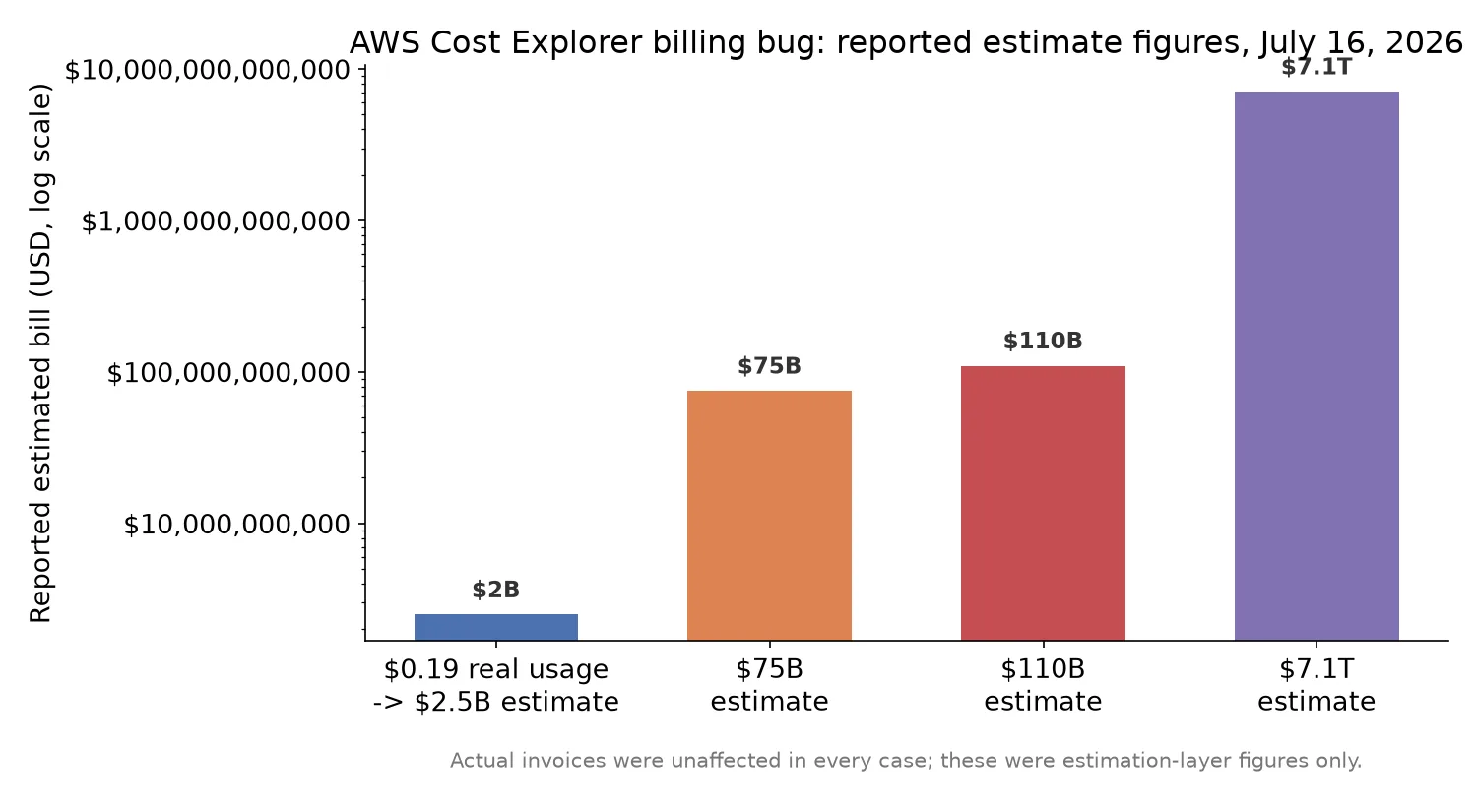
On the evening of July 16, some AWS customers opened their billing dashboard and saw numbers that don’t exist anywhere in the real economy: an account that normally spends under a dollar a month showing an estimated bill of nearly $2.5 billion. Others saw $75 billion, $110 billion, and at the extreme end, one report of $7.1 trillion. AWS confirmed this was a bug, not a real charge, and fixed it. But the incident is a genuinely useful case study in a failure mode that has nothing to do with AWS specifically: what happens when automation trusts an estimate as if it were ground truth.
What actually broke
AWS traced the bug to its estimated billing computation subsystem, the part of Cost Explorer that projects your likely monthly bill based on usage so far, which failed due to a unit-pricing error starting around 7:38 PM PDT on July 16, 2026. The bug corrupted the projection math for affected accounts, in some reported cases turning under a dollar of real usage into a headline-grabbing, physically impossible dollar figure.
Crucially, AWS confirmed this was strictly an estimation-layer failure. Real invoices and actual metered charges were computed correctly throughout the incident. Nobody’s real AWS bill jumped to a trillion dollars overnight; what broke was the number shown in the projection tool, not the number that ends up on the invoice.
Why “just an estimate” still matters
It would be easy to read “actual invoices were unaffected” as “no real impact, move on.” That undersells the actual risk. Cost Explorer’s estimate feed isn’t purely decorative. AWS Budget Actions can automatically restrict or pause resources when a spending threshold trips. Cost Anomaly Detection fires alerts based on deviations from expected spend. Plenty of teams also build their own automation on top of the Cost Explorer API: Slack bots, PagerDuty escalations, even scripts that throttle non-critical batch jobs when projected spend looks abnormal.
Every one of those systems was looking at the same corrupted numbers as the humans who screenshotted their trillion-dollar estimates for social media. A Budget Action configured to restrict resources at, say, 150% of a monthly budget threshold would have had every reason to fire during this window, not because spend actually changed, but because the number it was reading said it had.
The actual lesson, independent of AWS
This isn’t really a story about AWS’s billing code specifically; every large system has bugs, and a unit-pricing error in one subsystem is a genuinely unusual, low-probability event. It’s a story about what happens the moment you let an automated, irreversible action fire directly off a single upstream signal with no sanity check between the signal and the action.
The pattern generalizes well past billing. Autoscaling decisions driven by a single metrics source, deployment rollbacks triggered by one monitoring dashboard, access revocation driven by one anomaly detector: all of these share the same structural risk. The failure mode worth designing for isn’t the signal going missing, most systems already handle that reasonably well. It’s the signal reporting a confident, plausible-sounding, wrong number.
| Automation pattern | Risk during a bad estimate | Better pattern |
|---|---|---|
| Auto-shutdown at spend threshold | Fires on a false spike, breaks production | Require confirmation for destructive actions above a sanity bound |
| Advisory Slack/email alert | Sends a false alarm, mildly annoying | Fine as-is; tolerate false positives here |
| PagerDuty escalation to on-call | Wakes someone up for nothing | Add an order-of-magnitude sanity check before paging |
| Custom throttling script | Silently degrades service for no reason | Log and flag, don’t auto-execute past a bound |
What to actually build
A practical fix doesn’t mean distrusting AWS or building a parallel billing system. It means adding one cheap check: if a cost signal jumps by an order of magnitude or more relative to your account’s own historical baseline in a single interval, treat the jump itself as suspicious, not just the underlying spend. Advisory alerts, a Slack message, a dashboard flag, can fire freely on that condition; false positives there cost nothing but a moment’s attention. Destructive or irreversible actions, shutting down resources, revoking access, pausing services, should require a higher confidence bar or a human in the loop before executing, precisely because the cost of acting on a bad number is so much higher than the cost of a delayed response to a real one.
If your team’s cost governance setup would have taken an irreversible action during a spike like this one, that’s worth fixing this week, not after it happens to you with a real signal behind it. We’ve covered the broader version of this problem in chaos engineering practices for finding these gaps before an incident does; a billing estimate bug is just a naturally occurring chaos experiment that AWS ran for you, for free, on a Thursday night.
Frequently asked questions
- What actually happened with the AWS billing bug?
- AWS's estimated billing computation subsystem, the part of Cost Explorer that projects what your monthly bill will likely be based on usage so far, had a unit-pricing error starting around 7:38 PM PDT on July 16, 2026. It produced wildly inflated cost estimates for some accounts, in some reported cases jumping from under a dollar in real usage to billions or trillions of dollars in projected charges. AWS paused billing estimate updates and worked through corrections over the following day.
- Were customers actually charged these amounts?
- No. This was confirmed to be an estimation-layer bug, not a metering or invoicing failure. Actual usage-based charges were computed and billed normally throughout the incident; only the projected, estimated figures shown in tools like Cost Explorer were wrong. If you saw an alarming number, your real invoice was not affected by it.
- If invoices were fine, why does this matter?
- Because AWS billing data doesn't just sit in a dashboard for humans to glance at. Many teams wire Cost Explorer data into automated systems: Budget Actions that can pause or restrict resources when a threshold is crossed, Cost Anomaly Detection alerts, custom scripts that page an on-call engineer or throttle non-critical workloads when spend looks abnormal. Any of those systems reacting to the corrupted estimate, rather than to real spend, could have taken real, disruptive action based on numbers that were never true.
- How do I build cost alerting that wouldn't have broken during this incident?
- Put a sanity bound between the estimate and any automated action: if a cost signal jumps by an order of magnitude or more in a single reporting interval relative to your account's historical baseline, treat that as itself suspicious and require human confirmation before taking an irreversible action, rather than auto-executing. Also separate advisory alerts (page someone, send a Slack message) from destructive ones (shut down resources, revoke access): the former can tolerate a false positive, the latter needs a much higher confidence bar before firing automatically.
- Does this mean I shouldn't trust Cost Explorer or Budget Actions?
- It means treat any single data source, including a vendor's own billing dashboard, as something that can be wrong, and design automation with that possibility in mind rather than assuming a first-party estimate is inherently ground truth. This is the same lesson that applies to any monitoring signal driving automated action: the failure mode to design for isn't just the signal being unavailable, it's the signal reporting a confident, wrong number.
Sources
Sponsored
More from this category
More from Cloud & Infrastructure
Sponsored
Discussion
Join the conversation.
Comments are powered by GitHub Discussions. Sign in with your GitHub account to leave a comment.
Sponsored