Business · Pricing
The 2026 Developer Rate Split: Junior Rates Are Falling, Senior Rates Are Climbing
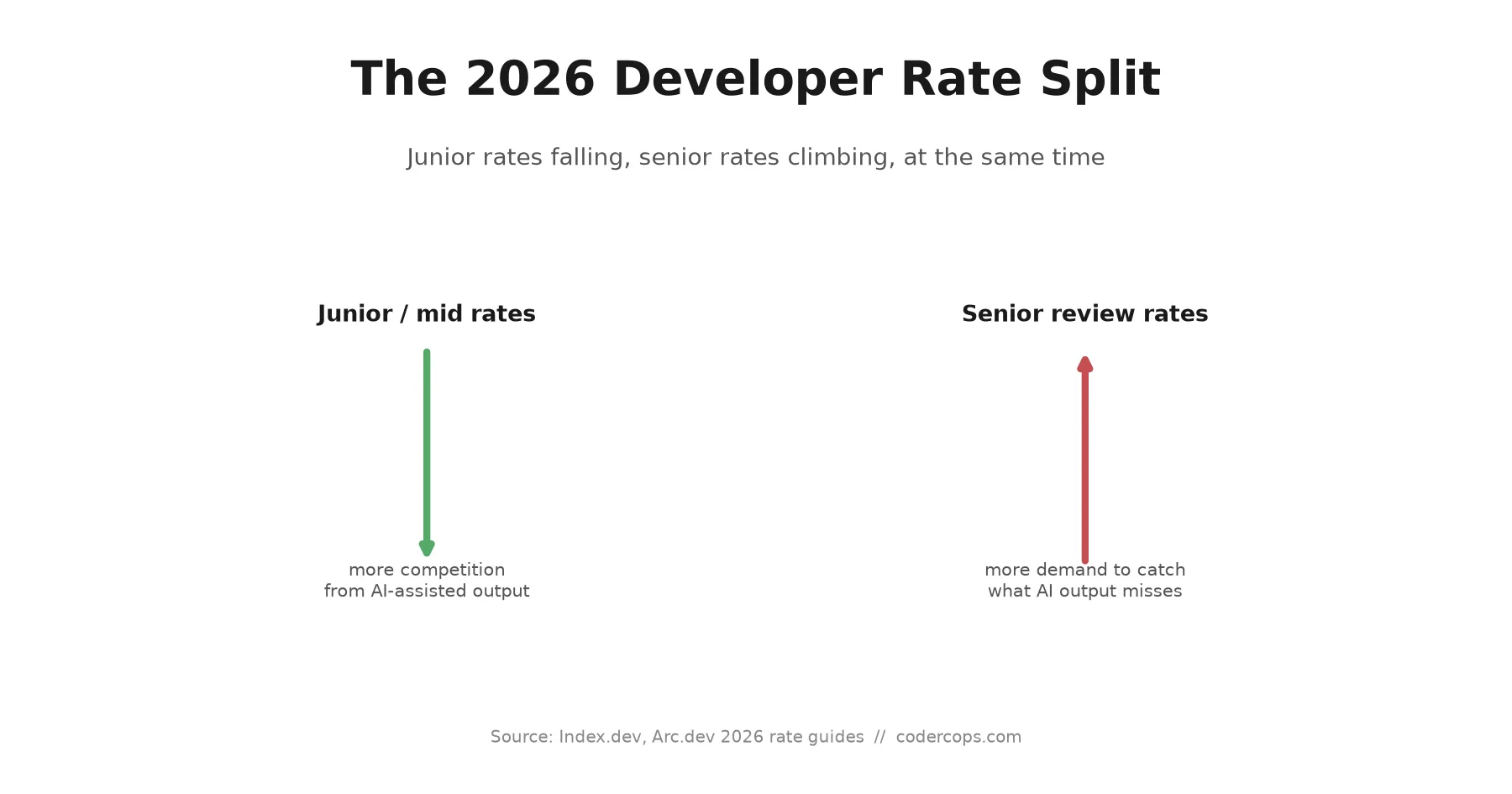
2026 freelance and agency rate data shows two opposite trends happening at once: AI-assisted competition is pushing junior and mid-level rates down while senior engineers who can manage AI output command more than ever. Here's what the numbers say and what it means for your budget.

Shashikant Gupta
5 min read
Sponsored
Two numbers moving in opposite directions tell the real story of developer pricing in 2026. Junior and mid-level rates are getting cheaper, in some markets meaningfully so. Senior rates, for the engineers who can actually supervise what AI tools produce, are climbing. If you’re budgeting a project off last year’s blended hourly assumptions, both halves of that split will surprise you.
What the 2026 numbers actually show
Aggregated 2026 rate data puts global freelance developer pricing in a wide band: roughly $25/hr in parts of Asia up to $140/hr in North America for general software work, with AI/ML specialists sitting in a distinct, higher tier at $100-250/hr. Regional averages break down roughly like this:
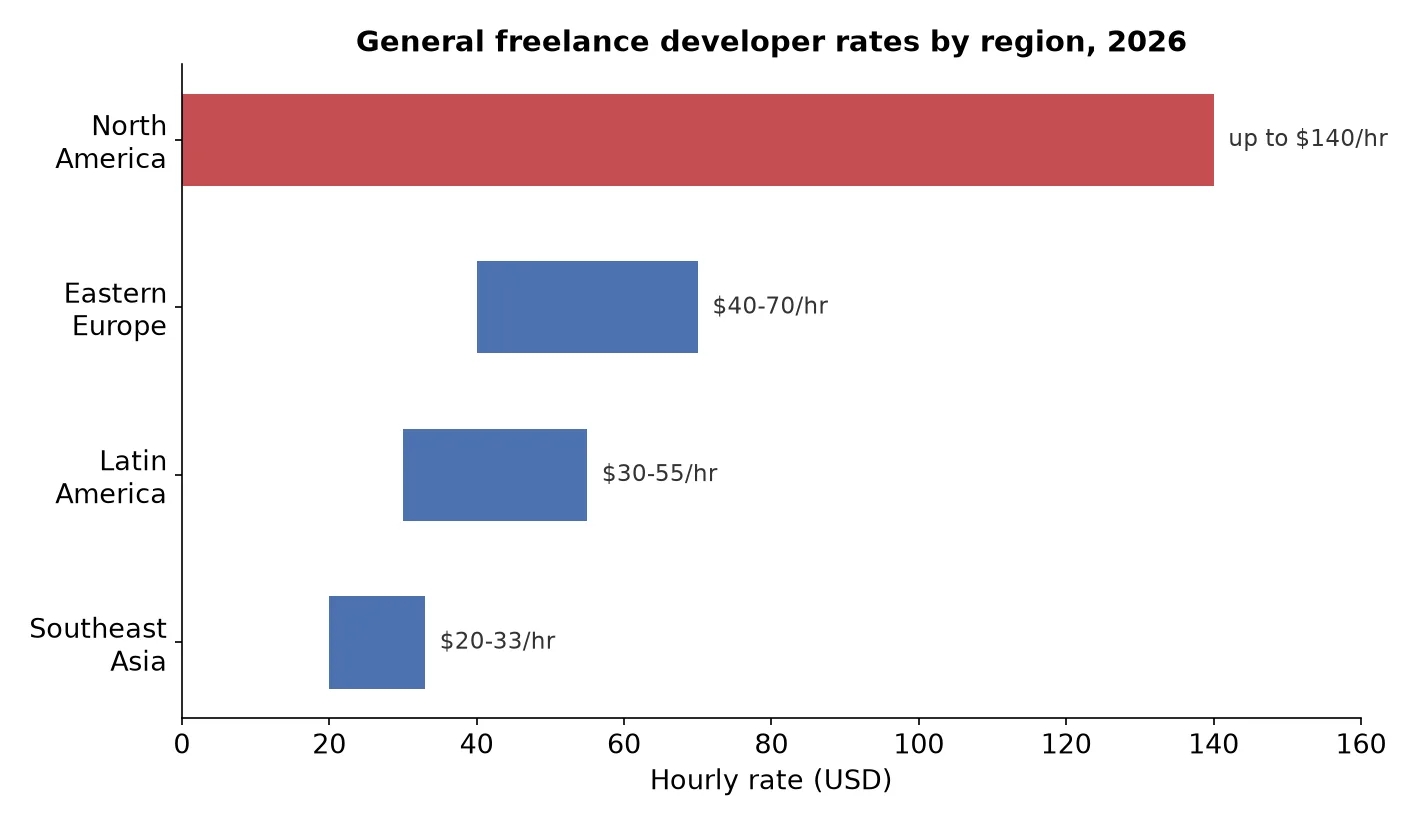
| Region | Typical hourly range |
|---|---|
| North America | up to $140/hr |
| Eastern Europe | $40-70/hr |
| Latin America | $30-55/hr |
| Southeast Asia | $20-33/hr |
| AI/ML specialists (global) | $100-250/hr |
Agency pricing shows a similarly wide spread. Traditional US-based consultancies typically bill $125-175/hr, while nearshore and offshore agencies offering comparable skill land at $27-82/hr. That’s a large enough gap that the headline hourly number alone rarely captures the real tradeoff, which is closer to “how much coordination overhead and time-zone friction am I willing to accept for the discount.”
The split that matters more than the averages
Averages hide the more interesting trend underneath them. Seniority multiplies rates by roughly 2-3x across every region measured, and that multiplier is widening rather than holding steady. The mechanism is straightforward once you say it out loud: AI coding tools have genuinely lowered the skill floor for producing working code, which has increased the effective supply of people who can deliver junior-tier output. More supply against roughly flat demand for that tier pushes those rates down.
Senior work hasn’t gotten cheaper, because it isn’t the same task. Someone still has to catch the subtle bug an AI-generated pull request introduces, judge whether an architecture decision will hold up under real load, and decide when the fast output is actually wrong in a way that won’t show up until production. That review-and-judgment layer is what senior engineers do, and it’s specifically not what coding assistants commoditize. If anything, more AI-generated code in circulation increases the total amount of that judgment work that needs doing, which is consistent with demand for senior talent growing faster than supply.
The clearest sign of this shift: senior talent in markets long treated as reliably cheap, Poland, Argentina, and Vietnam among them, is increasingly pricing closer to Western mid-level rates. The “cheap offshore” framing that shaped a decade of outsourcing decisions assumed the discount held at every seniority level. In 2026, it mostly holds at the junior and mid-level tiers and compresses sharply once you’re hiring someone senior enough to supervise AI output rather than just produce it.
The cost line almost nobody budgets for
Published hourly rates for cross-border hiring routinely leave out employer-of-record (EOR) and compliance costs, which typically add another 15-25% on top of the quoted number. That covers local employment law compliance, benefits administration, and payroll handling in whichever jurisdiction the contractor sits in. A rate comparison that ignores this makes an offshore engagement look cheaper relative to a domestic hire than it actually turns out to be once payroll is running.
This is the same category of hidden cost we walked through in our broader framework for what a developer actually costs: the sticker rate is rarely the number that determines your real budget, and 2026’s rate data makes that gap more consequential, not less, because the sticker rate itself is now moving in different directions depending on seniority.
What this means for how you actually budget
Two practical adjustments follow from this data, and they cut against each other in a way worth being deliberate about:
- Price junior and mid-level implementation work at increasingly competitive rates. The market has genuinely softened at this tier, and paying 2023-era rates for that work in 2026 is leaving money on the table.
- Don’t apply that same downward pressure to senior review and architecture work. That tier is getting more expensive because the work it does, catching what fast AI-assisted output gets wrong, has gotten more valuable, not less. Budgeting it at last year’s rate assumptions will make it hard to hire the person who can actually catch the problems your junior-tier AI-assisted output is now producing faster than ever.
A team that under-invests in the second category to fund more of the first is optimizing for the wrong half of a project. The implementation speed AI tools provide is only worth as much as the judgment applied to what they produce, and 2026’s rate data is the market pricing that tradeoff in real time. If you’re scoping a project and need help figuring out which parts of the work actually need senior judgment versus where competitive junior-tier rates make sense, that’s a conversation worth having before the budget gets locked in, not after.
Frequently asked questions
- Why are junior developer rates falling in 2026?
- AI-assisted coding tools have lowered the bar for producing working code, which increases the effective supply of people who can deliver junior-level output, including junior developers using AI tools to work faster and non-specialists using AI to handle simple tasks that once required hiring a junior developer. More supply against roughly flat demand for that tier of work pushes rates down, particularly in regions where junior and mid-level talent was already price-competitive.
- Why are senior developer rates rising at the same time?
- AI coding tools generate output fast, but someone still has to catch the subtle bugs, security gaps, and architectural mistakes that fast output produces at scale. That review-and-judgment work is exactly what senior engineers do, and it doesn't get commoditized by the same tools that commoditize routine implementation. Demand for people who can supervise AI-assisted teams and catch what the tools miss has grown faster than the supply of engineers experienced enough to do it well.
- Is offshore development still meaningfully cheaper than US-based work?
- For junior and mid-level roles, yes, the gap remains wide. For senior talent specifically, the gap has narrowed. Senior engineers in markets like Poland, Argentina, and Vietnam are increasingly pricing closer to Western mid-level rates rather than the steep discount 'offshore' implied a few years ago, because senior AI-fluent engineers are in short supply everywhere, not just in high-cost markets.
- What costs do published hourly rates usually leave out?
- EOR (employer-of-record) and compliance costs for cross-border hiring typically add 15-25% on top of the quoted hourly rate, covering local employment law compliance, benefits administration, and payroll handling in the contractor's jurisdiction. Published rate guides almost never fold this in, which makes a raw hourly comparison between two countries misleading unless you add it back.
- How should this change how I budget a project in 2026?
- Budget junior and mid-level implementation work at increasingly competitive rates, since that tier has real price pressure in your favor. But don't apply the same logic to the senior review, architecture, and AI-output-supervision work a project actually needs, since that tier is getting more expensive, not less. A budget built on last year's blended rate assumptions will underprice the judgment work and overpay for the part AI has made cheaper.
Sources
Sponsored
More from this category
More from Business
 R.01
R.01 How to Hire an Embedded Firmware Engineer in 2026
 R.02
R.02 DORA Metrics Explained: The Four Numbers That Actually Predict Team Performance
 R.03
R.03 Oracle Is Borrowing Tens of Billions for AI Data Centers. What That Means If You Build on OCI.
Sponsored
Discussion
Join the conversation.
Comments are powered by GitHub Discussions. Sign in with your GitHub account to leave a comment.
Sponsored