Business · Agency Operations
GitHub Copilot's October Billing Change, Explained
Copilot Business and Enterprise require prepaid per-seat billing from October 1, and promotional AI Credits already reverted. What agencies should budget for.

Anurag Verma
5 min read
Sponsored
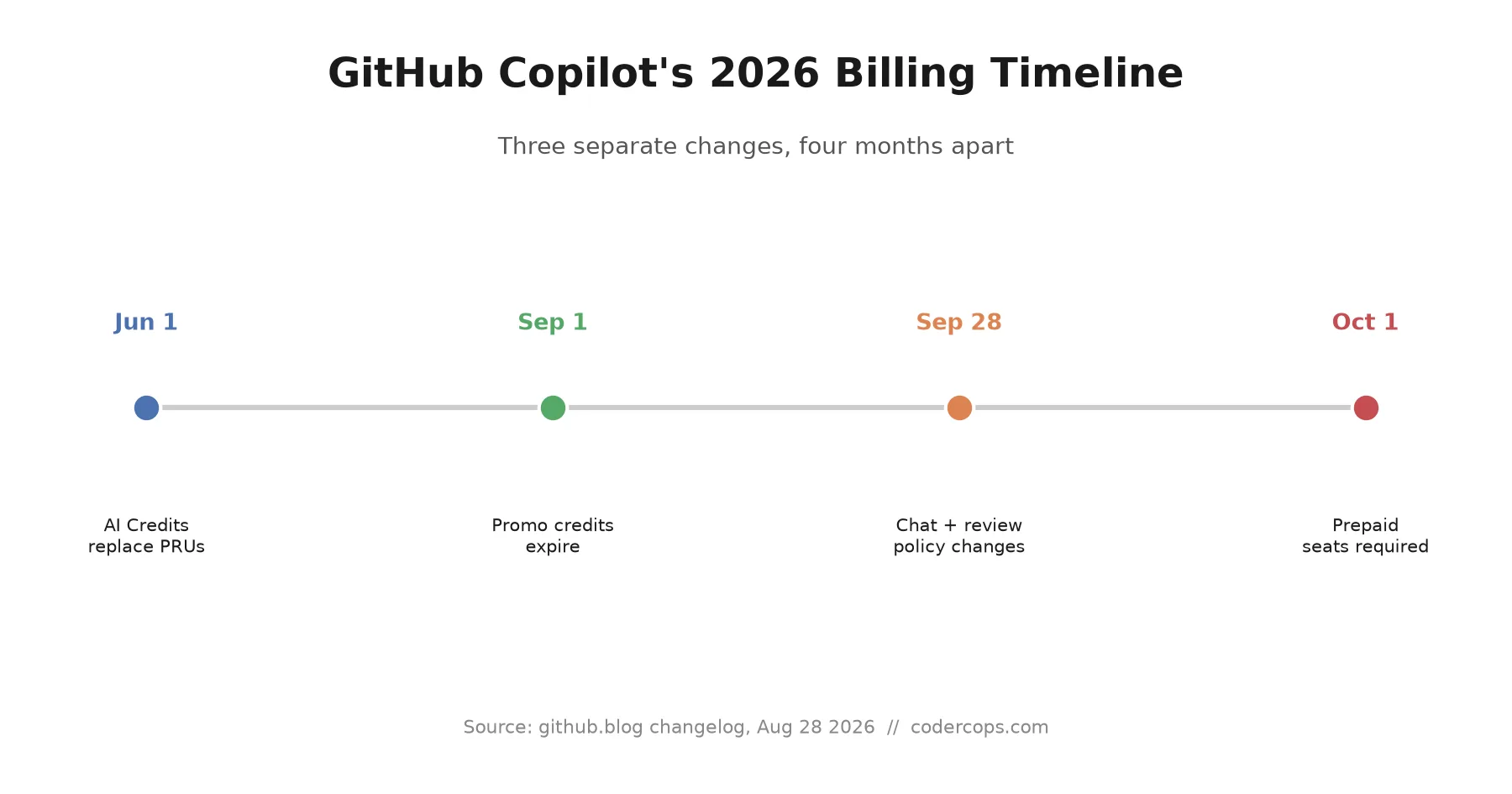
GitHub Copilot’s billing changed again. Starting October 1, 2026, every Copilot Business or Enterprise seat requires payment before the assigned person gets access, closing out a run of three separate changes inside four months. If you’re only tracking one of them, here’s the full picture, and what it means if you’re the one who has to budget for a team’s worth of seats.
What’s actually changing on October 1
GitHub’s August 28 changelog post lays out the mechanics plainly: new Copilot Business or Enterprise seat assignments will require payment for each seat before users gain Copilot access. That’s a change to when money moves, not to the sticker price. The $19-per-seat Business rate isn’t going up because of this. What’s going away is the gap between “someone got assigned a seat” and “that seat shows up on an invoice.”
Under the old model, a manager could assign a seat mid-cycle, let someone try Copilot for two weeks, and remove them before the next billing date closed, with no charge landing at all in some configurations. That flexibility is what’s ending. After October 1, assignment and payment happen in the same motion, with monthly billing tied to each seat’s own assignment date rather than one shared account-wide cycle.
New signups aren’t affected by the timing question, they were already paused. GitHub reopened Business and Enterprise signups on September 1 for customers paying by credit card or PayPal, which is the group this whole policy shift is really aimed at: making sure a seat is backed by real payment credentials from the moment it exists, not retroactively.
The change that already happened and might be why your bill looks different
Before getting to October, check September 1, because it’s easy to blame the wrong date. When GitHub swapped Premium Request Units for AI Credits on June 1, Business and Enterprise plans got a promotional bump: Business seats received 3,000 credits a month instead of the standard 1,900, Enterprise got 7,000 instead of 3,900. That promotion had an expiration built in from day one, and it expired September 1, 2026.
If your team’s Copilot usage felt fine all summer and suddenly started hitting overage charges in September, that’s the promotional credit pool reverting to standard, not a new October policy. Code completions and Next Edit Suggestions are still unlimited on paid plans either way, that part hasn’t moved. It’s chat, code review, PR summaries, and agent mode drawing down the smaller pool that’s the difference.
Two more changes landing the same week
The October billing shift isn’t traveling alone. GitHub’s same changelog bundles two policy changes effective no earlier than September 28:
Unified Copilot Chat policy. Separate data-retention rules for Copilot Chat on github.com, GitHub Mobile, and cloud agent usage collapse into one policy. The retention window for chat data extends from 28 days to the life of the account. If your organization has compliance requirements around how long AI chat logs persist, this is worth a look before it takes effect, since opting out means losing Copilot access on those surfaces entirely rather than a lighter-touch setting.
Code review effort default. New and existing repositories using Copilot code review switch from a Lite default to Balanced starting September 28. Balanced reviews are more thorough and, correspondingly, use more of your credit pool per review. If Lite was a deliberate choice for a high-volume repo, that setting needs to be re-selected explicitly before the switch, it won’t be preserved by default.
What this costs an agency in practice
We manage Copilot seats across multiple client engagements, and the practical shift here is less about the dollar amount and more about how seat assignment behaves operationally. It used to be a low-stakes trial: add a contractor for a two-week sprint, remove them after, absorb whatever partial-cycle cost fell out in the wash. After October 1, assigning a seat is an immediate, real charge, the same way turning on a paid SaaS seat is.
That argues for treating Copilot provisioning the way you’d treat any other billed tool in an onboarding checklist: assign it deliberately, note the date, and audit assigned-but-idle seats monthly instead of letting them ride until a quarterly license review catches them. It also means the credit-pool math from June and the seat-payment mechanics from October are now two line items to track for the same product, not one. If your team is weighing Copilot against Cursor, Windsurf, or another agentic IDE, billing predictability is now a real part of that comparison, not just model quality and completion speed.
For a client-facing agency, how you price AI-assisted development already had to account for the tools themselves being a moving cost, not a fixed one. GitHub reworking Copilot’s billing three times in four months is a concrete case study in why that line item in a software project estimate needs a review cadence of its own, not a number you set once at the start of an engagement and forget about. If you’re building or advising on a team’s tooling budget, put a recurring 90-day check on your calendar for this specific product. On this year’s track record, something will have changed again by then.
If you’re evaluating whether Copilot still fits your team’s workflow and budget, our agency services cover exactly this kind of tooling and cost audit for engineering teams.
Frequently asked questions
- What exactly changes for GitHub Copilot on October 1, 2026?
- Existing Copilot Business and Enterprise customers move to the same prepaid model new signups got starting September 1: every seat assignment requires payment before that user can access Copilot. Previously there was billing-cycle flexibility between assigning a seat and being charged for it. After October 1, assignment and payment happen together, with monthly billing aligned to when each seat was assigned rather than a single account-wide cycle date.
- Is this the same as the AI Credits change from June?
- No, and mixing them up will throw off your budgeting. June 1 replaced Premium Request Units with AI Credits, a token-based system for chat, code review, PR summaries, and agent mode (code completions stay unlimited). October's change is about seat billing mechanics: when a seat gets charged, not what a seat's usage costs. Both changes affect a Business plan's total bill, but they're independent and both need tracking.
- Did our team's Copilot Business credit allowance just get cut?
- If you didn't notice a change on October 1, check September 1 instead. Business and Enterprise plans got a promotional credit boost when AI Credits launched in June, 3,000 credits per Business seat instead of the standard 1,900. That promotion ended September 1, 2026. Teams running close to their monthly allowance felt that reduction three weeks before this billing change, not because of it.
- Does this affect individual Copilot Pro or Pro+ subscribers?
- The prepaid-seat change specifically targets Business and Enterprise plans, which assign seats to team members rather than billing an individual directly. Pro and Pro+ are already charged directly to the subscriber at signup, so this particular mechanic doesn't change anything for them. The credit-pool math (1,500 credits for Pro, 7,000 for Pro+) is unaffected by either the June or October changes.
- What should an agency managing Copilot seats for client teams do differently?
- Stop treating seat assignment as a free, reversible action. Under the old model, adding someone to try Copilot for a sprint cost nothing until the next invoice, and removing them before that cycle closed meant no charge. After October 1, assigning a seat is an immediate financial commitment. Build seat provisioning into your project onboarding checklist the same way you'd handle a paid SaaS license, and audit assigned-but-inactive seats monthly rather than quarterly, since idle seats are now a clean, immediate cost rather than a rounding error absorbed into a monthly total.
Sources
Sponsored
Sponsored
Discussion
Join the conversation.
Comments are powered by GitHub Discussions. Sign in with your GitHub account to leave a comment.
Sponsored