Business · Hiring
How to Hire a Product Manager in 2026
PM job descriptions read identically across companies. The actual job doesn't. Which of the three real PM jobs you're hiring for, and what the role costs.

Anurag Verma
6 min read
Sponsored
Post the same “Senior Product Manager” job description at a Series A startup and a 2,000-person company, and you will get candidates who genuinely believe they’re applying for the same job. They are not. The title is one of the least standardized in software, which means the resume screen tells you almost nothing and the interview loop is where the actual hiring decision gets made, or gets made badly.
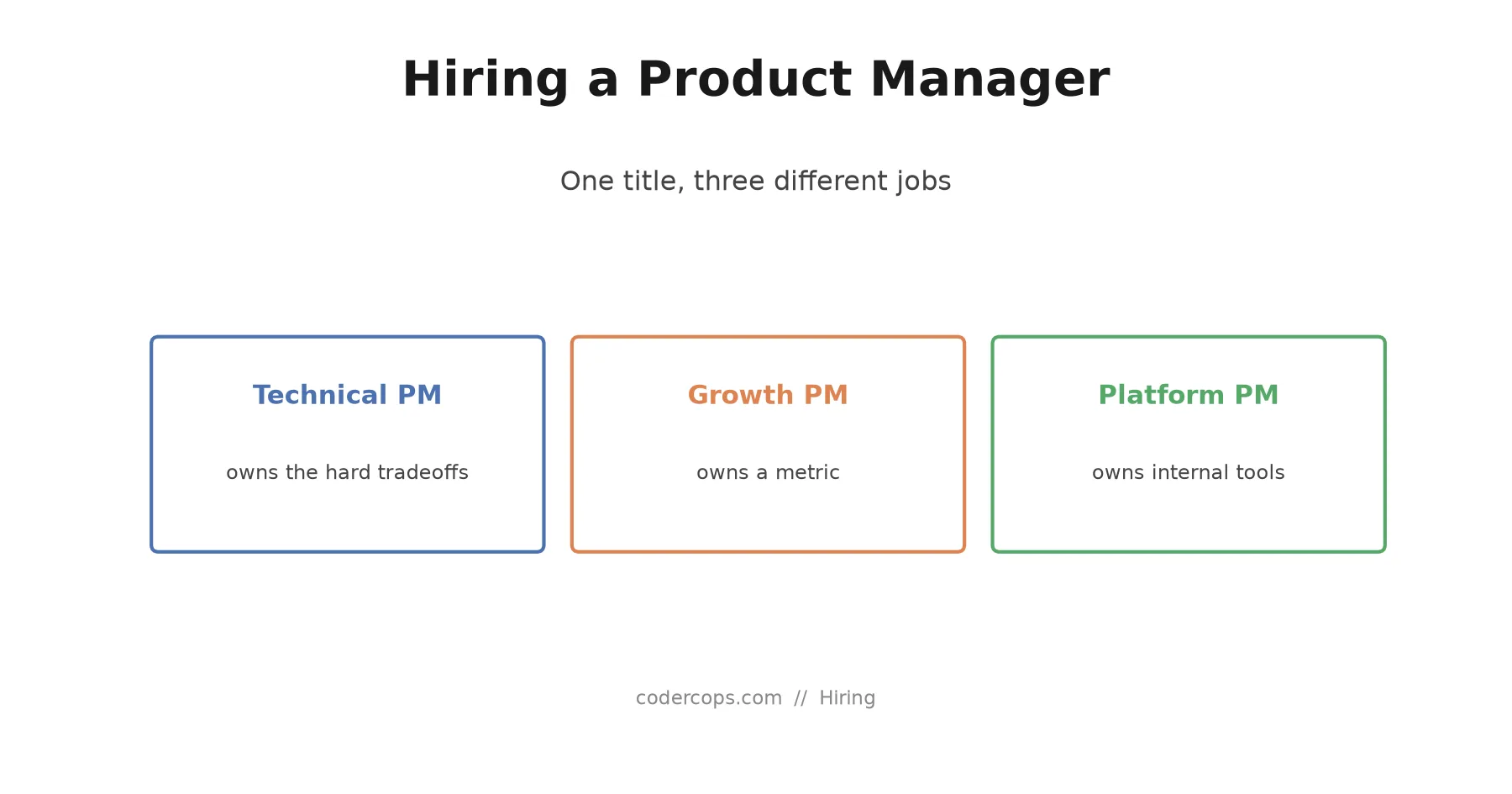
The three jobs hiding inside “product manager”
Technical PM. Owns a product surface with real engineering complexity underneath: an API, a data platform, an infrastructure product, anything where the constraints are as much about what’s technically feasible as what users want. This PM needs to sit in architecture discussions as a peer, not as someone waiting for a translation. If your product’s hardest tradeoffs are technical (consistency vs latency, build vs buy, how much technical debt to carry into a launch), you need someone who can reason about those tradeoffs directly.
Growth PM. Owns a metric, usually acquisition, activation, or retention, and lives in experimentation. Comfortable running dozens of A/B tests a quarter, reading funnel data without help, and iterating fast on small changes rather than shipping big features. If your bottleneck is “we don’t understand why users drop off at step three,” this is the hire, not a generalist PM who’s used to shipping roadmap items.
Platform PM. Owns internal-facing product: the APIs, tools, and abstractions other teams build on. The customer is other engineers or other product teams, and the job looks a lot like platform engineering’s product counterpart, optimizing for developer experience and internal adoption rather than a single end-user metric. Underrated and frequently mis-hired for, because the impact is indirect and harder to sell in a job posting.
Most companies write one job description and expect it to cover all three. Decide which one you actually need before you write the posting, because the interview loop, the take-home (if you use one), and the reference checks should all be built around that specific job, not a generic PM archetype that doesn’t match the work.
What actually predicts a good hire
Reading a real technical document. Hand the candidate an actual system design doc or API contract from your codebase, with identifying details redacted if needed, and ask them to walk through what it implies: what’s hard here, what could go wrong, what would you ask the engineer who wrote this. You are not testing whether they could have written it. You’re testing whether they can follow it well enough to scope work accurately and push back on an unrealistic timeline with something more substantive than a gut feeling. A PM who can’t do this will chronically under-scope technical work, because they have no independent read on what’s actually involved.
A decision they got wrong. Ask about a real product decision, not a hypothetical: what problem were you solving, what did you consider and reject, what shipped, and what happened once real users touched it. The valuable answer isn’t a clever idea that worked. It’s whether they can honestly narrate a decision that didn’t go the way they expected and describe specifically what changed because of it. Candidates who only have success stories have either not shipped enough to have failures worth discussing, or aren’t being straight with you about the ones they have.
SQL, not a certification. “Data-driven” is meaningless as a resume line and easy to fake in an interview. The honest test is whether a candidate can write a query that pulls their own funnel or retention numbers without waiting on an analyst. Sit them down with your actual schema (or a representative sample) and ask for a specific number: weekly active users by cohort, conversion rate by acquisition channel, whatever maps to how your team actually works. A PM who can self-serve this moves faster and asks better questions of the data team when they do need help, instead of treating every question as a ticket.
Stakeholder disagreement, described specifically. Ask about a time an engineer or designer pushed back hard on a decision and what happened next. You’re listening for whether they actually changed their approach based on the pushback, or whether the story is really “I explained my reasoning until they agreed.” The second pattern is common and it’s a real problem in a PM, because it means disagreement gets managed rather than incorporated.
Portfolio and reference signals
PMs rarely have a public portfolio the way engineers do, so the useful signals are different:
- A specific, well-scoped case study of one launch, with real before/after metrics, not a highlight reel of every project they touched
- Writing samples: a PRD, a launch retro, an internal memo, anything that shows how they structure an argument and handle ambiguity in writing
- References who worked with them, not just for them, especially an engineer or designer who can speak to how they handled disagreement day to day
- For technical PM roles specifically, any evidence of technical background: a CS degree isn’t required, but prior work as an engineer, technical support, or solutions engineering is a strong signal they can hold their own in an architecture conversation
What to pay
Comp for PMs tracks company stage more than it tracks years of experience, which is different from most engineering roles and worth being explicit about when you’re setting a range.
| Stage | India (annual) | US (annual) |
|---|---|---|
| Early-stage (mid-level) | $25k-$40k | $110k-$150k |
| Growth-stage (mid-level) | $35k-$55k | $130k-$170k |
| Growth-stage (senior) | $45k-$70k | $160k-$210k |
| Mature org (senior/staff) | $60k-$90k | $200k-$280k+ |
Equity weighs more heavily in PM total comp than for most engineering hires, especially at earlier stages, and it’s worth being upfront in the process about how much of the offer is equity versus cash so you’re not negotiating past each other later. A PM candidate evaluating an early-stage offer is pricing risk differently than one evaluating a role at a company with a mature product org, and a comp conversation that ignores that difference tends to produce offers that get declined for reasons that had nothing to do with the number.
This post is part of our hiring series. For the underlying screening philosophy across roles, see how we vet developers, and for the adjacent leadership hire, how to hire an engineering manager. If you’re building out a broader team and want a second read on scoping the roles before you post them, that’s the kind of conversation our services team has with clients regularly.
Frequently asked questions
- What's the difference between a technical PM, a growth PM, and a platform PM?
- A technical PM owns a product surface with real engineering complexity underneath it (an API, an infrastructure product, a data pipeline) and needs enough technical fluency to make tradeoffs with engineers as a peer, not a translator. A growth PM owns acquisition, activation, or retention metrics and lives in experimentation: A/B tests, funnel analysis, and rapid iteration cycles. A platform PM owns internal-facing product surfaces, the tools and APIs other teams build on, and optimizes for developer experience and internal adoption rather than end-user metrics. Most job descriptions blend all three; most people are genuinely strong at one.
- Should I require a PM candidate to know how to code?
- No, but require technical fluency, which is a different bar. A PM doesn't need to write production code, but they do need to read a system design doc or an API contract and understand what it implies for scope and risk. The practical test: hand them a real technical document from your codebase and ask them to summarize the tradeoffs in it. A PM who nods along without following it will consistently misjudge how long things take and what they cost.
- How do you evaluate 'product sense' in an interview?
- Not by asking abstract questions like 'how would you improve product X.' Ask about a real decision they made: what problem they were solving, what they considered and rejected, what shipped, and what they learned once it was in front of users. The strongest signal isn't a clever idea, it's whether they can articulate why they were wrong about something and what they changed as a result. A candidate who only tells success stories either hasn't shipped much or isn't being honest about it.
- What does a product manager cost in 2026?
- It varies more by company stage than by years of experience. A PM at a Series A startup wearing several hats runs meaningfully less than a specialized PM at a company with a mature product org, even at similar seniority. In the US, expect roughly $110k-$150k for a mid-level PM at an early-stage company, $150k-$210k at a growth-stage company, and $200k-$280k+ for senior or staff PMs at larger, more mature orgs, often with equity that shifts the total comp picture significantly. In India, ranges run roughly $25k-$45k mid-level and $45k-$90k senior, with product-led SaaS companies paying at the top of that band.
Sponsored
Sponsored
Discussion
Join the conversation.
Comments are powered by GitHub Discussions. Sign in with your GitHub account to leave a comment.
Sponsored