Technology · Developer Trends
Octoverse 2025: TypeScript Overtook JavaScript
GitHub's Octoverse 2025 shows TypeScript displacing JavaScript for the first time, driven partly by how AI tools behave with typed code. What the data says.

Shashikant Gupta
5 min read
Sponsored
For the first time since GitHub started tracking language usage, TypeScript is the most-used language on the platform. Not JavaScript. Not Python. The Octoverse 2025 report puts the shift at August 2025, and the reason behind it is more interesting than “TypeScript is popular”: it’s a direct consequence of how AI coding tools behave differently depending on whether the code they’re touching has types.
The number that matters
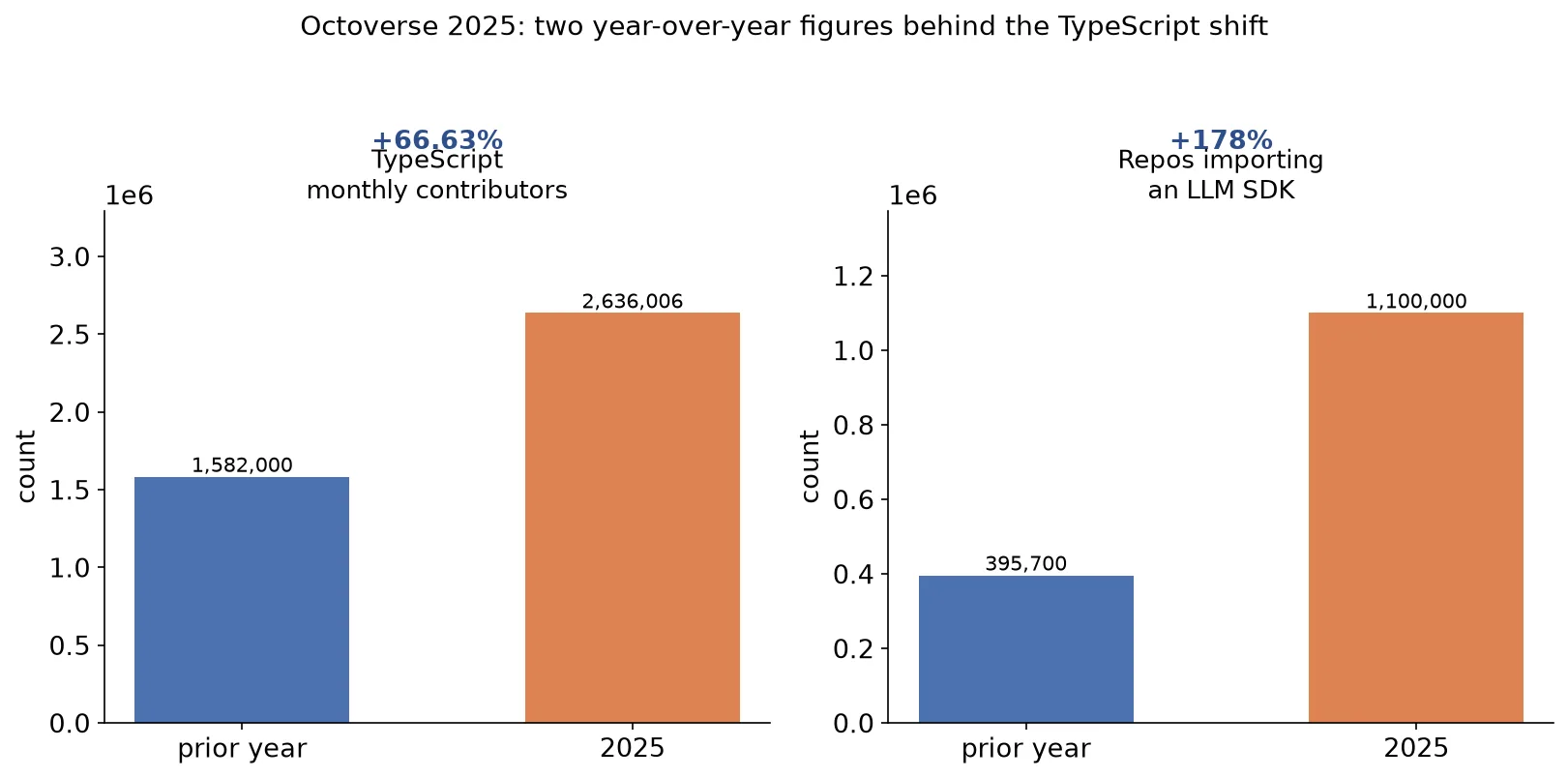
TypeScript now counts 2,636,006 monthly contributors on GitHub, a 66.63% increase year over year. That’s not gradual language-preference drift, that’s a language moving up the rankings past two more established incumbents inside a single year.
GitHub’s explanation isn’t really about developer taste. It’s about a documented, measurable failure mode in AI-generated code and how typed languages handle it differently than untyped ones.
Why AI tooling favors typed code
The report cites a 2025 academic study with a specific, checkable finding: 94% of compilation errors in LLM-generated code were type-check failures. That’s a striking number because it tells you where AI models actually get things wrong. They’re not primarily failing at logic or algorithm choice, they’re failing at the kind of structural correctness that a type system checks automatically, at compile time, before the code ever runs.
In an untyped JavaScript codebase, that same category of error doesn’t get caught until runtime, if it gets caught at all before a user hits it. In a TypeScript codebase, the compiler flags it immediately, often inside the editor before the AI-suggested code is even accepted. For a team where a meaningful share of code changes start as AI suggestions, that’s not a marginal convenience. It’s the difference between an error surfacing in a five-second feedback loop versus a production incident.
The “convenience loop”
GitHub’s own framing for this is a “convenience loop,” and it’s worth sitting with because it describes a feedback mechanism, not just a trend:
- AI coding tools produce more reliable output in TypeScript because the compiler catches a large class of their mistakes automatically.
- Developers experience that reliability as AI tooling working better, so they reach for TypeScript more often, including in new projects that might previously have started in plain JavaScript.
- More TypeScript usage means more TypeScript code in the training data and telemetry that improves AI coding tools going forward.
- AI tools get incrementally better at TypeScript specifically, reinforcing step one.
Loops like this are self-reinforcing in a way that ordinary “language X is trending” adoption isn’t. It’s part of why GitHub is willing to call this a structural shift rather than a preference swing that could as easily reverse next year.
The scale underneath the language story
The language shift didn’t happen in a vacuum; it happened against a platform growing everywhere at once. Over 36 million new developers joined GitHub in the past twelve months, more than one every second, pushing the total past 180 million. Developers created more than 230 new repositories every minute. Pull requests merged at an average of 43.2 million per month, up 23% year over year. Commits pushed across the year approached 1 billion, up 25.1%.
Against that backdrop, the AI-specific numbers stand out even more: nearly 80% of new developers used Copilot within their first week on the platform, and more than 1.1 million public repositories now directly import an LLM SDK into application code, up 178% year over year. That last figure matters more than Copilot adoption alone, because it’s not measuring AI-assisted writing of code, it’s measuring how much software being built is itself AI-powered at the application layer.
What this actually means for your team
If your team already writes TypeScript, the report is validation, not new information. The more useful takeaway is for teams still weighing typed versus untyped JavaScript for a new project, especially one where AI-assisted coding is doing meaningful drafting work. The traditional case for TypeScript was about large-codebase maintainability over years. This data points at a faster-acting reason: type checking catches a specific, measured, and common category of AI mistake before it costs you a debugging session.
That’s a real argument, but it’s not a mandate to convert every JavaScript project overnight. Weigh it the way you’d weigh any framework decision. Our React vs Angular vs Vue comparison covers the broader tradeoff of picking tooling based on ecosystem momentum versus your team’s actual constraints, and the same discipline applies here: TypeScript’s compile-time safety is a genuine win for AI-assisted workflows, but the migration cost for an existing large JavaScript codebase is real and worth weighing against gradually typing new code going forward instead.
The data is clear on one thing: for the first time, the most popular language on the world’s largest code host is the one built to catch machine mistakes before they ship. That’s worth taking seriously regardless of which side of the loop your team is on.
Frequently asked questions
- What is GitHub's Octoverse report?
- Octoverse is GitHub's annual report on activity across its platform, covering language usage, repository growth, pull request volume, and developer demographics. The 2025 edition, covering data through roughly August 2025, is the first to show TypeScript as the single most-used language on GitHub, ahead of both Python and JavaScript.
- Why did TypeScript overtake JavaScript specifically now?
- GitHub's data points to AI-assisted coding as a major driver. The report cites a 2025 academic study finding that 94% of compilation errors produced by LLM-generated code were type-check failures. Static typing catches a category of AI mistakes at compile time that untyped JavaScript would only surface at runtime, which makes typed code meaningfully more reliable when a large share of a codebase's changes are AI-suggested. GitHub calls this a 'convenience loop': AI tools work better with TypeScript, so developers use TypeScript more, which produces more TypeScript training data, which makes AI tools even better at generating it.
- How much did AI adoption actually grow according to Octoverse 2025?
- Two figures stand out. Nearly 80% of new developers used GitHub Copilot within their first week on the platform. And more than 1.1 million public repositories now import an LLM SDK directly into application code, up 178% year over year as of the report's August 2025 cutoff, meaning a large and fast-growing share of software being built is itself AI-powered, not just AI-assisted in its writing.
- Does this mean I should migrate my JavaScript codebase to TypeScript?
- Not automatically, but the report's underlying reasoning is worth taking seriously if your team relies heavily on AI-assisted coding. If a meaningful share of your code changes are AI-suggested, TypeScript's compile-time checks catch a documented category of AI errors before they reach runtime. That's a different argument than the traditional 'TypeScript improves large-codebase maintainability' case, and it applies even to smaller projects if AI tooling is doing a lot of the drafting.
- What other numbers from Octoverse 2025 matter for teams planning for next year?
- Scale numbers worth knowing: developers created over 230 new repositories every minute, 43.2 million pull requests were merged per month on average (up 23% year over year), and close to 1 billion commits were pushed across 2025 (up 25.1% year over year). Whatever your team's tooling decisions, the baseline rate of software being produced on GitHub grew by double digits across nearly every metric the report tracks.
Sources
Sponsored
Sponsored
Discussion
Join the conversation.
Comments are powered by GitHub Discussions. Sign in with your GitHub account to leave a comment.
Sponsored